

On paper, it seems like the math would be clear. A nearly 22-year-old space telescope, well past its prime, is falling out of space after decades of hunting the biggest explosions in the universe. Rest in peace, right?
After all, it would cost NASA $30 million to save the telescope, called the Swift Observatory, which the agency launched in 2004 on a planned two-year mission. Some of us have cars that we’ve replaced far sooner for much less. And now, higher-than-expected drag on the satellite from Earth’s outer atmosphere (caused by solar storms) will pull Swift out of orbit by year’s end. So why not accept the inevitable fiery demise of the observatory when it plunges back to Earth?
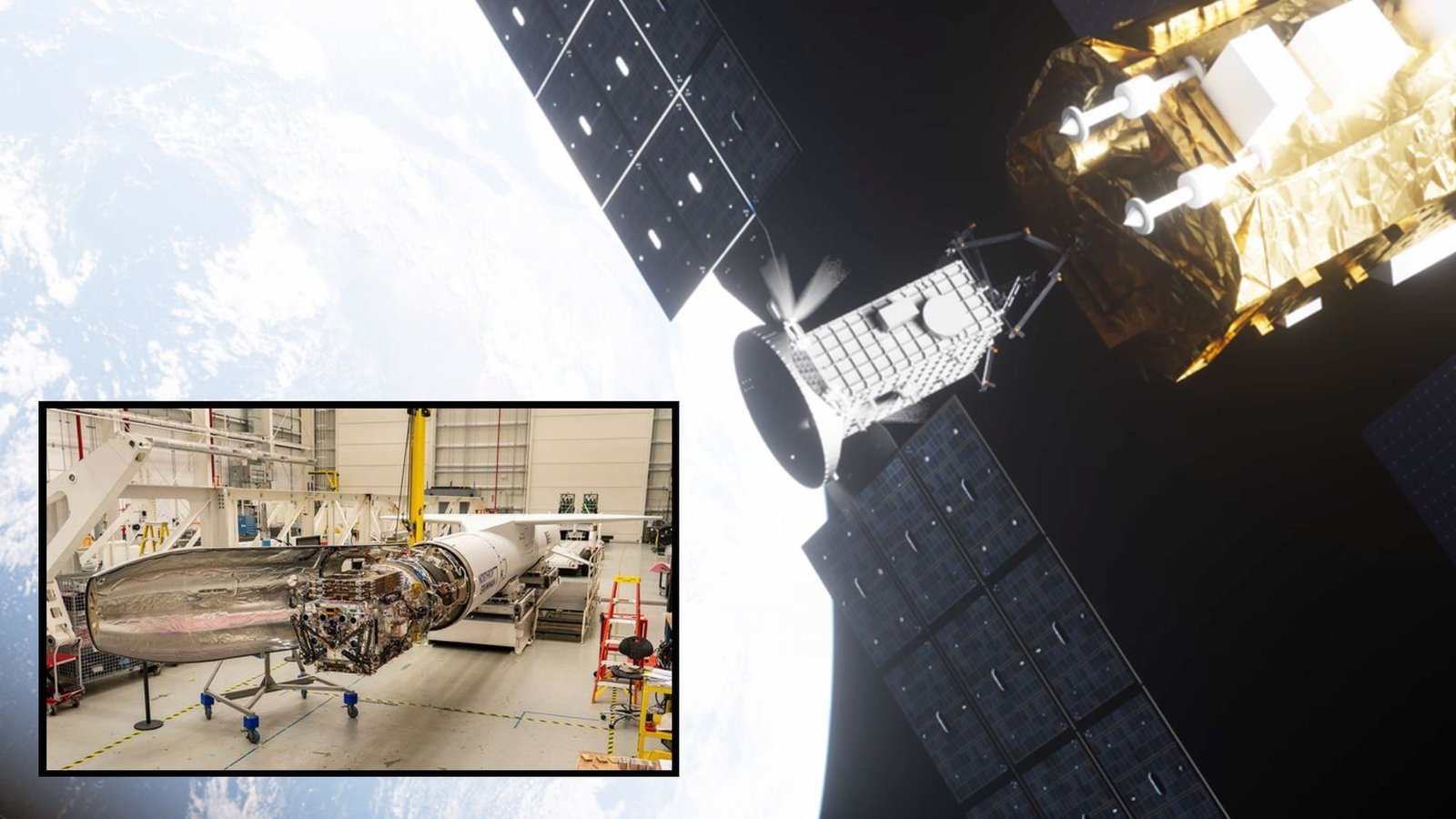
Swift, it turns out, is still worth it, according to NASA. The observatory has spent over two decades as a sort of orbital sentinel that scans the cosmos for gamma-ray bursts, ready to quickly point itself at the short-lived — but insanely powerful — space explosions at a moment’s notice. No other off-Earth observatory, not even the famed Hubble Space Telescope or James Webb Space Telescope, can perform such a feat of astronomy. So NASA is launching a rescue mission on June 27, one led by the company Katalyst Space using its new Link spacecraft.
“We didn’t want to set the precedent that anything that comes out of orbit has to be boosted, because it is part of our space ecosystem to have things deorbit frequently,” Shawn Domagal-Goldman, NASA’s Astrophysics Division director, told reporters during a Swift rescue mission briefing on June 17. “But this was not just any spacecraft; this is an observatory with unique capabilities for astrophysics … It is a swift observatory that can quickly pivot across the night sky to find things that go boom in the night.”
A sentinel in the night

NASA originally built and launched Swift in 2004 for $250 million. Since then, the observatory has served as a first responder of sorts to rapidly spot distant gamma-ray bursts that can last mere seconds, yet unleash more power than our sun will in its entire lifetime. Because of its success, Swift’s mission has been extended repeatedly.
“The name is not an acronym. It comes from the ability to rapidly and autonomously repoint its narrowfield X-ray and UV [ultraviolet] telescopes almost anywhere on the sky,” Swift Principal Investigator Brad Cenko told reporters during the June 17 briefing. (NASA renamed Swift the Neil Gehrels Swift Observatory in 2018 after the mission’s first principal investigator, who died a year earlier.)
“The universe is a very dynamic place. Somewhere in the cosmos, a massive star explodes every second,” he added. “And over time, our exceptional operations team, led by Penn State, has found new and innovative ways for the satellite to rapidly respond to these discoveries.”

The Hubble Space Telescope can capture sharper photos than Swift, but it takes up to two days to point Hubble at a new target, Cenko said. It takes Swift mere minutes. “It really is NASA’s first responder, and by working together in this complementary manner, the NASA astrophysics portfolio can tackle questions that would be impossible for any single facility to answer,” Cenko added.
Observations from Swift helped confirm that the heaviest elements in our universe, including precious metals like platinum and gold in your rings and necklaces, were forged by the explosive power associated with gamma-ray bursts (which scientists think are produced by supernovas and neutron-star mergers). In 2022, Swift discovered a gamma-ray burst so bright, scientists nicknamed it the “BOAT,” short for Brightest of All Time. At the time,it was the most powerful space explosion ever seen.
But now Swift is falling back to Earth on a trajectory at an increasing rate and will burn up in our atmosphere soon, if nothing is done.
Katalyst to the rescue with Swift Boost
NASA’s Swift rescue mission, called Swift Boost, is scheduled to launch Saturday (June 27) on the last-ever Pegasus XL rocket, an air-launched booster built by Northrop Grumman. It will be carried aloft by the last L-1011 Stargazer carrier plane, which Northrop also operates, on a flight out of the U.S. military’s Reagan Missile Test Site on Kwajalein Atoll in the South Pacific’s Marshall Islands.
To rescue Swift, NASA has turned to the untested Arizona-based company Katalyst Space, which the space agency picked to fly the Swift Boost mission just nine months ago, in September 2025. That is a mindbogglingly short time in which to build a brand-new spacecraft, then launch it on a rendezvous mission to a space observatory that was never built to be rendezvoused with, and then push the Swift telescope to a higher orbit — one that will guarantee at least five or more years of science life, if successful.
It’s a huge bet, and something that’s never been done before. Even Swift’s top scientist has butterflies in his stomach.
“Absolutely, no doubt. Been some sleepless nights, a number of them,” Cenko told Space.com in an interview last week. “On the other hand, working with this team of folks gives me great confidence.”
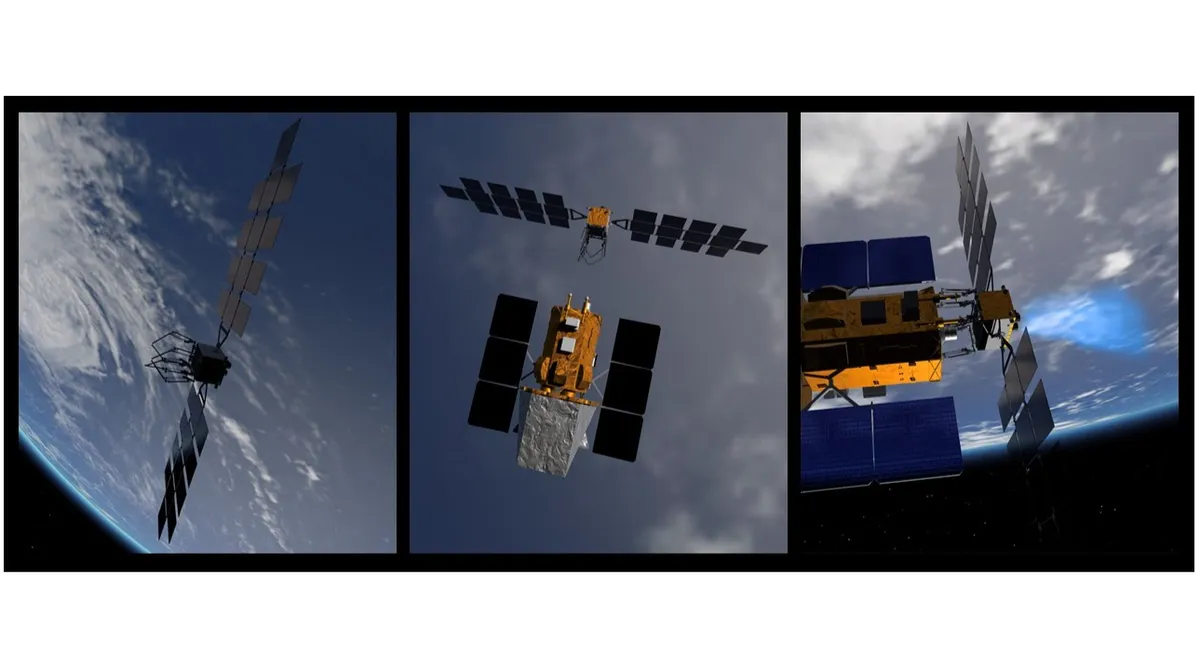
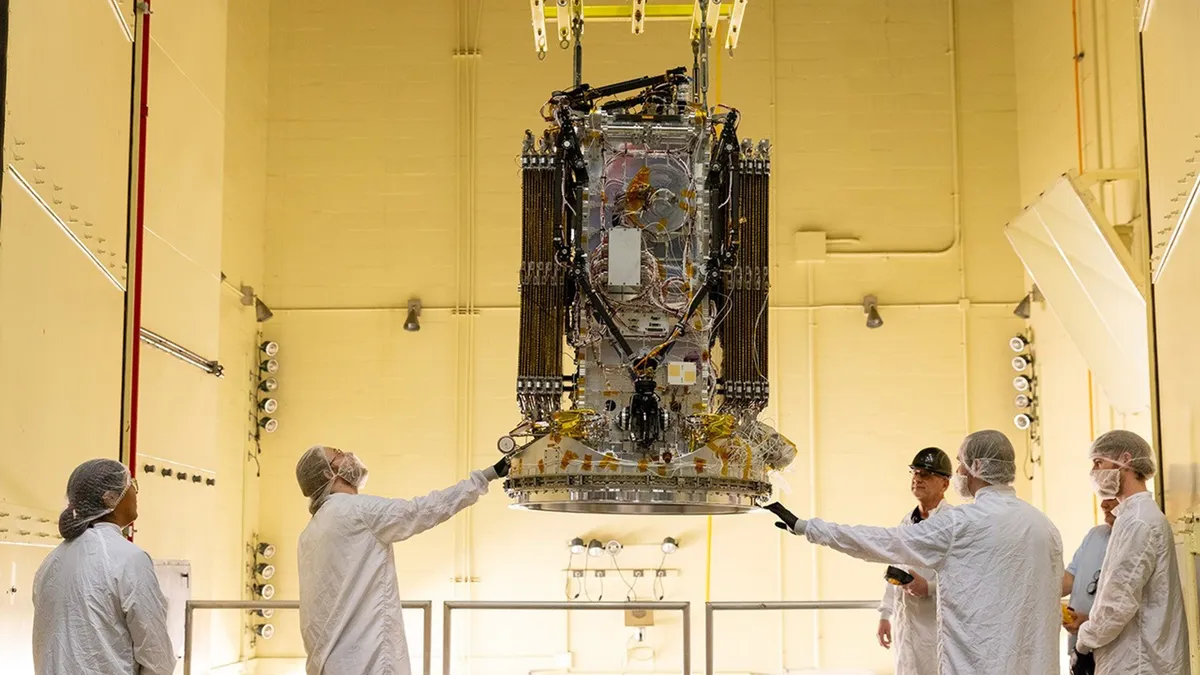
Cenko and NASA’s Swift mission team have worked closely with Katalyst mission managers and engineers on the Swift Boost mission. Katalyst calls its rescue ship Link. It’s a small spacecraft about the size of a refrigerator that has three main ion engines, three robotic arms and a suite of sensors and thrusters to attempt to capture the falling Swift observatory. Link has gone from a blank sheet of paper to a finished spacecraft attached to a rocket viaan “unprecendented development timeline,” its Katalyst builders said.
“That is something that we were able to do, because every part of this mission has been driven by the exceptional urgency provided by the Swift requirements,” said Kieran Wilson, Link’s principal investigator at Katalyst. The top requirement: Be ready to launch before Swift falls out of space.
A risky plan

Swift was originally placed in an orbit 375 miles (600 kilometers) above Earth when it launched in 2004. The spacecraft has no engines of its own to maintain its orbit. It’s now on a path to fall below 186 miles (300 km) in altitude by October. At that point, Katalyst’s Link may not be able to reach Swift in time to save the space telescope.
Testing and computer modeling have been key to try and iron out all the kinks in the mission.
“We’ve been relying on NASA expertise to ensure that we’re not making silly mistakes along the way and maximize our probability of success,” Wilson said.
“There’s a lot of very simple things that can go wrong, and we’re adding a lot of additional complexities to the program, but we’ve been through an aggressive test campaign over the last few months,” he added.
After launch, Link will spend several weeks in orbit conducting a series of tests to ensure it is ready to try and save Swift. If all goes well, it will then rendezvous with Swift, grapple on with its robotic arms, and spend up to three months slowly raising the observatory’s orbit.
If Katalyst succeeds in saving Swift, the company will have done something never accomplished in space history: reboosting an ailing space telescope using a spacecraft developed in less than a year to rescue a target that was meant to be left in space on its own forever. Katalyst sees big business in such a service, and already has a U.S. Space Force contract to demonstrate a similar capability for larger spacecraft using its new Nexus vehicle. That mission will launch in 2027.
And if Katalyst doesn’t succeed? Then Swift will fall out of space on its own, something the space observatory is already going to do anyway.
Those are stark all-or-nothing stakes, but ones that Cenko can accept. The science team even put Swift in a low-power mode in February, halting all research operations to help slow its drag-induced descent.
“I also remind myself that the alternative here is that we reenter the Earth’s atmosphere, so in that sense, you know, the risk here is relatively low,” Cenko told me. “Maybe we can’t be doing science for a few more months. But trading that against the potential benefit of many years of upsurge? That is a no-brainer.”