

Pennsylvania’s natural gas, coal and petrochemical industries are taxed too little, and they are now declining so cannot be expected to rescue the state from growing budget deficits, according to a new analysis of the fossil fuel industry and its effect on the state’s worsening fiscal position.
A report, called “Valuing the Future,” and written by the Institute for Energy Economics and Financial Analysis, a nonprofit research group that focuses on energy finance, accuses state lawmakers of imposing too light of a tax burden on the fossil fuel industry, especially compared to other energy-producing states like Texas and North Dakota. Policymakers in Pennsylvania assumed that higher rates would deter development and hurt the state’s economy.
Some 20 years after high-volume hydraulic fracturing for gas made Pennsylvania the second-biggest producer of natural gas after Texas, data now shows that low taxes on the industry have not helped Pennsylvania’s economy, and lawmakers must accept that they will now have to look elsewhere for any revenue boost, the report said.
“Pennsylvania set its natural gas taxes low on the theory that higher tax rates would suppress production and by extension the state’s economy,” said Trey Cowan, an author of the report. “We now have enough data to evaluate that theory, and the results are not favorable. Tax rates have had an asymmetric, limited effect on producer behavior.”
The Marcellus Shale Coalition, the natural gas industry’s trade group, dismissed the report as a biased result of deep-pocketed opponents of natural resource development. Rather than assessing the industry only on its ability to generate tax revenue, it should also be seen as a creator of jobs and a provider of low-cost energy to consumers, said MSC President Jim Welty.
Residential electricity rates in Pennsylvania increased almost 14 percent in the past year, according to federal data.
“For the natural gas industry, it’s the jobs created and preserved along with the family-sustaining wages paid. It’s the benefit to consumers in mitigating energy costs. It’s the billions in economic activity generated along with the direct investments in local communities. And it’s the enhancement of our nation’s energy security, among many other direct and indirect benefits,” Welty wrote in a statement.
By all those measures, Pennsylvania’s natural gas industry has been “a resounding success,” he said.
The report is based on a February bulletin by Pennsylvania’s Independent Fiscal Office, which provides nonpartisan analysis of fiscal, budgetary and economic issues but makes no recommendations on policy. The office then forecast a structural deficit of $6.06 billion for 2026-27. Its latest report, on June 11, revised down the projected deficit for the year beginning July 1 to $5.56 billion but still showed the deficit rising from $4.75 billion in fiscal 2025-26.
Although Pennsylvania, like other states, is required to pass a balanced budget each year, it commonly uses a variety of means including borrowing or deferring spending to reconcile spending and revenue.
The IEEFA report scorned Pennsylvania’s use of “impact fees”—imposed on the number and age of horizontally drilled natural gas wells, plus an average of natural gas futures prices—to tax the industry, rather than “severance fees” based on the volume of production, like those charged by other leading oil and gas states, yielding far more revenue.

Impact fees contributed $164.5 million to Pennsylvania’s revenue in fiscal year 2024, much less than the revenue collected through severance fees charged by other big oil and gas-producing states, including Texas with $8.1 billion, North Dakota with $3.1 billion, and New Mexico with $2 billion. In Texas, natural gas production from fiscal 2015 to 2025 was 1.4 times that of Pennsylvania, but revenue from natural gas production was 9.3 times higher, the report said.
Pennsylvania’s impact fees account for only 0.3 percent of state revenue, “a pittance of what other states collect from their oil and gas producers,” the report said.
The “folly” of Pennsylvania’s continuing use of impact fees is shown by a 26 percent drop in tax revenue from the natural gas industry between 2014 and 2024, even as production volume rose by 80 percent over the same period, thanks to the increasing use of more productive technology, the report said.
“Because average taxed amount per well is shrinking over time, the impact fee taxing formula was intentionally designed to favor the natural gas industry rather than the public it is supposed to protect,” it said.
Revenue from the impact fee is paid to Pennsylvania counties, municipalities and state agencies to mitigate the effects of the gas industry in areas such as environmental protection and emergency response. In 2025, proceeds totaled $244 million, the second-highest annual total after $279 million in 2022, according to Pennsylvania’s Public Utility Commission, which administers the tax.
This story is funded by readers like you.
Our nonprofit newsroom provides award-winning climate coverage free of charge and advertising. We rely on donations from readers like you to keep going. Please donate now to support our work.
The cost to the state of inspecting and permitting wells exceeds the revenue from fees paid by operators. Gov. Josh Shapiro’s 2026-27 budget proposal includes $16 million for the Department of Environmental Protection’s Oil and Gas program to make up the shortfall. In 2019, a report commissioned by the environmental organization Delaware Riverkeeper Network estimated that environmental, health and community costs associated with fracking could be costing Pennsylvania as much as $1.5 billion annually.
In one sign of a contracting fossil fuel industry, the number of people employed by Pennsylvania’s oil and gas industry almost halved to 21,670 from 37,000 in the 10 years between 2014 and 2024, according to federal data reported by IEEFA. Because of increasing technological improvements, the number of workers needed to produce 1 billion cubic feet of gas plunged to the current 1.4 from 15 in 2010, the report said.
In the coal industry, the number of workers has plunged to some 7,000 from 13,000 a decade ago, and the state’s coal consumption has dropped by half since 2000 as more coal-fired power plants have retired, and coal exports out of state have dropped by 45 percent over the same period.
David Hess, a former secretary of Pennsylvania’s Department of Environmental Protection, and now the publisher of an environmental newsletter, said the report was right to call for a severance tax but that it is unlikely to happen because of the industry’s influence on the state legislature.
“This is one of many reports over decades making a good case for a severance tax on natural gas production like other states have,” Hess wrote in an email. “But the reality is the votes just aren’t there in the House and Senate to adopt one, the gas industry is too entrenched after 23 years,” he said, referring to the start of the so-called fracking boom in the early 2000s.
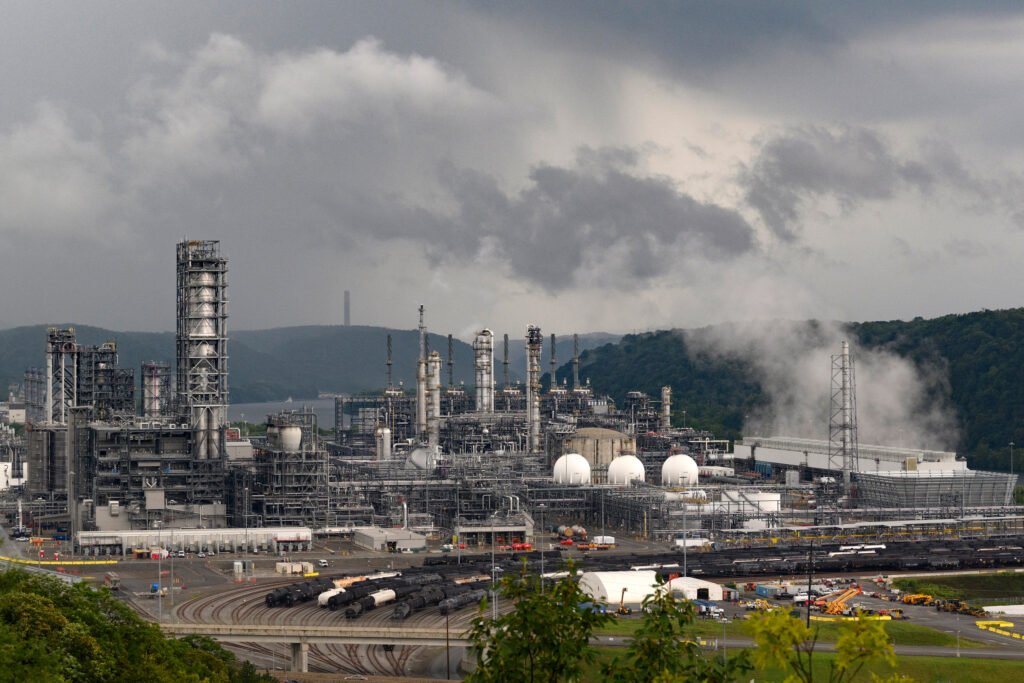
Hess also praised the report’s highlighting of record tax breaks given to Shell for its building of a massive ethane “cracker” plant at Monaca in Beaver County near Pittsburgh, a project that opened in 2022. Still, chances are slim that state lawmakers would withdraw those tax breaks, he predicted.
“Shell has been making noises about selling the plant because it is underperforming and the tax credit is part of what is propping it up,” Hess said. “What would happen without it? You can imagine the alarm bells that would go off in the faces of lawmakers.”
As coal declines, natural gas sheds workers and petrochemicals are pressured by slumping global sales, the question for policymakers is whether they want to play a role in the energy transition, the report argued.
“The nature of fossil fuel’s past economic contributions does not absolve policymakers from the responsibility of dealing with the consequences of the industry’s continued decline,” it said. “The task of ensuring that the ongoing transition is just should be central to policymakers’ agendas.”
Spokespeople for the Republican caucuses in both houses of the Pennsylvania legislature did not respond to requests for comment on their longstanding rejection of a severance tax.
About This Story
Perhaps you noticed: This story, like all the news we publish, is free to read. That’s because Inside Climate News is a 501c3 nonprofit organization. We do not charge a subscription fee, lock our news behind a paywall, or clutter our website with ads. We make our news on climate and the environment freely available to you and anyone who wants it.
That’s not all. We also share our news for free with scores of other media organizations around the country. Many of them can’t afford to do environmental journalism of their own. We’ve built bureaus from coast to coast to report local stories, collaborate with local newsrooms and co-publish articles so that this vital work is shared as widely as possible.
Two of us launched ICN in 2007. Six years later we earned a Pulitzer Prize for National Reporting, and now we run the oldest and largest dedicated climate newsroom in the nation. We tell the story in all its complexity. We hold polluters accountable. We expose environmental injustice. We debunk misinformation. We scrutinize solutions and inspire action.
Donations from readers like you fund every aspect of what we do. If you don’t already, will you support our ongoing work, our reporting on the biggest crisis facing our planet, and help us reach even more readers in more places?
Please take a moment to make a tax-deductible donation. Every one of them makes a difference.
Thank you,