


To some political pundits and Democratic strategists, one takeaway from the 2024 presidential election was clear: Don’t talk about climate change.
An Inside Climate News analysis of press releases issued by members of the House and Senate shows that elected Democrats seem to have embraced this message of “climate hushing,” with mentions of climate change plummeting since 2025. They’ve pivoted to a focus on energy affordability in the wake of President Donald Trump’s decision to attack Iran—and the resulting surge in oil prices.
It’s clear that the high cost of gasoline and electricity is a top concern for voters. But the idea that mentioning climate change poses a risk for Democratic candidates in the upcoming midterm elections is generating pushback from many academics who study public opinion on energy and climate, and from some leading Democrats who argue that failing to link the energy affordability message to a wider picture of clean energy and climate change is a mistake.
“Whatever their motives, the climate hushers are wrong about pretty much everything,” U.S. Sen. Sheldon Whitehouse (D-R.I.) argued in an op-ed published last week on the website of WBUR, the Boston-based public radio station.
Momentum behind the idea of “climate hushing” has been growing over the past year. Last September, the Searchlight Institute, a think tank founded by centrist Democratic strategist Adam Jentleson, released a poll of voters in battleground states, concluding: “How to Talk About Climate Change: Don’t.”
Last month, Matthew Huber, a geographer at Syracuse University who studies energy and climate politics, published an op-ed in The New York Times arguing that Democrats should drop mentions of climate and concentrate instead on energy affordability. “When it comes to climate change, for now, it might be better to say nothing at all,” he concluded.
An autopsy into Kamala Harris’ defeat by Trump, commissioned by the Democratic National Committee and also released last month, continued the theme: “Climate change and green energy transition messaging created anxiety among workers in traditional industries worried about job losses.”
To quantify climate hushing, Inside Climate News turned to Congress Press, an archive of congressional press releases maintained by Derek Willis, who teaches data journalism at the University of Maryland.
Congressional Democrats frequently mentioned climate change during President Joe Biden’s administration. Notable peaks occurred around the time of the United Nations’ climate conference in November 2021, when nations gathered to strengthen their emissions targets, and in August 2022, when Congress passed the Inflation Reduction Act, featuring the largest-ever federal investment in climate change mitigation and clean energy. Since Trump returned to office, however, they have been much more muted, as judged by the percentage of releases that mention the issue.
In part, that reflects the multiple fronts on which Democrats are pushing back on the Trump agenda. “You can imagine there’s just fewer releases that have room for climate,” said Matt Burgess, an economist at the University of Wyoming who studies climate policy.
But Democrats have found some room to discuss the issue of energy affordability since the start of the Iran war.
Members from both parties began to mention energy affordability more frequently from late 2021, as rising fuel prices and electricity bills became a concern for voters. References peaked in 2022 after Russia’s invasion of Ukraine disrupted energy markets and inflation rose to levels not seen since the 1980s. During this time, Republican attacks on Biden frequently berated him for high energy prices.
Since the U.S. and Israel attacked Iran, triggering a disruption of shipping through the Strait of Hormuz that sent oil prices spiraling upward, the tables have turned. Energy affordability is now a focus for Democratic criticism of Trump.
Few observers question the current emphasis on energy affordability. “You have to solve the inflation problem before you’re going to get traction on climate. That’s just the way it is for hard-pressed, middle-income and working-class consumers,” said Paul Bledsoe, who headed communications for the White House Climate Change Task Force under President Bill Clinton and now runs a consulting firm that focuses on energy, climate and tax policy.
But there’s vigorous debate among climate advocates and Democratic strategists over the wisdom of concentrating solely on energy affordability at the expense of addressing climate change.
For its part, the League of Conservation Voters (LCV), a prominent voice for environmental advocacy, suggests linking the affordable energy message to support for clean energy projects. “Voters believe that using more clean energy will make electricity more affordable,” the LCV Victory Fund argued in a memo released this month.
“That is talking about a climate solution, but it’s talking about it in a way that meets voters and the public where they are,” said Sara Chieffo, senior vice president of government affairs with the LCV Action Fund.
But the Inside Climate News analysis suggests that climate hushing among congressional Democrats also extends to terms linked to clean energy.
Some Democratic strategists argue that the apparent reluctance to talk about climate change and clean energy is a mistake. “Walking away from climate demobilizes our base. There’s a huge bloc of low-propensity environmental voters—people who rate climate as one of their top voting issues, but don’t reliably turn out,” said Michelle Deatrick, who chairs the Democratic National Committee’s Council on the Environment and Climate Crisis. “And they’re voters we need as part of the coalition. They skew younger, they’re more likely to be women, they are more diverse, lower income.”
The Searchlight Institute is doubling down on its advice, however. “The words climate change are inherently polarizing,” argued Danielle Deiseroth, its chief of staff, who fears that tying the message of energy affordability to climate change will dilute its persuasiveness. “When some folks are saying, ‘Well, it doesn’t hurt to just shoehorn climate change in there,’ I think we need to be really careful about this phenomenon of crowding out.”
Both sides of the debate point to recent successful Democratic election campaigns to support their positions. “We ran an analysis of Zohran Mamdani’s ads,” said Deiseroth, referring to his 2025 campaign for New York City mayor. “And guess what: He didn’t talk about climate change. He talked about affordability.”
This story is funded by readers like you.
Our nonprofit newsroom provides award-winning climate coverage free of charge and advertising. We rely on donations from readers like you to keep going. Please donate now to support our work.
Deatrick, meanwhile, argues that Democratic candidates for the Georgia Public Service Commission, which regulates utilities in the state, ran successfully on a combined message of affordability, renewable energy and concerns about climate change. “We’re not running away from our weakness, we’re fighting on some of our strongest ground,” she said.
Academic experts on public opinion dispute the conclusion that discussing climate change poses a significant risk for Democrats. “There’s not a political cost in my opinion just talking about climate change,” said Matto Mildenberger, a political scientist at the University of California, Santa Barbara, who studies public opinion on climate policy.
The most recent Climate Change in the American Mind survey, run in April by Yale University and George Mason University, found that 58 percent of registered voters would prefer a candidate for public office who supports action on global warming. The same percentage thought that developing clean energy sources should be a priority for the president and Congress.
“It’s very clear that the 2024 election was not a referendum on climate change,” said Anthony Leiserowitz, director of the Yale Program on Climate Change Communication, who notes that neither Harris nor Trump made it a focus in their campaigns.
“Americans believe in climate change, they’re worried about climate change,” he added. “Their support for action on climate change did not change before, during or after the election.”
For Whitehouse, who is leading the pushback from within Congress against climate hushing, speaking out on clean energy and climate change represents an opportunity for Democrats to counter negative labels dogging them. “Democrats are clearly associated in word clouds with terms like ‘weak’ and ‘won’t fight,’” he said.
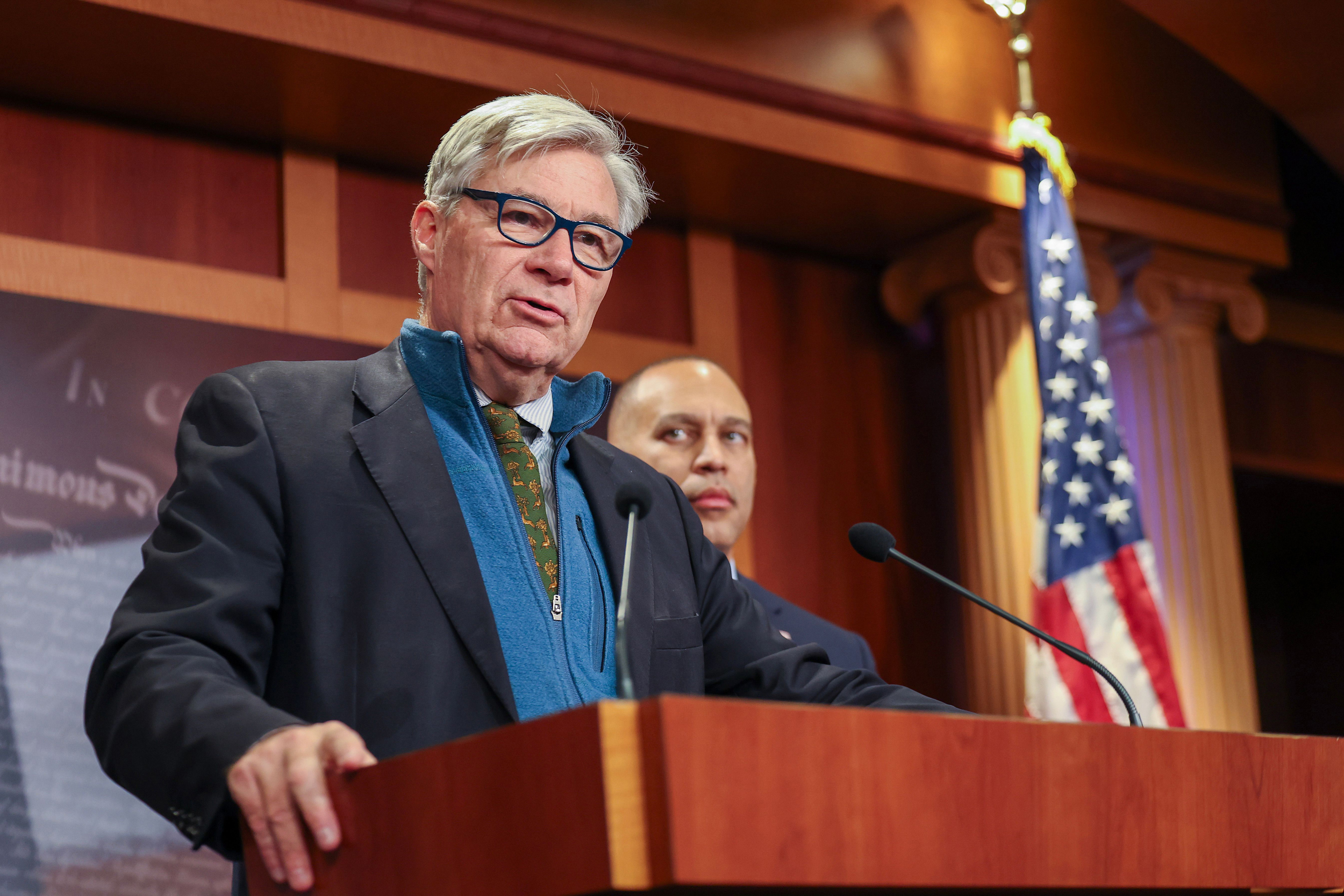
Whitehouse argues that voters welcome a focus on clean energy, which is now cheaper to bring online than power from fossil fuels. And he thinks they are angry about efforts from the Trump administration, allied with fossil fuel interests, to block wind and solar power projects.
“There’s a terrific story to tell with real villains in it,” Whitehouse told Inside Climate News. “You wouldn’t tell the story of Little Red Riding Hood and leave out the wolf.”
Whitehouse noted that the climate crisis will have economic consequences beyond the cost of gasoline and electricity. Already, it is driving up home insurance premiums in states like Florida, threatened by supercharged hurricanes, and California, where wildfires are the main concern. If current trends continue, he noted, climate change could trigger a collapse of the insurance industry. “And we do not want to be caught with our pants down when suddenly it happens and we’ve gone mute,” Whitehouse said.
Still, while climate hawks like Whitehouse are keen to take the fight to Republicans on climate change, for now they have another fight on their hands: convincing Democratic strategists that this is a winning proposition with uncommitted voters.
About This Story
Perhaps you noticed: This story, like all the news we publish, is free to read. That’s because Inside Climate News is a 501c3 nonprofit organization. We do not charge a subscription fee, lock our news behind a paywall, or clutter our website with ads. We make our news on climate and the environment freely available to you and anyone who wants it.
That’s not all. We also share our news for free with scores of other media organizations around the country. Many of them can’t afford to do environmental journalism of their own. We’ve built bureaus from coast to coast to report local stories, collaborate with local newsrooms and co-publish articles so that this vital work is shared as widely as possible.
Two of us launched ICN in 2007. Six years later we earned a Pulitzer Prize for National Reporting, and now we run the oldest and largest dedicated climate newsroom in the nation. We tell the story in all its complexity. We hold polluters accountable. We expose environmental injustice. We debunk misinformation. We scrutinize solutions and inspire action.
Donations from readers like you fund every aspect of what we do. If you don’t already, will you support our ongoing work, our reporting on the biggest crisis facing our planet, and help us reach even more readers in more places?
Please take a moment to make a tax-deductible donation. Every one of them makes a difference.
Thank you,

Data Journalist
Peter Aldhous is a science and data reporter based in San Francisco. He got his break in journalism in 1989 as a reporter for Nature in London, fresh from a Ph.D. in animal behavior. Later he worked as European correspondent for Science, news editor for New Scientist and chief news & features editor with Nature, before moving to California in 2005 to become New Scientist’s San Francisco bureau chief. From 2015 to 2022 he worked on the science desk at BuzzFeed News. Peter also teaches investigative and policy reporting, data visualization, and news features writing in the Science Communication Program at the University of California, Santa Cruz. He is a two-time winner in the Global Editors Network Data Journalism Awards. His reporting has also been honored by the Association of British Science Writers, the Association of Health Care Journalists, the Society of Environmental Journalists, and the Royal Statistical Society.