

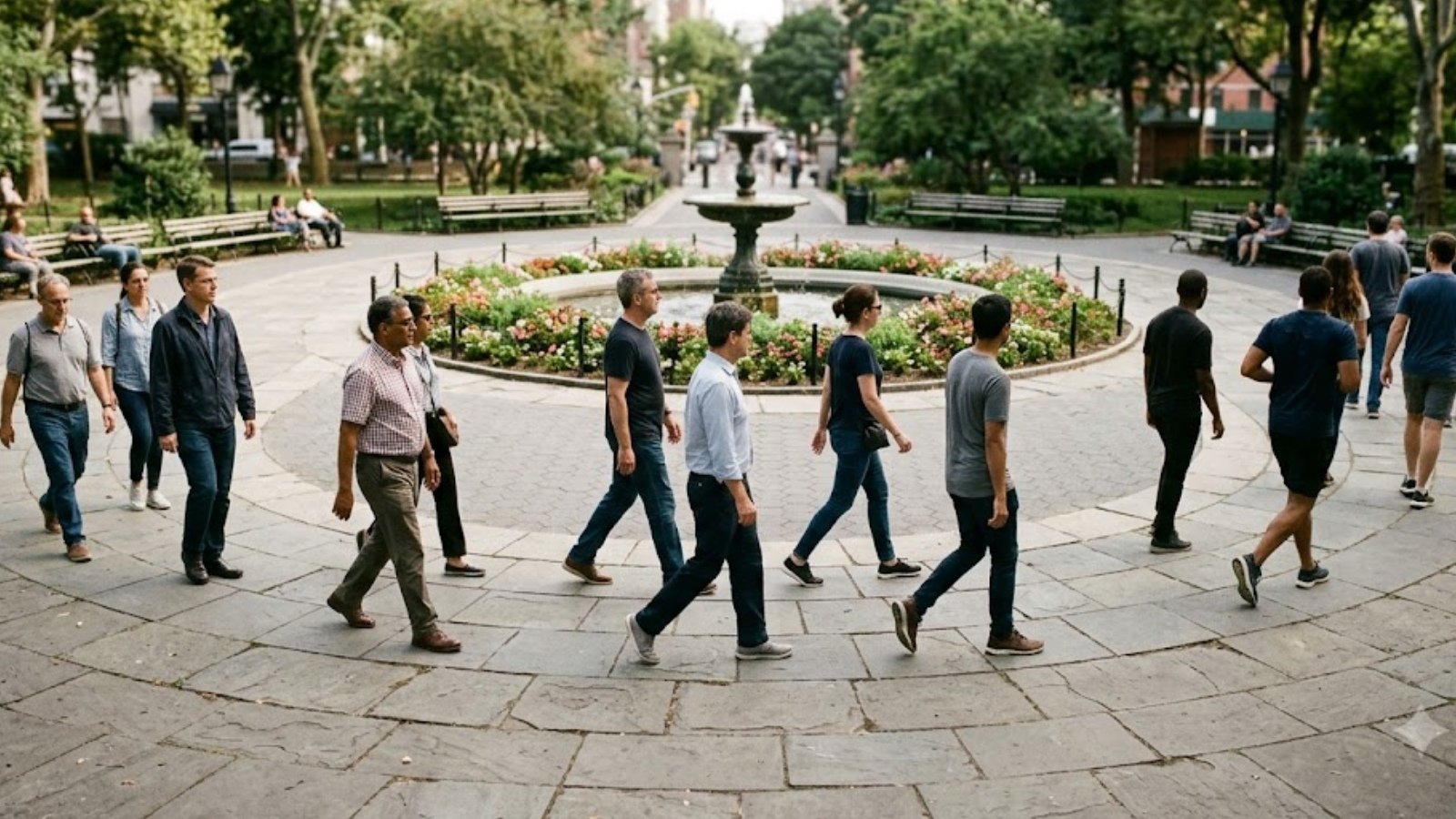
Do humans naturally prefer walking anticlockwise? According to recent reports, experiments conducted across countries ranging from Spain to Japan have repeatedly observed a subtle but consistent left-turn bias in human movement. Whether people are asked to walk in circles, navigate open spaces, or move around tracks, many appear more likely to veer anticlockwise than clockwise.
The finding has sparked curiosity among health experts, raising questions about whether this tendency is rooted in biology or shaped by the environment. According to Dr Sheetal Goyal, Consultant Neurologist at Wockhardt Hospitals, Mumbai Central, “The finding is intriguing, but it is probably too early to call it a hardwired biological trait,” she says. “Human movement is influenced by a combination of brain lateralisation, handedness, eye dominance, balance systems, and learned behaviours.”

DISCLAIMER: This article is based on information from the public domain and/or the experts we spoke to.
However, biology may only be part of the story, she adds. “Many people grow up in environments where sports tracks, running tracks, and even crowd movement patterns often favour anticlockwise motion. These repeated experiences may subtly reinforce a preference over time.”
When drifting to one side could signal a health issue
“Several neurological disorders can affect directional movement,” says Dr Goyal. “Conditions involving the inner ear balance system, stroke, Parkinson’s disease, multiple sclerosis, and certain cerebellar disorders may cause a person to drift toward one side while walking.”
The body’s balance system relies on constant communication between the brain, inner ear, eyes, muscles, and joints. Disruption in any part of this network can alter gait and spatial orientation.
Musculoskeletal conditions may also play a role. “Unequal leg length, arthritis, chronic hip or knee pain, and spinal alignment issues can change the way a person walks,” Dr Goyal explains.
Story continues below this ad
She advises seeking medical attention if a tendency to drift develops suddenly or is accompanied by symptoms such as dizziness, weakness, imbalance, or vision problems.
Did evolution favour a left-turn bias?
The discovery has also sparked speculation about whether favouring one walking direction may have offered humans an evolutionary advantage. For now, scientists remain unconvinced.
“At present, there is no strong evidence that favouring an anticlockwise walking direction provided a specific survival advantage,” says Dr Goyal.
Humans do exhibit natural asymmetries, most notably handedness. Roughly 90% of people are right-handed, reflecting how the brain organises movement and motor control. However, linking those asymmetries directly to walking direction remains largely speculative.
Story continues below this ad
“This observation is more likely a by-product of how the nervous system organises movement rather than a trait that evolved for a particular purpose,” she notes. For most individuals, the anticlockwise tendency is likely nothing more than an interesting behavioural pattern.
Do athletes and older adults show the same preference?
According to Dr Goyal, age, fitness levels, training history, and physical condition can all influence movement patterns. “Athletes and runners often spend years moving anticlockwise on tracks, which may strengthen any existing preference,” she says.
Track-and-field events around the world are traditionally run in an anticlockwise direction, meaning many athletes repeatedly train their bodies to move that way, she adds.
Older adults, meanwhile, may display different tendencies because balance, vision, muscle strength, and reaction times naturally change with age. “Fitness levels, previous injuries, and specialised training can all modify how people walk,” Dr Goyal explains. “While a general anticlockwise trend may exist, individual factors often have a greater impact than any innate directional bias.”
Story continues below this ad
DISCLAIMER: This article is based on information from the public domain and/or the experts we spoke to.