

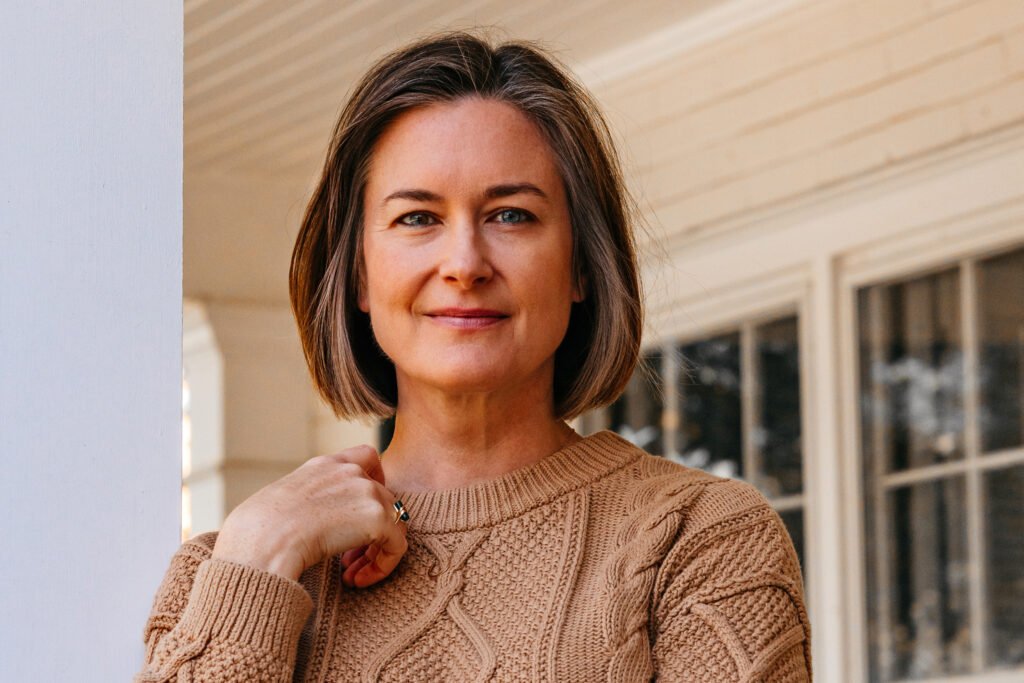
After years working in the climate movement, Katharine K. Wilkinson noticed that advocates consistently lacked the emotional stamina and support needed to stay active, inspired and connected to others engaged in climate work.
Climate advocates are tired. The burnout is real. Solutions are abundant and renewables like solar are cheaper than ever before, but the political will for change, especially at the federal level, is in short supply.
People often ask, “‘What can I do?’” Wilkinson said in a recent interview, and the climate movement responds with punch lists of to-dos. “The punch lists sell us short on those nodes of possibility, that we are not just action takers and chore doers, that our very lives can be meaningful sites of contribution,” she said.
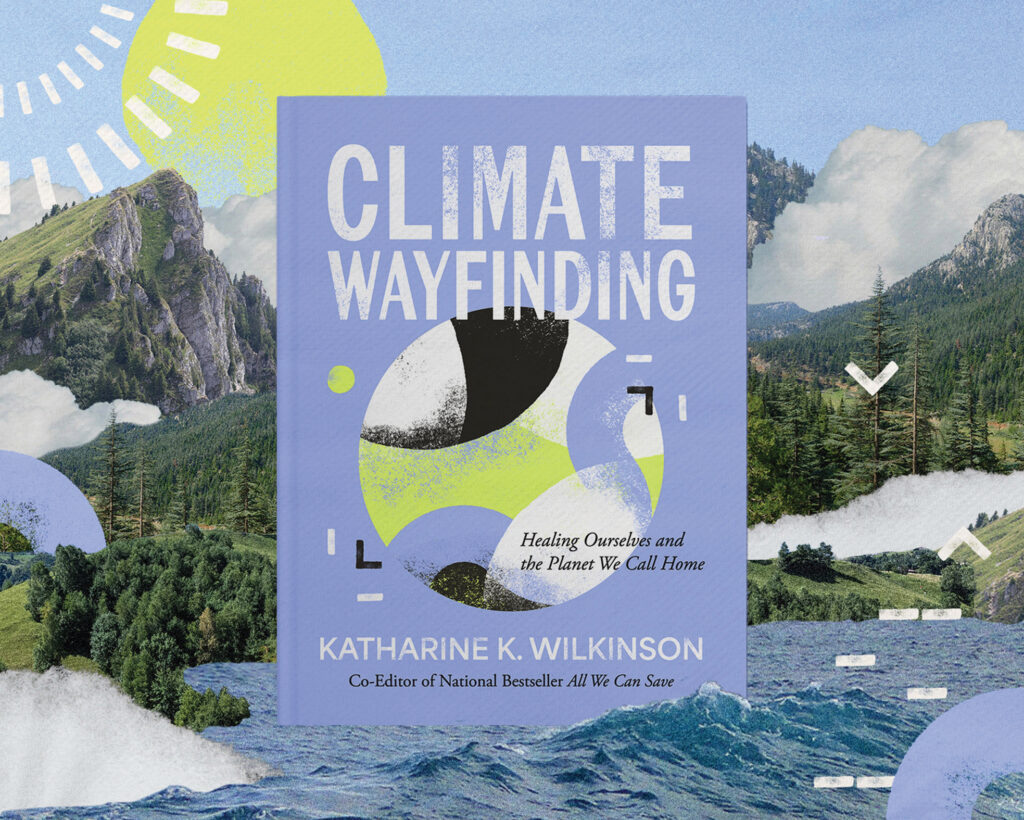
In her new book, “Climate Wayfinding,” published last month, Wilkinson lays out a framework to build emotional resilience and find direction in the climate movement even when the challenges feel endless.
“Climate Wayfinding” blends poetry, art, essays, playlists and personal reflection into active chapters that guide the reader through their own climate journey. It is, in large part, a book designed for active facilitation, where readers are encouraged to discuss central questions and themes with a small group. “It’s not just another climate book that talks to you, but it is a book that can actually walk with you on your own path of exploration wherever you are in your own climate journey,” Wilkinson said.
An Atlanta native with a doctorate in geography and environment from Oxford, Wilkinson co-hosts the climate podcast “A Matter of Degrees” and co-edited the 2020 anthology “All We Can Save,” featuring essays by 60 women on the climate movement.
Inside Climate News caught up with Wilkinson to discuss her new book, climate grief and how activists can brave this political moment.
This interview has been edited for length and clarity.
CLAIRE BARBER: What is the climate movement missing at this moment?
KATHARINE WILKINSON: The gap that I see, or at least that I am focused on, is that there is this often smaller, quieter, sometimes invisible human infrastructure of social movements that is so important and so intimately related to these big visible moments of change.
I live in Atlanta, Georgia. This is where I grew up. You cannot move through this city and not be aware of the role of the Black church in the civil rights movement. We can’t understand second-wave feminism without understanding the role of consciousness-raising circles that were happening in living rooms. We can’t understand so many movements of social change without that piece of the movement infrastructure.
When I think about the climate space, and certainly my own journey over the last 27 years and counting, those spaces for sense-making, for grieving, for renewal and deep dreaming, I have found those to often be in very short supply within the [climate] movement itself.
I think it is not good social movement strategy for us not to be actively cultivating that human infrastructure and meeting people in those bigger, deeper wonderings that we hold. I think they are part of what keeps people on the sidelines and it is certainly at the heart of burnout and bowing out.
BARBER: What is Climate Wayfinding in the first place?
WILKINSON: Climate Wayfinding began as a program and it is now a book, and at its simplest, it is a series of frameworks and practices for looking inward with care, looking outward with curiosity and looking forward with courage. As a program, that takes the shape of an experiential learning journey that uses a bunch of different modalities from group work to guided meditation, free writing, creative mapping exercises, that help us explore, discern and ultimately synthesize some clarity about the path ahead and our own contributions in this time.
BARBER: Why take the time to look inward and to slow down when there’s so much going on in the world right now?
WILKINSON: I know from my own experience that those moments of taking the time to pause, to breathe, to reflect, are often very brief in the grand sweep of our lives and all the doing that we do, but they can play this enormously powerful kind of direction setting, compass setting role, and often are the thing that help us get through that overwhelm, that paralysis, the depth of the ache that we might be feeling that can either keep us frozen or frittering, or dispersed in so many different directions.
I think it is precisely in moments where the urgency feels so big and the overwhelm is so strong, that we need these moments together to step back and to shore ourselves up.
This story is funded by readers like you.
Our nonprofit newsroom provides award-winning climate coverage free of charge and advertising. We rely on donations from readers like you to keep going. Please donate now to support our work.
BARBER: Do you experience climate anxiety and grief?
WILKINSON: In many ways, grief was the entry point for me into this work.
When I was 16, I spent a semester living in the woods with 25 kids in western North Carolina and I was deeply inspired by how we operated as a community. It’s when I started reading Mary Oliver and Annie Dillard and Daniel Quinn’s novel, Ishmael, and I was, at that time, encountering firsthand the ecological wounds of the Southern Appalachians of clear cuts in the national forest, and the harms of industrial agriculture, and mountaintop coal removal and the heartache and the sense of my heart being broken open in relationship to this ecosystem I had really come to love all of that was happening at the same time.
And so I think I’ve never known what it means to be engaged, environmentally without feeling that sense of grief.
It was a portal for me in a lot of ways. It’s been decades of work to figure out how to not just have my heart broken, but broken open, and how to make that grief not be something that just sends me into the fetal position, but actually becomes a source of guidance and motivation to keep doing this work.
BARBER: What is driving a sense of hope for you right now?
WILKINSON: I often orient less toward hope than I do the idea of possibility, which feels like something that I can hold onto with a bit more concreteness. The thing that is helping me stay oriented to possibility, especially as we witness so many losses certainly at the federal level in the U.S., is the existence of the climate majority. When I started [on] my own path in this space, the climate majority did not exist. Now, when we poll people around the world, very clear majorities are worried about this issue, want to see more action from government. We have very full sidelines.
And the other thing we have that didn’t exist 25 years ago was really robust solutions. In particular, we had clean energy technologies, but we didn’t have them with the efficacy and the economic feasibility that we have now. And so when I hold the reality of the people and the solutions, that for me means there is so much that is possible if we are able to move both of those forward in really vigorous ways.
BARBER: What is driving your climate grief right now?
WILKINSON: The thing that is a deep source of grief is the decades of denial and delay that have gotten us so much deeper into crisis than we ever needed to be. And that so much, even under the best case scenarios, is going to be lost in terms of places, communities, cultures, species [and] ecosystems.
It’s overwhelming, the sheer magnitude of that loss and if all we were doing was looking at that loss with no ways to respond, that would be, I think, an unfathomable source of grief. But the challenge for all of us, is to be able to hold all of that at the same time. The depth of the loss and the enormity of what is still possible.
BARBER: One big part of your book is the formation of a third space. We know, not just in the climate movement, but really everywhere right now, at least in the United States, it’s really hard for people to find a third space. For someone who is struggling with that or someone who feels isolated how should they approach your book?
WILKINSON: I often remind myself that the building of community can sound like this big grand thing but it can start with as few as two or three people. … I think the sense that so many have of a craving for climate community or just community in general in this time, to me, is a nudge for all of us to see ourselves as the people who can and will build that community. It doesn’t need to be rocket science.
BARBER: You obviously have a background in religion and philosophy. How does that influence your book?
WILKINSON: Sometimes I think about the body of work of Climate Wayfinding as something of the applied environmental humanities. There’s poetry, there’s art, there’s song. All of that is very present, and for me, all of that has a real kind of spiritual undergirding.
The very kind of sensibilities and approaches of this book probably, they all respond to the reality that this work is not just strategic, it is not just tactical, it is emotional, it is relational, it is creative, and it is often spiritual. I hope that this work has a contribution to honoring those aspects of climate engagement and the climate movement, not as sort of fluffy, nice-to-have things on the side, but actually at the very heart of this work.
BARBER: What role can creativity play in the climate movement?
WILKINSON: One of the roles for creativity to me is about tapping into other ways of knowing beyond just the analytical mind, which has often been so central and celebrated and is so necessary, but is not perhaps the whole story. The practices of free writing and these fun creative mapping exercises that we do, I think they give us access to things that we might already know but haven’t yet been able to bring to the surface.
BARBER: What gaps or opportunities for growth still exist beyond your book?
WILKINSON: I would love to see us, whether it is through the use of Climate Wayfinding or any of the other kind of kindred bodies of work, take seriously what is required for deep, sustained, courageous climate engagement over time. That is not a nice-to-have, it is absolutely essential.
About This Story
Perhaps you noticed: This story, like all the news we publish, is free to read. That’s because Inside Climate News is a 501c3 nonprofit organization. We do not charge a subscription fee, lock our news behind a paywall, or clutter our website with ads. We make our news on climate and the environment freely available to you and anyone who wants it.
That’s not all. We also share our news for free with scores of other media organizations around the country. Many of them can’t afford to do environmental journalism of their own. We’ve built bureaus from coast to coast to report local stories, collaborate with local newsrooms and co-publish articles so that this vital work is shared as widely as possible.
Two of us launched ICN in 2007. Six years later we earned a Pulitzer Prize for National Reporting, and now we run the oldest and largest dedicated climate newsroom in the nation. We tell the story in all its complexity. We hold polluters accountable. We expose environmental injustice. We debunk misinformation. We scrutinize solutions and inspire action.
Donations from readers like you fund every aspect of what we do. If you don’t already, will you support our ongoing work, our reporting on the biggest crisis facing our planet, and help us reach even more readers in more places?
Please take a moment to make a tax-deductible donation. Every one of them makes a difference.
Thank you,

Fellow
Claire Barber is a fellow at Inside Climate News and a master’s in journalism student at Stanford University. She is an environmental and outdoor journalist, reporting primarily in the American Southwest and the West. Her writing has appeared in The San Francisco Chronicle, Outside, Powder Magazine, Field & Stream, Trails Magazine and more. She loves to get lost in the woods looking for a hot spring, backpacking to secluded campsites and banana slugs.