

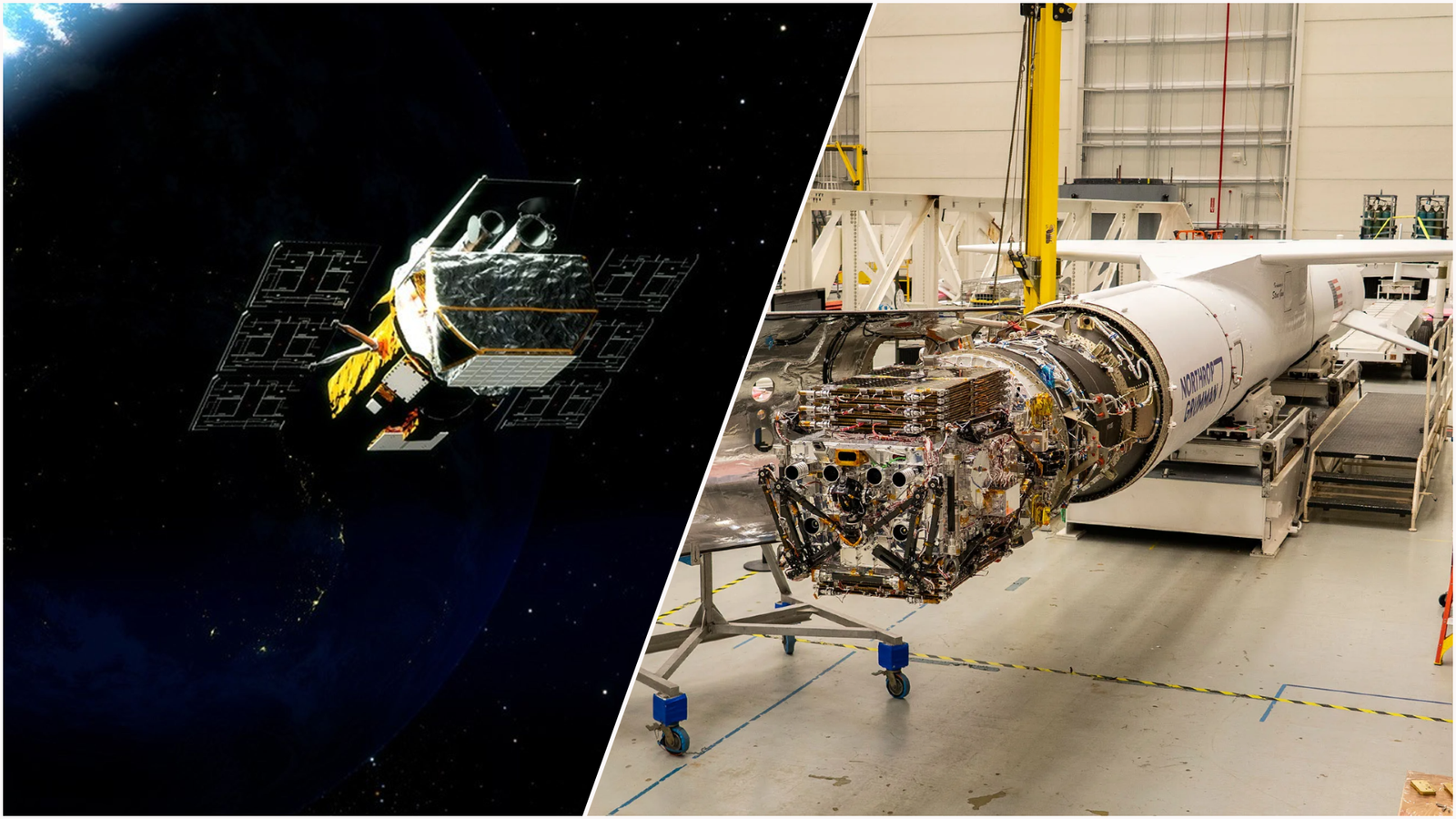
WALLOPS ISLAND, Va. — For over 20 years, NASA’s Swift space observatory has been conducting prolific science in orbit, hunting for signs of gamma-ray bursts — the most powerful explosions in the universe. Now, it’s falling to Earth, doomed to a fiery death by the end of the year as its orbit decays.
But maybe not.
NASA, it turns out, has a daring rescue mission in the works, something never before attempted in space: the Swift Boost mission. The endeavor calls for an untested spacecraft built by the Arizona company Katalyst Space Technologies to rendezvous and dock with Swift — something the observatory was never designed to do — before the observatory falls back to Earth.
If all goes well, Katalyst’s space tug (it’s called Link) will lift the Swift observatory into a higher, safer orbit — one that will add years of life to the aging space telescope’s mission. Liftoff is officially set for June 27, with Link launching on the last-ever Pegasus XL rocket, an air-launched booster built by Northrop Grumman.
“Frankly, I have to be honest: No one thought it was going to be possible,” Shawn Domagal-Goldman, NASA’s Astrophysics Division director, told reporters here on Wednesday (June 17). “No one thought we would get as far as we’ve already gotten today.”
What stands out most is how quickly the mission came together.

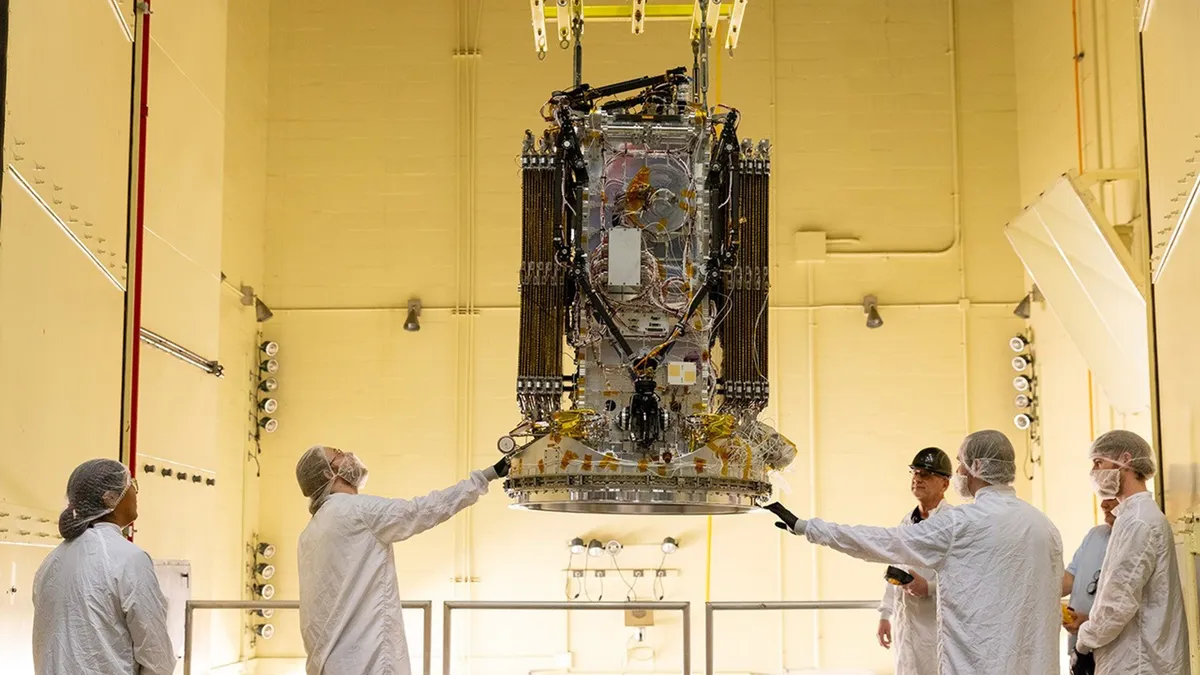
It was just in September 2025 that NASA picked Katalyst to build a spacecraft capable of boosting Swift on a budget of $30 million. That was nine months ago. And now, the finished Link spacecraft — with its three robotic arms, three main Hall thrusters and a suite of other instruments — is packed aboard its Pegasus XL rocket and tucked on the belly of its L-1011 Stargazer carrier plane for a trip to its launch site in the South Pacific’s Kwajalein Atoll.
“In the last nine months, we have gone from a clean sheet to a spacecraft that is currently integrated on a rocket on an airplane, ready to go to Kwaj for launch,” said Kieran Wilson, Link’s principal investigator at Katalyst Space, on Wednesday. “This is an absolutely unprecedented development timeline for this program.”
Yet that “swift” timeline, if you will, is essential if NASA is to rescue the Swift space observatory.

NASA originally launched Swift (its full name is the Neil Gehrels Swift Observatory, after its late principal investigator) in 2004 on a $250 million mission to search the sky for gamma-ray bursts and other high-energy astrophysics phenomena in the cosmos. From its original orbit about 375 miles (600 kilometers) above Earth, Swift was a silent sentinel, ready to quickly pivot to new targets with unprecedented speed.
“Swift was designed to study gamma-ray bursts, short-lived flashes of high-energy light that release more energy in just a few seconds than the sun will in its entire lifetime,” Swift principal investigator Brad Cenko told reporters Wednesday. “It’s been extremely successful in this regard, detecting over 2,000 of these sources all the way out to the edge of the visible universe.”
It was Swift that helped scientists confirm without a doubt that the heaviest elements we know of, including the shiny gold and platinum in the jewelry you’re wearing right now, were forged by these explosive cosmic events, Cenko said. Swift was expected to last two years in orbit. It’s well into its second decade now, and still in good health — well, except for that “falling out of space” part.
You see, Swift doesn’t have thrusters, or a propulsion system of any kind. And over the years, an increase in solar activity — space weather from the sun — has puffed up Earth’s atmosphere to create more drag on Swift than expected, pulling it down from its initial orbit.
Last year, the Swift mission team realized the space telescope was falling faster than expected. Without a rescue mission, Swift would crash to Earth by the end of this summer.
“It was okay for a generic spacecraft to come out of orbit,” Domagal-Goldman said. “But this was not just any spacecraft. This is an observatory with unique capabilities for astrophysics … It is a swift observatory that can quickly pivot across the night sky to find things that go boom in the night.”
“So we decided, yeah, we want to go save this one this time because of how special it is,” he added.
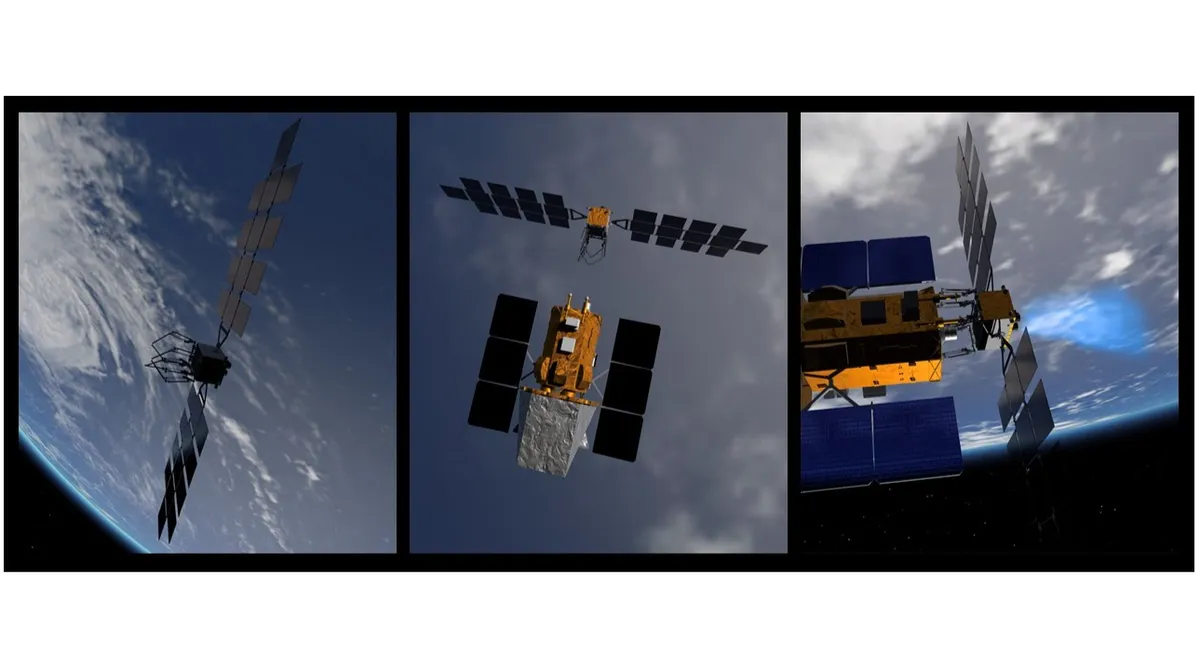
A lot has to go right for Katalyst’s Link spacecraft to rescue Swift.
The 937-pound (425-kilogram) spacecraft will launch into an initial testing orbit on June 27 and perform a series of checkouts to ensure that its basic systems (three main engines, 16 reaction control thrusters, solar arrays, robotic arms) are all working properly.
“We’ll have a commissioning period of a few weeks, after which we will begin maneuvers in order to approach Swift,” Wilson said.
Once Link reaches Swift’s orbit, it will perform a series of proximity operations, dock, and then raise the space observatory to its initial orbit over the period of a several months. If that goes to plan, Swift could be back to performing science by this fall, Cenko said. (The telescope has been in a low-power mode to preserve what orbit it can since February.)
If Link is successful, Swift could get another five or more years of life in space. Link, meanwhile, will detach and be intentionally deorbited (meaning it will fall to Earth on purpose) to end its mission.
“All this is challenging and risky,” Wilson said. “There’s a lot of spacecraft that have had far longer development cycles with far more funding behind them that have failed for mundane reasons.”
A lot of simple things can go wrong.
For example, the solar arrays on Link might malfunction, Wilson said. Swift has been in orbit for so long, its protective insulation blankets may be as brittle as glass and break when Link’s robotic arms grab on, he added.
And then there’s the sun. It was increased solar activity that put Swift in its perilous situation. That activity is ongoing. In fact, Swift may be one big solar storm away from doom if the sun fires off a major storm before Katalyst’s Link can reach it.
Swift is on track to fall below an altitude of 186 miles (300 km) by October. At that point, it may be too low for Link to reach the observatory. A surprise solar storm could accelerate that fall, but NASA remains hopeful.
“At the moment, we think we have several months where Swift will be at a sufficiently high altitude to give Katalyst folks a great chance to capture and boost us,” Cenko said.
Katalyst is banking on the future need for spacecraft servicing and life extension in space. This week, the company raised $12 million in funding to develop an even more capable spacecraft called Nexus, which it plans to “expand satellite servicing to multi-orbit, multi-mission operations.”
“Over the last decade or so, we’ve gotten very good at launching things into space,” said Robert Lamontagne, Katalyst’s vice president for strategic partnerships. “Katalyst is here really to kind of demark the end of that throwaway model, and the start of a new model.”
The first test flight of a Nexus mission could launch in 2027. Its target: a U.S. Space Force satellite called Rooster in geostationary orbit 22,236 miles (35,786 km) above Earth, much higher than the Swift observatory. That Nexus-1 mission will launch atop an Ariane 6 rocket next year.