

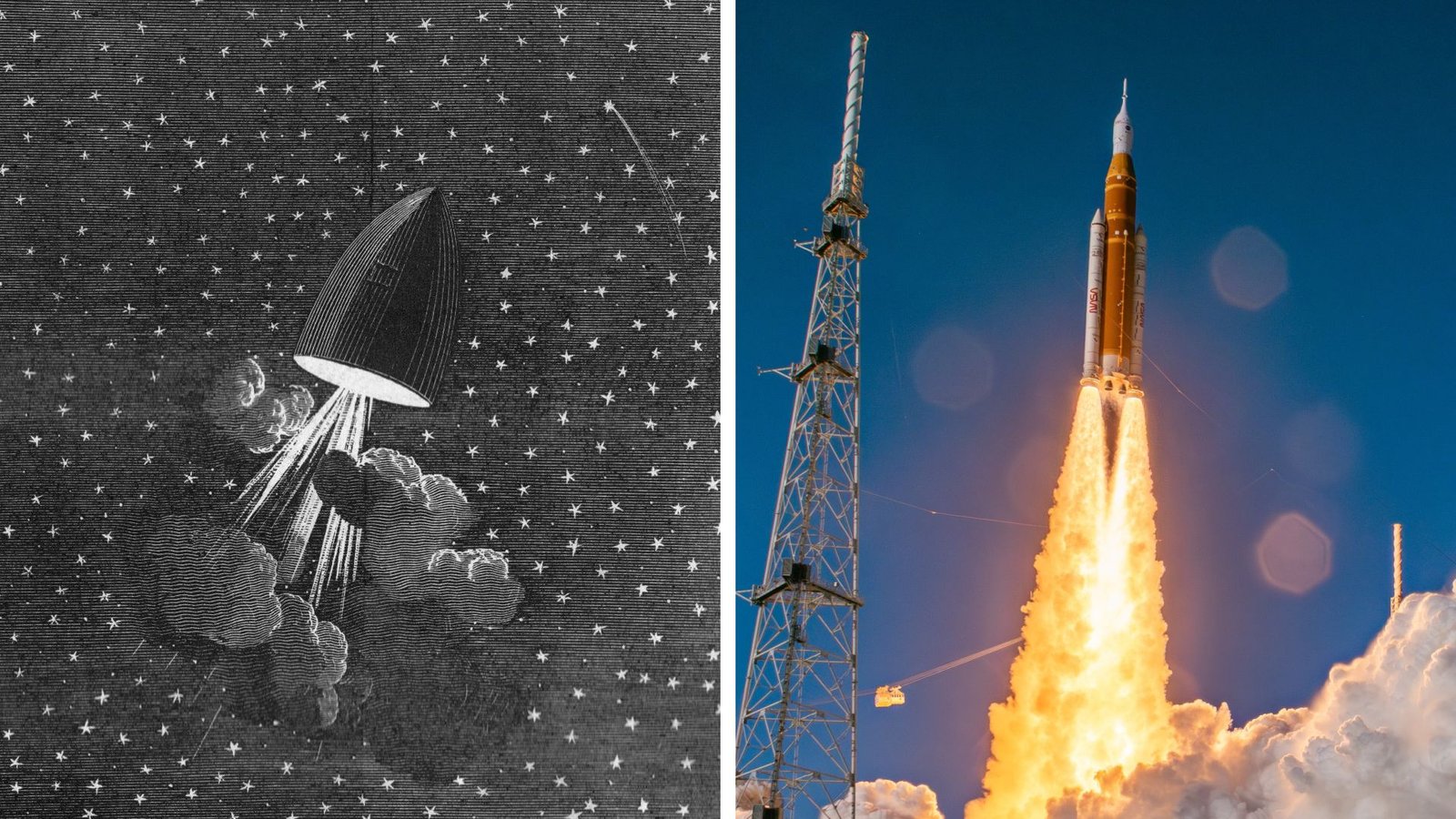
“From the pages of Jules Verne to a modern-day mission to the moon, a new chapter of our exploration of our celestial neighbor is complete.” So said NASA commentator Rob Navias as Artemis 2’s Integrity spacecraft landed safely in the Pacific this past April.
It is striking just how similar the mission profile of Artemis 2 was to the journey described by the French author in the mid-19th century. At a time when his peers were writing about fanciful balloon trips to other planets, Jules Verne dealt realistically with escape velocity, orbital slingshots, and course-correction burns. Yes, he made mistakes — some of them laughably obvious to the modern reader — but many aspects of his stories were eerily prescient of the real space missions that were still a century or more away.
Often called the father of science fiction, the prolific Verne wrote of extraordinary voyages on modes of transport that did not yet exist, like the submarine in “Twenty Thousand Leagues Under the Sea”, and took readers to unexplored regions, such as “Journey to the Center of the Earth”.

Verne’s fourth novel, “From the Earth to the Moon”, was published in 1865. Its darkly comic opening chapters describe how the members of the Baltimore Gun Club find their ballistic talents surplus to requirements at the conclusion of the American Civil War (a conflict still ongoing as Verne wrote). Club president Impey Barbicane proposes a new outlet for their skills: “I began to wonder whether, with a sufficiently large cannon, it might be possible to shoot a projectile to the moon.”
Verne was obsessed with facts and figures. He explains the math and science of Barbicane’s 900 ft (274 m) cannon, or “Columbiad”, in great detail, including the trajectory of its projectile.
His reasoning about where to locate the Columbiad was sound enough to be replicated by NASA decades later: launch from as close to the equator as possible to get a speed boost from the Earth’s rotation. Verne picked a spot near Fort Myers, on the opposite side of the Floridian peninsula to Cape Canaveral, but at a very similar latitude.
G-force extremes

Image credit: Émile-Antoine Bayard and Alphonse de Neuville

Image credit: Space.com / Josh Dinner
As “From the Earth to the Moon” proceeds, French adventurer Michael Ardan volunteers to man the Columbiad’s hollow projectile. Barbicane and his nemesis, Captain Nicholl, soon agree to join him.
But here we hit the first major problem in Verne’s vision. Unlike a rocket, which accelerates to escape velocity over a few minutes, subjecting its crew to strong but survivable g-forces, a projectile fired from a cannon accelerates almost instantaneously. Barbicane, Nicholl, and Ardan would have been crushed to a paste.
Nonetheless, the fictional launch is successful, and “All Around the Moon”, published four years later in 1869, picks up the story. Instead of hitting the moon, as Barbicane had rather recklessly intended, the projectile turns out to be on a free-return trajectory, taking it around the far side of our natural satellite.
Some of the sequel’s details are charmingly naive. Although Verne equips his travelers with chemical apparatus to produce oxygen and scrub carbon dioxide, he has no qualms about them opening portholes on several occasions, as long as they’re quick! His projectile’s interior is spacious and richly appointed like a Victorian study, and its occupants enjoy gourmet meals with fine wines, a far cry from the rehydrated rations that Reid Wiseman and company munched on during Artemis 2.
Verne also has his crew mostly bound to the capsule’s floor by gravity. He mistakenly has them experience weightlessness only at the “neutral point”, the spot where the Earth’s and moon’s gravitational pulls are equally balanced. Still, it is quite amazing to read zero g imagined at a time when it was completely beyond all human experience (except perhaps briefly, if one of the recently invented “safety elevators” failed).
A light in the darkness

Image credit: Émile-Antoine Bayard and Alphonse de Neuville

Image credit: NASA
Like the crew of Artemis 2, Barbicane, Nicholl, and Ardan eagerly observe the lunar surface during their journey. Describing their observations, Verne stuck mostly to real earthbound observations, which he’d meticulously researched in the libraries of Paris. But as his crew swings around the far side of the moon, “enveloped in a veil of darkness the most profound”, they catch a distant glimpse of a fiery light.
This evocative flicker in the vast blackness of lunar night must have been just what Wiseman and co experienced when they saw micrometeor impacts on the dark side of the moon. Those who watched the Artemis 2 broadcast may remember the team in the Science Evaluation Room (SER) literally jumping for joy when the astronauts reported seeing these flashes.

Image credit: Émile-Antoine Bayard and Alphonse de Neuville

Image credit: NASA
In line with the science of his time, which said that lunar craters were volcanic, Verne ascribes his flickering light to an eruption. But a couple of pages later, his capsule encounters a meteoroid which explodes nearby. “Thousands of glittering fragments were flying around them in all directions,” he writes, via Edward Roth’s translation. We can only imagine how the SER would have reacted to that!
As the fictional capsule approaches the point of neutral gravity for the second time, the crew fears getting stuck there. In another farsighted plot point, Verne has his characters attempt a course-correction burn using firework-like rockets. The burn fails, but the capsule has just enough inertia to be drawn to Earth once again.
Barbicane, Nicholl, and Ardan splash down in the Pacific – again somehow surviving a massive shock, since their capsule has no parachutes – and are eventually recovered by the US Navy, much like the Apollo and Artemis crews. The closing chapters of “All Around the Moon” see the trio paraded victoriously through the streets all over America, in a final foreshadowing of real lunar missions.

Image credit: Émile-Antoine Bayard and Alphonse de Neuville

Image credit: NASA
“A hundred years ago, Jules Verne wrote a book about a voyage to the moon,” said Neil Armstrong during Apollo 11’s homeward flight in 1969. “His spaceship, Columbia [sic], took off from Florida and landed in the Pacific Ocean after completing a trip to the moon.”
Nearly 60 years later, and 160 years after their first publication, the imaginative spaceflights of Jules Verne continue to echo humanity’s real missions to our nearest neighbor.