

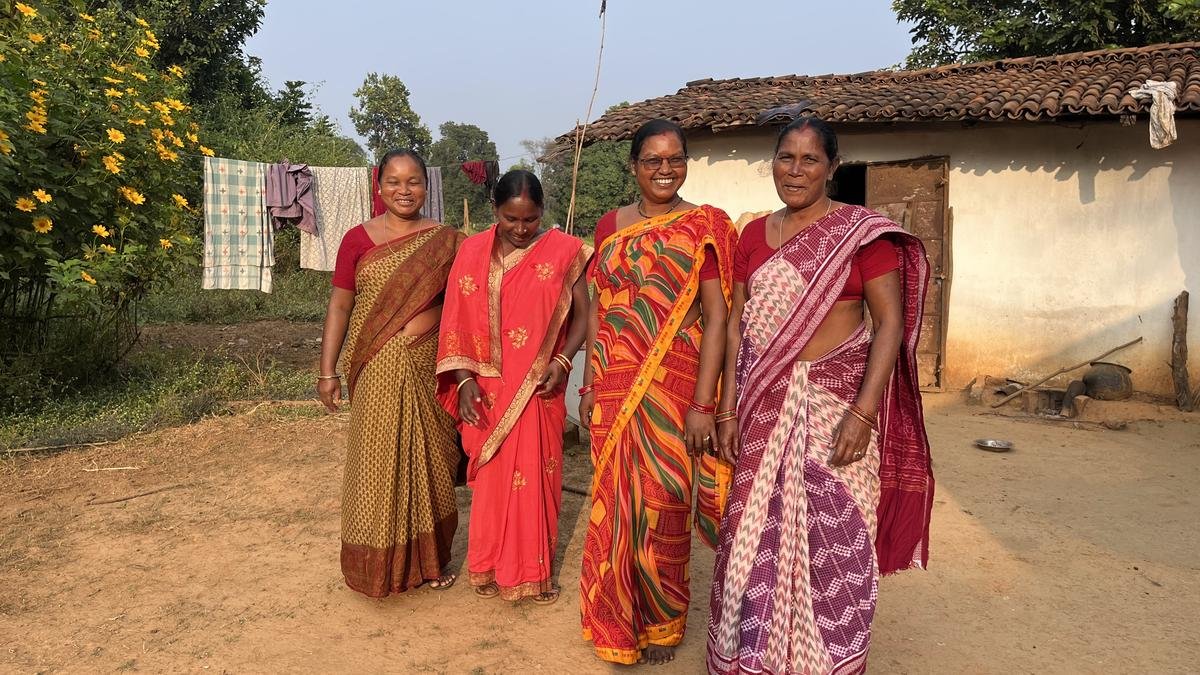
On May 20, Uttar Pradesh’s Banda district recorded 48 degrees Celsius, among the highest temperatures globally that day. But life continued as usual for Meena Srivastava in Bundelkhand, where she’s spent nearly two decades working since 2006 as an Accredited Social Health Activist (ASHA) worker. “Humein garmi ki aadat hai, par is saal garmi kuch zyada hi hai… (We are used to the heat but it’s exceptionally hot this year),” says this ASHA from Naugawa village, UP.
Srivastava, 46, begins her workday around 8 am. She returns home by 11 am, but labour pains, diarrhoea, or other medical emergencies don’t follow a timetable. Often, she has to step out for work in the scorching afternoon heat, around 2-2:30 pm.
Climate reshaping labour
She starts surveys early, carries water and ORS, and tries to finish outdoor work before noon. “I have always done this, but it is getting tougher as I grow older and the work never stops,” says Srivastava, who is currently on a vaccination drive. Her monthly earnings barely reach ₹4,000, and payments are often delayed. “I haven’t been paid since March,” she says.
Laxmi Kaurav, an ASHA supervisor from Madhya Pradesh’s Bhind district, says, “Not only are we not given any special guidance during heatwaves, there is also an increase in the number of surveys and camps during summer, along with pressure from officials.”

Laxmi Kaurav (Left) supervising paperwork with ASHA workers in Daboh PHC, Lahar, MP.
| Photo Credit:
Reshmi Chakraborty
Across India, climate change and rising temperatures are reshaping outdoor labour — from agriculture to informal gig work. Frontline health workers like ASHAs, who conduct household surveys, support patients, and organise health camps, are increasingly exposed to extreme heat.
According to the 2025 Lancet Countdown on health and climate change report, heat exposure led to a loss of 247 billion labour hours in 2024, a 124 % increase compared to the 1990s. Many ASHA workers report lost incentives during heatwaves due to missed work and illness.
Uneven implementation
The National Health Mission (NHM), which runs the ASHA programme, has integrated heat-related modules through the National Programme on Climate Change and Human Health (NPCCHH). But workers and health advocates say implementation remains uneven, with training largely focused on identifying heatstroke and community awareness rather than protecting ASHAs themselves. “The focus [on ASHA’s training] is mainly on identifying heatstroke cases, giving first aid, and ensuring swift referral,” says Dr. Archana Bhonsle, joint director, non-communicable diseases, NHM Maharashtra. “More detailed heat-related training is given to medical officers, who then pass it down to their subordinates, including ASHAs.”

ASHA workers in Daboh PHC, Lahar, MP.
| Photo Credit:
Reshmi Chakraborty
For ASHAs, the most common advice remains simple: avoid peak afternoon hours. Umbrellas, sun jackets and caps are not provided to them.
Kaurav recalls a camp held in extreme heat, on June 9, for high-risk pregnant women in Bhind, under the Pradhan Mantri Surakshit Matritva Abhiyan (PMSMA). “Officials said ambulances would be available, but none came. There were no chairs, drinking water, or cooling arrangements. It felt pointless to make pregnant women sit in this heat just to distribute iron and calcium tablets and meet targets,” says Kaurav. If the system struggles to protect beneficiaries, workers stand little chance.

Expectant mothers waiting for ambulance in heat after the camp in Bhind.
| Photo Credit:
Special arrangement
Health workers falling ill
Hemlata, an urban ASHA worker from Indore, was hospitalised in early May with severe dehydration and required intravenous fluids in a private hospital — paid entirely out of her pocket. “Forget compensation or sick leave, our pay is cut if we take leave or cannot complete work,” she says.
Her daily work takes her to 15-30 households, where she conducts heat-awareness drives while remaining exposed to the same conditions.

Beneficiaries waiting at a camp without enough chairs, water and cooling facilities.
| Photo Credit:
Special arrangement
According to the findings of , a heat-and-health advocacy initiative, among 86 ASHA workers in Haryana, 68% reported dehydration, 67.4% stated heat exhaustion, and 23.2% mentioned heatstroke. Nearly 40% reported urinary tract infections, and about 22% lost more than nine working hours per week due to extreme heat.
“ASHAs are expected to educate communities and respond to public health needs, but there is little institutional focus on protecting their own health,” says Vasundhara Jhobta, project associate, HeatWatch.
In 2025, HeatWatch conducted a training session for 50 ASHAs in Haryana through the Centre of Indian Trade Unions (CITU). Many participants said it was the first time training focused on their own health rather than community health.

HeatWatch Heat Stress Management Awareness session for ASHA workers in March 2025 in Rohtak, Haryana
| Photo Credit:
Courtesy Apekshita Varshney/HeatWatch
A structural exclusion
Sunita Rani, general secretary of Haryana’s ASHA Workers’ Union, says workers have repeatedly demanded that surveys not be scheduled during extreme heat. They have also asked for rest areas, drinking water and free health check-ups during summer. “None of these has been formally provided,” she says.
The advice to start early has limits. “We cannot start at 8 am, because we also have household responsibilities,” she says. “And the women we need to meet are often busy before 9:30-10 am. We end up staying out until 2-3 pm.”
Many veteran ASHAs, now in their late 40s and early 50s, are also navigating perimenopause and menopause while working long hours in extreme heat on low and irregular pay. Matilda Kullu, 51, an ASHA from Sundergarh, Odisha, says she has developed chronic urinary tract infections and leg pain due to restricted water intake during fieldwork. “Our areas are spread over long distances, with no toilets and irregular transport. So, I limit water intake. It gets worse in summer.”

Expectant mothers wait for a 108 ambulance after a camp in Bhind, MP.
| Photo Credit:
Special arrangement
Despite their frontline role, ASHAs are not officially classified as a climate-vulnerable occupational group in India’s climate-health frameworks. NPCCHH modules mention their role in community awareness but offer little guidance on protecting workers themselves.
A few organisations, including HeatWatch and the Mahila Housing Trust (Ahmedabad), have attempted to fill this gap, but these remain limited.
Kullu observes that most climate-related awareness comes informally through routine meetings. “But specialised training or resources for ASHAs are almost absent. In all these years, we received money for umbrellas or protective gear only once,” she says.
Union leader Sunita Rani is blunt about why the situation persists. “People sitting in air-conditioned offices make policies without understanding ground realities. They should spend a day in the field with us,” she says.
ASHA workers like Srivastava rely on small coping strategies. “In my village, people know me. I can stop at any home for water or a restroom break,” she says. But urban ASHAs or those covering larger territories often lack even this flexibility, and many reduce water intake to avoid losing working hours.
Workers and union leaders alike argue that the lack of protection is structural, not accidental.
As climate change intensifies, ASHAs continue to work 8-12 hours a day in extreme heat without safety equipment, rest spaces, or reliable income. The workers responsible for community health are increasingly exposed to the same risks they are meant to mitigate.
“There must be formal recognition of climate-related duties,” says Apekshita Varshney, founder and executive director, HeatWatch. This would include training, compensation, protective gear, access to water and shade, rest facilities, and adjustments to working hours during extreme heat without wage loss. “Recognising ASHAs as a climate-vulnerable group is not only about occupational health. It is about climate justice, gender justice, and building a resilient public health system,” Jhobta concludes.
The writer is a freelance journalist and co-author of Rethink Ageing.