

Close Menu

    Subscribe to Updates

    Get the latest news information from worldwide businesses.

    What's Hot

    Anthony Fauci faces state probes after Biden pardon shields him federally

    August 1, 2026

    Dinosaur-killing asteroid may have caused firestorms 17 times hotter than the thermal limit lethal to humans

    August 1, 2026

    Jessica Pegula vs Diana Shnaider preview, head-to-head, odds, prediction & betting tips

    August 1, 2026
    Facebook Instagram YouTube LinkedIn X (Twitter)
    Trending
    • Anthony Fauci faces state probes after Biden pardon shields him federally
    • Dinosaur-killing asteroid may have caused firestorms 17 times hotter than the thermal limit lethal to humans
    • Jessica Pegula vs Diana Shnaider preview, head-to-head, odds, prediction & betting tips
    • I’m a Native New Yorker—This Sailing Is One of the Best Ways I’ve Seen the City
    • Tiny black holes may be secretly exploding stars across the Milky Way
    • 5,839 patients await life-saving organ transplants in A.P.
    • Sudden Belly Swelling Around Your Period? It Could Be ‘Endo Belly’
    • You could be taking way better photos on your phone
    Newspublicly
    • About Us
    • Advertise & Partner with us
    • Pitch Your Story
    • Contact Us
    Facebook Instagram LinkedIn X (Twitter)
    Subscribe
    • Home
    • World News
      • Asia
      • India
      • USA
      • UK & Europe
      • Middle East
    • Economy & Business
      • Global Economy
      • Corporate & Industry
      • Finance & Markets
      • Policy & Trade
    • Technology
      • Gadgets & Devices
      • Software & Apps
      • AI & Machine Learning
      • Robotics & Automation
    • Health & Medicine
      • Fitness & Nutrition
      • Research & Innovation
      • Disease & Treatment
      • Doctors, Clinics & Patient Care
    • Travel & Tourism
    • Automobile
      • Electric & Hybrid Vehicles
      • Auto Industry Insights
    • Sports
    • More
      • Education
      • Real Estate
      • Environment & Climate
      • Space & Astronomy
      • War & Conflicts
    Newspublicly
    Home»More»Space & Astronomy»Do galaxies have a ‘kill switch’ that makes them stop growing?
    Space & Astronomy

    Do galaxies have a ‘kill switch’ that makes them stop growing?

    AdminBy AdminJune 9, 2026No Comments4 Mins Read0 Views
    Share
    Facebook Twitter LinkedIn Copy Link WhatsApp


    Galaxies don’t grow forever. At some point, even the most prolific star-forming galaxies start to slow down, then stall, then settle into a long quiet retirement. Astronomers have known about this transition for a long time, but we haven’t had a clean physical explanation for why it happens, and why it happens at the particular mass scale that it does.

    A new paper led by Preetish Mishra of the Korea Institute for Advanced Study, along with an international team of scientists, makes a clear and testable proposal: that the slowdown in galaxy growth is caused by the birth of a stable cloud of hot gas surrounding the galaxy, and that cloud forms at a very specific mass: roughly 10^12.5 solar masses. Above that threshold, galaxies stop being efficient stellar factories, no matter how much raw material they have on hand.

    The question is: what flips the switch?

    To get to that calculation, the team used the Horizon Run 5 simulation, one of the largest cosmological simulations ever created. It takes a chunk of virtual universe roughly a gigaparsec across, models the full physics of gas, gravity, star formation, supernovas, and supermassive black holes from shortly after the Big Bang to the present day, and lets researchers track individual galaxies through their entire histories. Mishra and colleagues picked out roughly 20,000 of the most massive central galaxies and watched what happened to them over cosmic time.

    The key quantity they tracked is the stellar-to-total mass ratio. It’s a measure of how much of a galaxy’s entire mass budget (stars, gas, dark matter, black holes, everything) actually ends up locked into stars. Think of it as a galaxy’s star-formation efficiency report.


    You may like

    The team found that this ratio peaks sharply in galaxies with total masses between about 10^12.4 and 10^12.7 solar masses. Below that range, galaxies are turning gas into stars roughly as fast as the gas comes in. Above it, they slow down by more than a factor of three. That peak is the critical mass.

    Mishra’s theory as to why galaxies stop growing is the formation of a hot gas halo that has reached gravitational equilibrium. As a galaxy grows, the gas falling into it gets shock-heated. Up to a certain mass, that gas cools quickly enough to keep raining down and feeding new star formation.

    Space

    Past the critical mass, the halo gets dense and hot enough to hold itself up against gravity for billions of years. The gas can no longer cool fast enough to fall in and the galaxy is suddenly cut off from its fuel supply. It keeps gobbling up dark matter and dragging in satellite galaxies, but the cool gas that actually makes stars stops arriving.

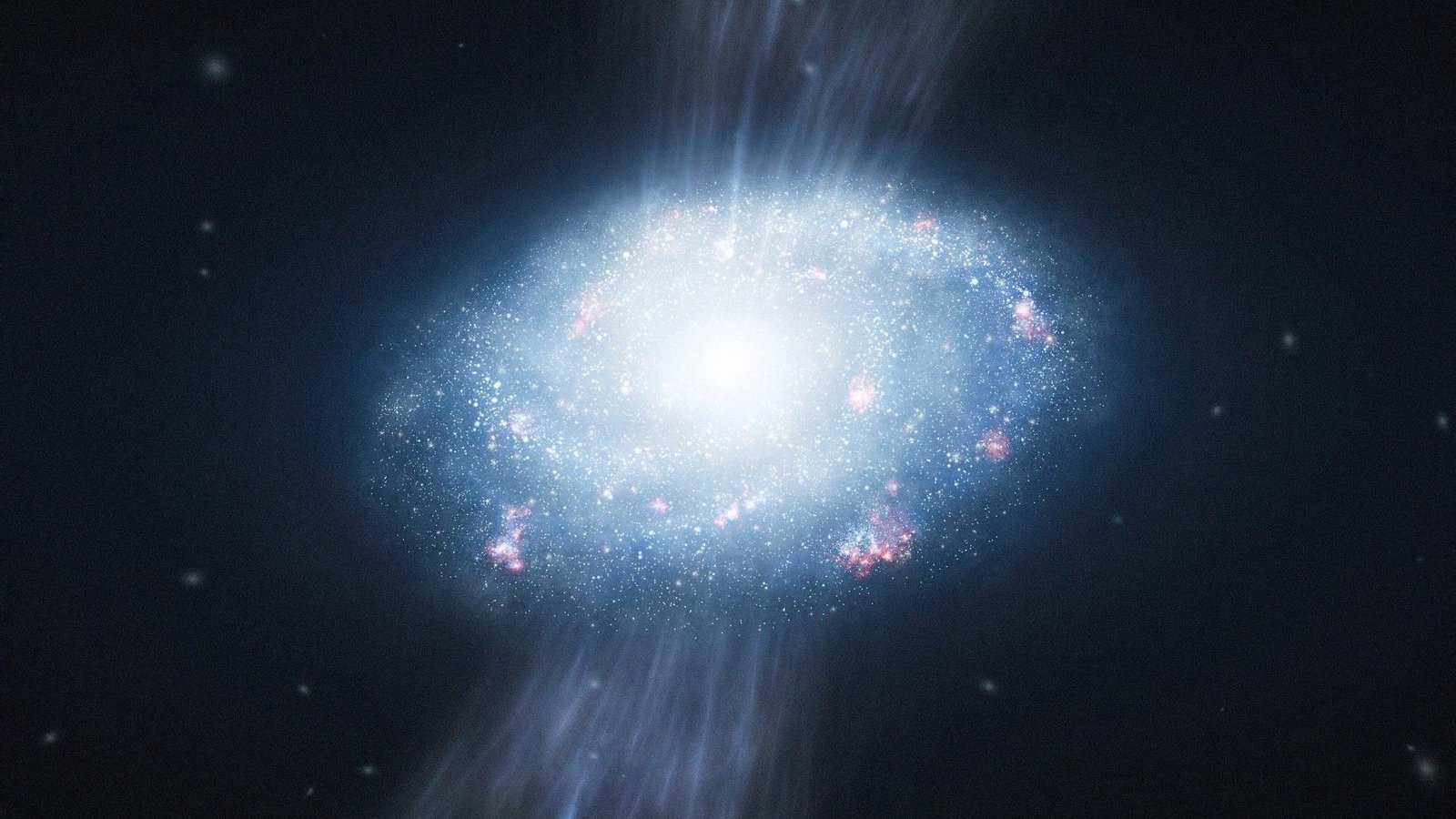
    a red swirl of gas with a central white spiral on a black starry background

    An artist’s impression shows a galaxy in the distant universe, just two billion years after the Big Bang, in the process of pulling in cool gas (shown in orange) from its surroundings. (Image credit: ESO/L. Calçada/ESA/AOES Medialab)

    The paper also rules out a competing explanation. One natural guess is that galaxies above the critical mass simply lose more of their normal matter to outflows from supernovas and active galactic nuclei. The team checked this directly by computing how much of each galaxy’s baryon budget actually stayed bound to the system. The variation turned out to be no more than 30 percent. That isn’t nothing, but it can’t account for the factor-of-three drop in star formation efficiency. The decisive change is on the inflow side, not the outflow side.

    A few caveats are worth flagging. Horizon Run 5 is a simulation, not a telescope, and its results depend on the sub-grid physics used to model star formation, supernovas, and black hole feedback. The authors did sensitivity tests and the basic result holds up, but the precise numerical value of the critical mass scale could shift as those prescriptions improve.

    The analysis also restricts itself to galaxies above 10^10.8 solar masses to make sure each one has enough simulation particles to be reliably resolved. Smaller galaxies are a story for another simulation.

    What makes this work satisfying is that it pins a famous observational pattern to a single, specific physical mechanism. Not just that galaxies above a certain mass quench, but that they quench because their hot gas halos become self-supporting. That is the kind of statement that can be checked against future surveys of galaxy clusters and the warm-hot intergalactic medium, the gas and dust between galaxies.

    We will know whether they got the right answer once those surveys roll in.


    Source link

    Author

    • Admin

      NewsPublicly.com is News & Articles Platform that creating SEO-focused articles on travel, lifestyle, and digital trends.

    Admin
    • Website

    NewsPublicly.com is News & Articles Platform that creating SEO-focused articles on travel, lifestyle, and digital trends.

    Related Posts

    Dinosaur-killing asteroid may have caused firestorms 17 times hotter than the thermal limit lethal to humans

    August 1, 2026

    This Week In Space podcast: Episode 221 — Starship Can Float?

    August 1, 2026

    ‘Flight of the Navigator’ at 40: the Disney space movie that messed with time dilation long before ‘Interstellar’

    August 1, 2026
    Leave A Reply Cancel Reply

    Demo
    Top Posts

    The Blue Moon rises on May 30— Where and when to see the second full moon of the month

    May 30, 202640 Views

    New SOCOM rifle allows barrel swapping and cartridge changes

    June 1, 202633 Views

    “Inside Gemini Robotics 1.5: How Robots Learn to Reason & Act

    November 22, 202527 Views

    525 pounds of cocaine seized after Nebraska K9 alerts troopers on I-80

    May 28, 202624 Views
    Don't Miss

    Anthony Fauci faces state probes after Biden pardon shields him federally

    August 1, 20266 Mins Read0 Views

    Gov Ron DeSantis: Dr. Fauci should be held in contempt Florida Gov. Ron DeSantis discusses…

    Dinosaur-killing asteroid may have caused firestorms 17 times hotter than the thermal limit lethal to humans

    August 1, 2026

    Jessica Pegula vs Diana Shnaider preview, head-to-head, odds, prediction & betting tips

    August 1, 2026

    I’m a Native New Yorker—This Sailing Is One of the Best Ways I’ve Seen the City

    August 1, 2026
    Stay In Touch
    • Facebook
    • Twitter
    • Instagram
    • YouTube
    • LinkedIn
    • WhatsApp

    Subscribe to Updates

    Get the latest creative news from SmartMag about art & design.

    Demo
    NEWSPUBLICLY
    Facebook X (Twitter) Instagram LinkedIn

    Home

    • About Us
    • Leadership
    • Advertise & Partner With Us
    • Pitch Your Story
    • Media Kit & Pricing
    • Career
    • FAQs

    Guidelines

    • Editorial & Submission
    • Partnership
    • Advertising & Sponsor
    • Intellectual Property Policy
    • Community & Comment
    • Security & Data Protection
    • Send Your Opinion

    Quick Links

    • Cookie Policy
    • Payment & Billing Terms
    • Refund & Cancellation
    • Copyright Policy
    • Complaint & Support
    • Sitemap
    • Contact Us

    Subscribe Us

    Get the latest news and updates!

    Copyright © 2026 Newspublicly (DIGITALIX COMMUNICATION). All Rights Reserved.
    • Privacy Policy
    • Terms of Use
    • Disclaimer