

Close Menu

    Subscribe to Updates

    Get the latest news information from worldwide businesses.

    What's Hot

    Some headaches need more than a painkiller: when you need to see a doctor

    June 8, 2026

    New Research Finds ERAS Protocol Speeds Recovery After Pelvic Surgery in Older Women

    June 8, 2026

    44 things coming to your Apple devices that you might have missed

    June 8, 2026
    Facebook Instagram YouTube LinkedIn X (Twitter)
    Trending
    • Some headaches need more than a painkiller: when you need to see a doctor
    • New Research Finds ERAS Protocol Speeds Recovery After Pelvic Surgery in Older Women
    • 44 things coming to your Apple devices that you might have missed
    • Apple bets cheaper AI will woo small developers
    • EU clears continued imports of Indian aquaculture goods
    • Muted returns on market bets steer funds back to banks
    • BofA sees ‘red flags’ in the U.S. stock market. Here’s what to buy now.
    • FM Sitharaman discusses ways to boost growth with Bengal CM
    Newspublicly
    • About Us
    • Advertise & Partner with us
    • Pitch Your Story
    • Contact Us
    Facebook Instagram LinkedIn X (Twitter)
    Subscribe
    • Home
    • World News
      • Asia
      • India
      • USA
      • UK & Europe
      • Middle East
    • Economy & Business
      • Global Economy
      • Corporate & Industry
      • Finance & Markets
      • Policy & Trade
    • Technology
      • Gadgets & Devices
      • Software & Apps
      • AI & Machine Learning
      • Robotics & Automation
    • Health & Medicine
      • Fitness & Nutrition
      • Research & Innovation
      • Disease & Treatment
      • Doctors, Clinics & Patient Care
    • Travel & Tourism
    • Automobile
      • Electric & Hybrid Vehicles
      • Auto Industry Insights
    • Sports
    • More
      • Education
      • Real Estate
      • Environment & Climate
      • Space & Astronomy
      • War & Conflicts
    Newspublicly
    Home»More»Space & Astronomy»Why do Venus and Jupiter meet up in the sky so often? It’s a symptom of a solar system that supports life on Earth
    Space & Astronomy

    Why do Venus and Jupiter meet up in the sky so often? It’s a symptom of a solar system that supports life on Earth

    AdminBy AdminJune 8, 2026No Comments4 Mins Read0 Views
    Share
    Facebook Twitter LinkedIn Copy Link WhatsApp


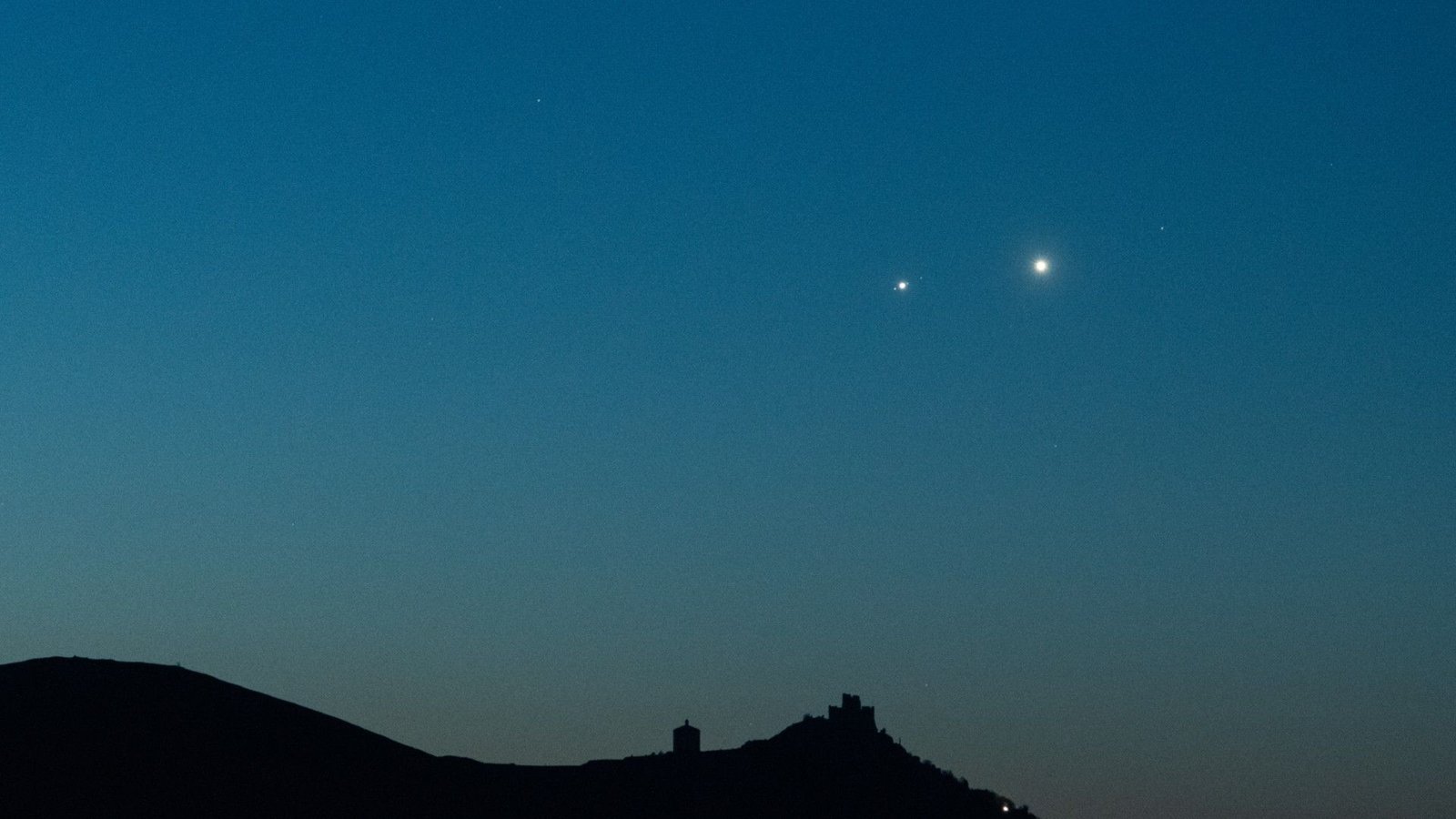
    Shortly after sunset on June 9, Venus and Jupiter will look very close together, in what is known as a planetary conjunction.

    Sunlight will reflect off the cloudy tops of Venus and Jupiter before journeying millions of miles to enter Earth’s sky in almost the same place, making the planets appear very close to one another on Tuesday (June 9). But in reality, the two planets will be separated by at least four Earth-sun distances in space.

    A conjunction between Jupiter and Venus also happened just ten months ago, in August 2025. Before that, in May 2024, preceded by March 2023. Its occurrence roughly once every year is a sign of a wonderful arrangement of planets that may be absent around other stars. And as it turns out, the conditions that set Venus and Jupiter up for their conjunction are the same that are critical for life to survive on Earth.

    ‘Pie’ in the sky

    Thanks to the explosion of exoplanet discoveries over the past decade, planetary scientists like Kat Volk, who works at the Planetary Science Institute in Tucson, Arizona, know there are many distant worlds taking wonky and puffed-up loops around their parent stars. But the solar system is more like a pie of pizza.

    The flat-disk shape means that, although the sky is a huge dome above our heads, the planets can only appear in part of it.


    You may like

    Venus, Jupiter, and their planetary siblings travel in almost concentric circles around the sun. That means that the planets appear just a handful of degrees above or below the sun’s apparent path through the sky, called the ecliptic. (The ecliptic is really the Earth’s orbital plane, but from our perspective it appears as though the sun is in motion.)

    The Earth’s orbital plane is only tilted a little relative to the average plane of the solar system, called the invariable plane, Volk tells Space.com.

    Space

    “That’s why, as we’re watching them in the sky, they’re all kind of following a path along the ecliptic plane.”

    It’s all reflective of how the sun and the planets formed, said Volk.

    “When the sun was being born out of some cloud of gas and dust, it was collapsing down to form the star. Then, angular momentum caused the material surrounding that [star], that didn’t make it into the sun, to form a disk that is rotating and orbiting around the star. The really massive bodies in the solar system  — the planets  — tended to form within that disk,” said Volk.


    What to read next

    two bright dots in the night sky

    A simulated view of the orbits of the planets on June 9, 2026. (Image credit: NASA/JPL-Caltech)

    But no two stars are the same. Some systems deviate significantly from this proto-structure. “If there’s another Earth out there, there’s no guarantee that the observers on that ‘Earth’ would see the same kind of nice ecliptic plane that we see in our solar system.”

    Our cosmic neighborhood is flat and relatively circular, but that is not universal. “The sun isn’t by itself in the galaxy,” said Volk. “A lot of stars form in clusters. Sometimes stars actually interrupt and interact with each other,” which could boot baby planets into a “wider range of inclinations.”

    Larger planetary tilts may have happened in the ancient past to our solar system. But after the gas giants migrated from nearer to the sun to the cold reaches they inhabit today, the inner planets and the remaining mass of small bodies like comets and asteroids likely helped to balance out their orbits.

    As a result, Earth gets to inhabit what’s known as a “dynamically cold” configuration. The planets coast past one another on the ecliptic, and appear to us to nuzzle one another every so often.

    two bright dots in the night sky

    Jupiter and Venus as seen during conjunction over Italy on April 30, 2022. (Image credit: Lorenzo Di Cola/NurPhoto via Getty Images)

    The planetary dance and life on Earth

    These celestial musings are a symptom of a solar system that supports life on Earth. Orbital dynamics control the distance a planet is from the star, and how stable the planet will be throughout its trip.

    Exoplanets with orbits tilted with respect to their invariable plane could disrupt the rest of their system. They could perturb the circular and flat configuration that supports worlds like Earth that have water — an essential ingredient for life as we know it — and the ‘Goldilocks’ distance year round from a star.

    “If our planet’s orbit was really elongated, you’d have different intensities with sunlight throughout the year. That would be an additional complication on the climate,” said Volk.

    “Orbital dynamics allows you to start to think about all those fun, different aspects of what makes our planet habitable, and ask how normal it is to have a habitable planet.”


    Source link

    Author

    • Admin

      NewsPublicly.com is News & Articles Platform that creating SEO-focused articles on travel, lifestyle, and digital trends.

    Admin
    • Website

    NewsPublicly.com is News & Articles Platform that creating SEO-focused articles on travel, lifestyle, and digital trends.

    Related Posts

    James Webb Space Telescope weighs ‘sleeping giant’ black hole from 10 billion light-years away — and it’s 6 billion times our sun’s mass

    June 8, 2026

    ‘Evolution’ at 25: A perfect fusion of ‘Ghostbusters’ and ‘Men in Black’ that’s become a sci-fi comedy classic

    June 8, 2026

    This former Paralympic athlete could become the 1st person with a physical disability to live in orbit

    June 8, 2026
    Leave A Reply Cancel Reply

    Demo
    Top Posts

    The Blue Moon rises on May 30— Where and when to see the second full moon of the month

    May 30, 202640 Views

    New SOCOM rifle allows barrel swapping and cartridge changes

    June 1, 202632 Views

    “Inside Gemini Robotics 1.5: How Robots Learn to Reason & Act

    November 22, 202525 Views

    525 pounds of cocaine seized after Nebraska K9 alerts troopers on I-80

    May 28, 202624 Views
    Don't Miss

    Some headaches need more than a painkiller: when you need to see a doctor

    June 8, 20263 Mins Read0 Views

    Headaches are so common in India that many of us dismiss them without a second…

    New Research Finds ERAS Protocol Speeds Recovery After Pelvic Surgery in Older Women

    June 8, 2026

    44 things coming to your Apple devices that you might have missed

    June 8, 2026

    Apple bets cheaper AI will woo small developers

    June 8, 2026
    Stay In Touch
    • Facebook
    • Twitter
    • Instagram
    • YouTube
    • LinkedIn
    • WhatsApp

    Subscribe to Updates

    Get the latest creative news from SmartMag about art & design.

    Demo
    NEWSPUBLICLY
    Facebook X (Twitter) Instagram LinkedIn

    Home

    • About Us
    • Leadership
    • Advertise & Partner With Us
    • Pitch Your Story
    • Media Kit & Pricing
    • Career
    • FAQs

    Guidelines

    • Editorial & Submission
    • Partnership
    • Advertising & Sponsor
    • Intellectual Property Policy
    • Community & Comment
    • Security & Data Protection
    • Send Your Opinion

    Quick Links

    • Cookie Policy
    • Payment & Billing Terms
    • Refund & Cancellation
    • Copyright Policy
    • Complaint & Support
    • Sitemap
    • Contact Us

    Subscribe Us

    Get the latest news and updates!

    Copyright © 2026 Newspublicly (DIGITALIX COMMUNICATION). All Rights Reserved.
    • Privacy Policy
    • Terms of Use
    • Disclaimer