

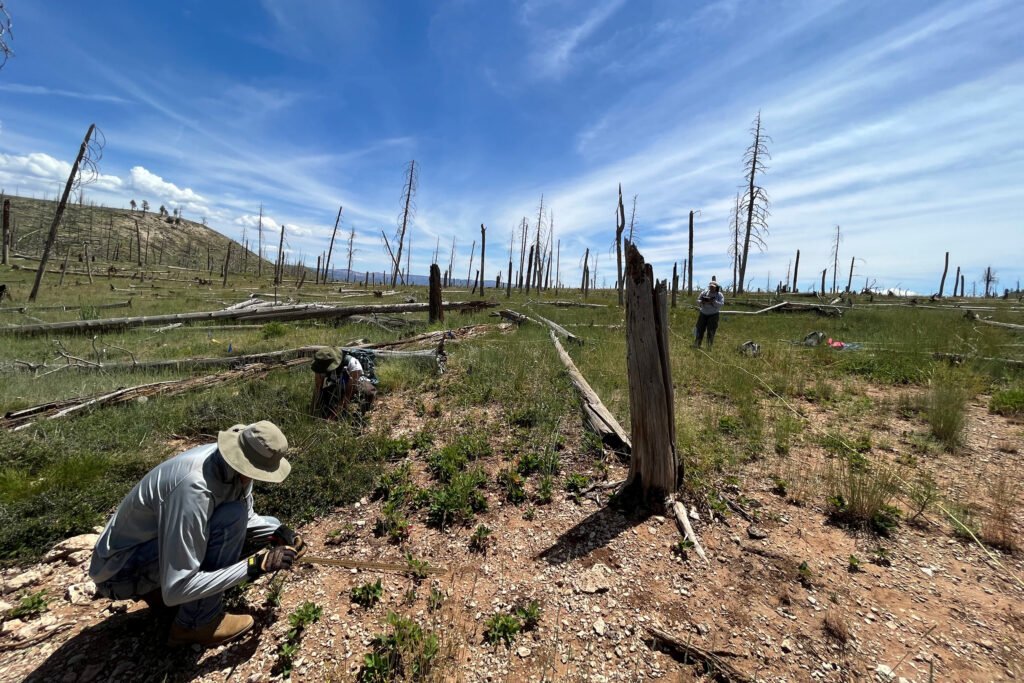
Four years after the Calf Canyon/Hermits Peak Fire burned 341,471 acres in northern New Mexico, the massive burn scar from the most destructive blaze in state history still holds vast stretches of leafless, barren and charred trees.
It’s one of many scorched landscapes across the state—the New Mexico Energy, Minerals and Natural Resources Department (EMNRD) reports that wildland fires have burned more than 5.45 million acres over the past 20 years.
The state is trying to reforest these lands, but it’s been tough going due to the sheer number of seedlings needed and the challenges of planting on burn scars, including often-extreme surface temperatures.
The New Mexico Reforestation Center that broke ground on April 27 in Mora County is slated to eventually produce 5 million seedlings, including ponderosa pine and Douglas fir, each year. But these efforts won’t amount to much if the tiny trees can’t survive the harsh conditions they’ll face when planted: sun, and lots of it, and increasingly drier conditions thanks to climate change.
That’s why researchers from EMNRD, New Mexico Highlands University, New Mexico State University and the University of New Mexico are working together on what they’re calling a “reforestation pipeline,” an interagency approach that addresses each step of the process from seed to tree. These efforts aim to create more successful and climate-resilient seedlings.
“The integrated reforestation pipeline model is one of the things that differentiates New Mexico’s reforestation efforts from other states,” said Jenn Auchter, director of the New Mexico Reforestation Center.
Training Tough Trees
New Mexico used to buy seedlings from a company in Idaho, but the long-distance travel turned out to be yet another stressor that reduced the survival rates of the newborn trees.
“So yes, we’re planting, but are we actually reforesting?” Auchter said.
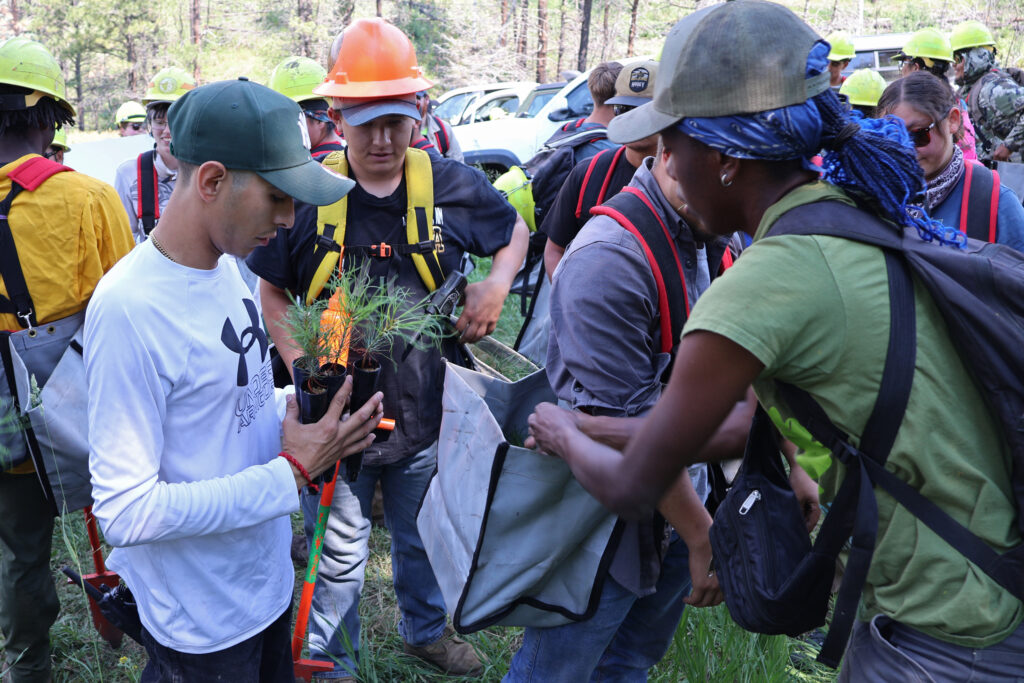
Now the state produces its own seedlings, to the tune of about 300,000 each year, at New Mexico State University’s John T. Harrington Forestry Research Center in Mora. The reforestation center, which will be located on the same campus, is slated to produce 1 million seedlings for reforestation in the fall of 2028 and 5 million annually after that.
Contractors collect and bag pine cones. Credit: Courtesy of Pouli Sikelianos/NMHU
But before seedling comes seed. Researchers from New Mexico Highlands University start scouting for mature pine cones in forests all over the state in the spring. They’re looking for what they call the “best trees on the worst site,” to find seeds from trees of various species that have already survived drought, wildfire or temperature extremes.
Contractors bag pine cones, which are sent to the seed shop, where they are dried and the seeds are separated from the cones. In 2024, they collected 12 million seeds.
Next, the researchers perform germination testing. Samples are also sent to the US Forest Service National Seed Laboratory, which tests and certifies the seeds’ genetic identity and physical quality. Eventually, seeds from that spring’s pine cone harvest reach the Harrington Center for nursery production.
This is where Andrei Toca, a research scientist at the center, toughens seedlings up so that they’re better prepared for the extreme conditions they’ll face outside, particularly drought and heat.
Ground temperatures can reach up to 150 degrees on burn scars, Toca said. Not only do they get hit hard with sun due to lack of shade, but the dark, charred surface absorbs much more solar radiation than light-colored or plant-covered terrain. Meanwhile, the state faces ongoing aridity—approximately 94 percent of the state was experiencing drought conditions as of May 12. This includes drier winters, which rob seedlings of insulating snow, making it more difficult for them to survive the winter.
Toca and his team are exposing seedlings to controlled drought, which causes them to create a larger root system that can absorb more underground moisture, and cuts the number of needles they produce, reducing the tree’s surface area to minimize water loss. The scientists also strategically expose seedlings to warmer temperatures in the nursery.
“Generally, nurseries grow seedlings under optimal conditions where they would grow just like in your garden, like very nice, very lush, green and large seedlings,” Toca said. “Well, that’s not ideal necessarily for the burn scars. What we are trying to do is introduce those seedlings to the very stress factors that they will face later on.”
Model Conditions
The next part of the pipeline hones in on ideal locations to plant seedlings once they’re ready. Matt Hurteau, a professor at the University of New Mexico and director of the Center for Fire Resilient Ecosystems and Society, leads these efforts.
“Plant and seedling survival in these wildfire footprints across the Southwest has averaged about 25 percent,” he said. ”What we’ve been doing is a years-long campaign to try and figure out how to improve those numbers.”
In 2016, Hurteau planted ponderosa pines and several other species under a range of different conditions in the footprint of the 2011 Las Conchas fire in the Jemez Mountains to better understand how the trees’ survival varied. He used information from that research to build a model that predicts the likelihood that a planted seedling will survive in various positions on a particular landscape. The model considers incoming solar radiation, or how much of the sun’s rays hit a patch of ground, which is influenced by factors such as the steepness of a slope and the direction it is facing, along with other topographic information such as a planting site’s position on the slope or whether it’s in, say, a gully.
This story is funded by readers like you.
Our nonprofit newsroom provides award-winning climate coverage free of charge and advertising. We rely on donations from readers like you to keep going. Please donate now to support our work.
He says the model can predict the chance that a planted seedling will survive with about 63 percent accuracy. He and his team have produced maps for the Hermits Peak/Calf Canyon Fire’s footprint, which land managers can use to decide when and where to plant. So far, the model is limited to ponderosa pine, one of the most commonly transplanted species, but Hurteau said it could be replicated for use with other types of trees.
Hurteau has found that when planted in middle or lower elevation ranges, ponderosa pine seedlings fare the worst on south, southeast, southwest and west-facing slopes because they’re exposed to too much solar radiation.
“They’re much hotter and drier than, say, slopes that are northwest to northeast, maybe even east facing,” Hurteau said.
Areas that are more likely to accumulate water see higher survival rates, he added.
Since the first experiment, Hurteau and his team have planted another 10,000 seedlings in the burn scar of the 2011 Las Conchas Fire in the Jemez Mountains and the 2020 Luna Fire footprint northwest of Mora. Other test seedlings have been planted at the Philmont Scout Ranch near the Colorado border, where a fire burned in 2018.
But the trees that once grew in fire affected landscapes might not be the best to transplant to reforest those areas.
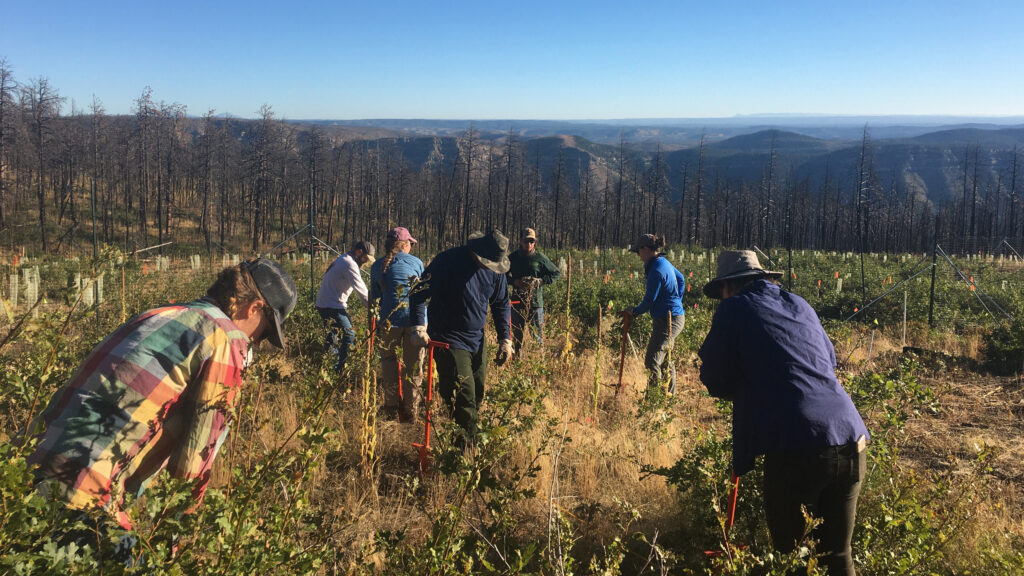
Hurteau thinks that scientists and planners might need to start considering integrating drought- and fire-tolerant species that are currently found further south into more northern areas of the state.
“We tend to limit ourselves reforestation-wise to species that occur within the area,” he said, adding that because of the lengthy nature of reforestation, Southwestern states need to be looking at longer-term solutions.
For instance, the Chihuahuan pine, which grows in southern New Mexico and southern Arizona, might do well further north in both states.
“That species has got different adaptations to fire and different adaptations to drought and could be a good candidate for establishing in these landscapes that are likely to burn with more frequency in the future and are going to become hotter and drier,” Hurteau said.
Race Against Time
Advocates of New Mexico’s reforestation efforts say they come at a crucial time.
“Over the last 15 years, we’ve seen fires get larger, burn larger areas, burn at higher intensities, and do a lot more damage in terms of the threats to downstream communities from post-fire flooding or from loss of water supplies when reservoirs are choked with post-fire sediment,” said Steve Bassett, director of conservation programs for The Nature Conservancy in New Mexico, which partners with more than 100 organizations on large-scale forest and watershed restoration efforts in northern New Mexico and southern Colorado through its Rio Grande Water Fund.
In the wake of the Calf Canyon/Hermits Peak Fire, for instance, residents of nearby Las Vegas, New Mexico, had their water shut off when the blaze contaminated the city’s only supply with ash and other debris. Restaurants and hotels closed and “it had a terrible effect on the local community,” Bassett said.
Burn scars are more prone to flash flooding, he added.
“The clock is ticking,” Bassett said. “Every year that passes, we’re setting our forests back by not being able to seize the moment.”
“Certainly it will take some time for the reforestation center to get up to its full capacity, but the sooner we can get there, the better,” he added. “We have a huge backlog from the 7 million acres of [forests] that have already burned, and we know that’s not going to stop. There are going to be future fires, and so that backlog will just continue to grow.”
About This Story
Perhaps you noticed: This story, like all the news we publish, is free to read. That’s because Inside Climate News is a 501c3 nonprofit organization. We do not charge a subscription fee, lock our news behind a paywall, or clutter our website with ads. We make our news on climate and the environment freely available to you and anyone who wants it.
That’s not all. We also share our news for free with scores of other media organizations around the country. Many of them can’t afford to do environmental journalism of their own. We’ve built bureaus from coast to coast to report local stories, collaborate with local newsrooms and co-publish articles so that this vital work is shared as widely as possible.
Two of us launched ICN in 2007. Six years later we earned a Pulitzer Prize for National Reporting, and now we run the oldest and largest dedicated climate newsroom in the nation. We tell the story in all its complexity. We hold polluters accountable. We expose environmental injustice. We debunk misinformation. We scrutinize solutions and inspire action.
Donations from readers like you fund every aspect of what we do. If you don’t already, will you support our ongoing work, our reporting on the biggest crisis facing our planet, and help us reach even more readers in more places?
Please take a moment to make a tax-deductible donation. Every one of them makes a difference.
Thank you,