

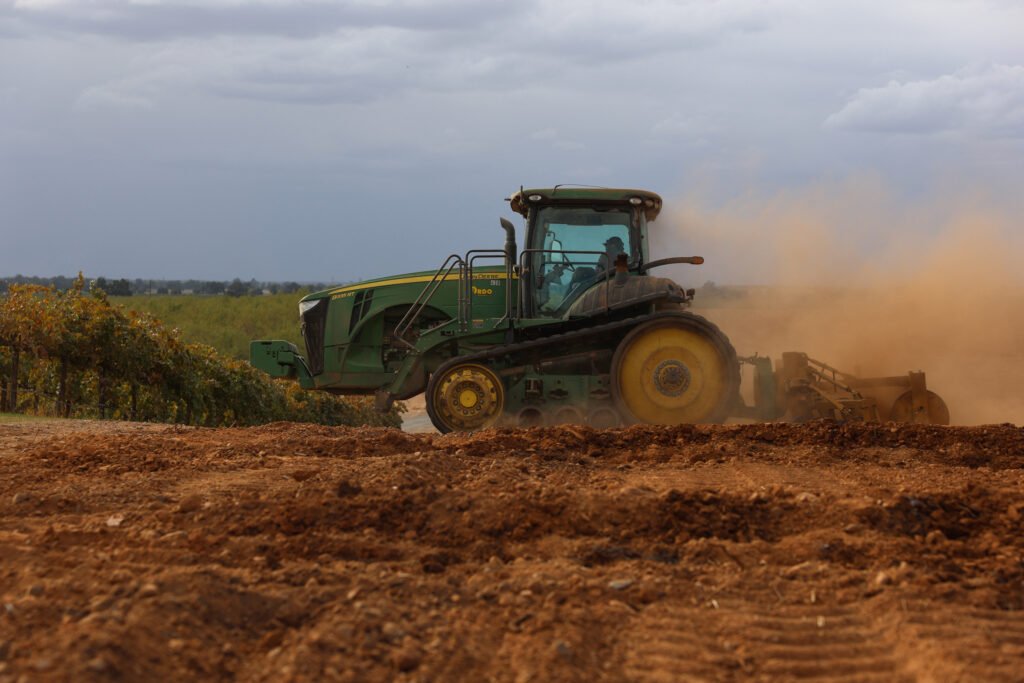
California regulators passed a rule in January 2024 that they said would protect communities from one of the state’s most popular, and dangerous, pesticides.
For decades, they knew that 1,3-dichloropropane, or 1,3-D, causes tumors in multiple organs in laboratory animals, which led the state to flag it as a carcinogen in 1989. Yet regulators allowed growers to fumigate fields with large volumes of 1,3-D to kill anything living in the soil before planting strawberries, almonds, grapes and other billion-dollar crops.
But now, a year after regulators implemented a rule they said would reduce cancer risk by decreasing the amount of 1,3-D in the air, applications of the highly volatile compound have spiked, state records show.
Growers applied a million more pounds of 1,3-D last year than they did in either 2023, before regulators enacted the “residential bystander” rule, or in 2024, after they implemented it.
Increases were highest in Kern and San Joaquin counties, where it was used mostly on almond and grape plantings. Notably, the “adjusted total pounds”—which accounts for different application methods, weather conditions and other factors that affect how much of the volatile pesticide escapes into the air—nearly doubled in both counties and increased by almost 20 percent statewide.
“Their new regulations are failures,” said Mark Weller, the campaign director for the statewide public-interest group coalition Californians for Pesticide Reform. “They put in new regulations and 1,3-D use went up.”
The Department of Pesticide Regulation (DPR) enacted new rules in 2024 to restrict the use of 1,3-D to protect residential bystanders by implementing setback distances, requiring deeper injection in soil with higher moisture content, along with new fumigation methods and tarp requirements to reduce fumigant emissions into the atmosphere, said agency spokesperson Amy MacPherson. “DPR specifically developed methods that could allow for comparable levels of use while reducing overall emissions.”
Anne Katten, pesticide and work health and safety project director for the nonprofit California Rural Legal Assistance Foundation, analyzed emissions detected at an air monitor in Delhi, California, one of six monitors operated by DPR. Katten found a 30 percent increase in average levels of 1,3-D in the air during the first three quarters of 2025 (the most recent publicly available data) compared to the same period in 2024.
Delhi is a largely Latino town in Merced County, where the $10 billion agriculture industry employs one in five residents and farmers primarily use 1,3-D to grow almonds and sweet potatoes. Merced is also where regulators detected alarmingly high levels of 1,3-D at a junior high school in 1990 and suspended its use for five years.
Public health policy assumes that there is no safe level of exposure to a carcinogen, to account for disparities in exposure and variable susceptibility across different populations. Fumigants like 1,3-D can also produce severe short-term symptoms, including respiratory distress, chest pains, eye irritation and dizziness.

In 2023, researchers in China reported what they believed to be the first death from inhaling 1.3-D, which commonly causes nausea, dizziness and headaches in exposed California farmworkers. A 50-year-old Chinese greenhouse worker died of renal failure and brain swelling more than a week after a brief encounter with 1,3-D in a poorly ventilated workspace.
1,3-D is now banned in 40 countries, according to Pesticide Action Network International.
The whole point of the regulations was not necessarily to reduce 1,3-D use but to reduce emissions, said Caroline Cox, a retired pesticide scientist and former research director at the nonprofit Center for Environmental Health. “It just doesn’t seem like the regulations are really doing what they were designed to do.”
Farmworker communities and their allies have tried lawsuits, media campaigns and die-in protests to compel pesticide regulators to protect them from 1,3-D. In February, they returned to court to seek relief from DPR’s “continued failure to meet its legal obligations to protect farmworkers and other members of the public from … a toxic, cancer-causing fumigant.”
DPR now has two separate safety levels for the same chemical, the 2024 residential bystander rule and another rule for occupational bystanders, which went into effect at the beginning of 2026. Having two different 1,3-D regulatory targets for residents and workers does not account for the fact that farmworker communities, where people live and work next to treated fields, typically face much higher exposure risks from childhood to old age.
This story is funded by readers like you.
Our nonprofit newsroom provides award-winning climate coverage free of charge and advertising. We rely on donations from readers like you to keep going. Please donate now to support our work.
“Both regulations miss the mark and allow for the continued use of 1,3-D in a way that neither satisfies DPR’s mandatory legal obligations nor sufficiently protects public health,” farmworker and community advocates argued in their legal brief.
Before enacting the new rules, DPR capped the amount of 1,3-D growers could apply within a roughly 36-square-mile area called a township. DPR did not include a township cap in the 2024 regulations because agency officials expected the setbacks and other additional requirements to mitigate both acute and cancer risks. Still, the cap remained in place, due to a court order, until January, when the occupational bystander rule went into effect.
One township in Kern County already exceeded the previously required annual township cap, and several in Kern and Merced counties are approaching it, in just the first quarter of this year, state records show. As a 2024 Inside Climate News analysis found, the disproportionate burden of pesticide exposure falls on immigrants with limited English proficiency—which describes the majority of California’s farmworker population.
DPR’s MacPherson attributed increased applications of 1,3-D to “unusually high replanting of vineyards and orchards in Kern County, which only occurs about once every 10 to 20 years.”
DPR is monitoring areas with relatively high use in the first quarter, she said, but needs to see a full year of data before drawing “meaningful conclusions.”
DPR released a plan to accelerate sustainable pest management in 2024 with a top goal of eliminating the adverse human health and environmental impacts associated with pesticide use. It does not include a list of priority pesticides.
Seeing elevated emissions of 1,3-D after regulators removed the cap troubles Katten at the California Rural Legal Assistance Foundation. “They were saying everything was going to be OK because things were on a downward trend, and they clearly aren’t,” Katten said. “Their sustainable pest management efforts are not bearing fruit yet.”
At a recent meeting with DPR, Weller told staff members the agency used to be committed to reducing fumigant use in California. “Are you still interested in that?” he asked.
No one answered yes, he said.
About This Story
Perhaps you noticed: This story, like all the news we publish, is free to read. That’s because Inside Climate News is a 501c3 nonprofit organization. We do not charge a subscription fee, lock our news behind a paywall, or clutter our website with ads. We make our news on climate and the environment freely available to you and anyone who wants it.
That’s not all. We also share our news for free with scores of other media organizations around the country. Many of them can’t afford to do environmental journalism of their own. We’ve built bureaus from coast to coast to report local stories, collaborate with local newsrooms and co-publish articles so that this vital work is shared as widely as possible.
Two of us launched ICN in 2007. Six years later we earned a Pulitzer Prize for National Reporting, and now we run the oldest and largest dedicated climate newsroom in the nation. We tell the story in all its complexity. We hold polluters accountable. We expose environmental injustice. We debunk misinformation. We scrutinize solutions and inspire action.
Donations from readers like you fund every aspect of what we do. If you don’t already, will you support our ongoing work, our reporting on the biggest crisis facing our planet, and help us reach even more readers in more places?
Please take a moment to make a tax-deductible donation. Every one of them makes a difference.
Thank you,

Reporter, California
Liza Gross is a reporter for Inside Climate News based in Northern California. She is the author of The Science Writers’ Investigative Reporting Handbook and a contributor to The Science Writers’ Handbook, both funded by National Association of Science Writers’ Peggy Girshman Idea Grants. She has long covered science, conservation, agriculture, public and environmental health and justice with a focus on the misuse of science for private gain. Prior to joining ICN, she worked as a part-time magazine editor for the open-access journal PLOS Biology, a reporter for the Food & Environment Reporting Network and produced freelance stories for numerous national outlets, including The New York Times, The Washington Post, Discover and Mother Jones. Her work has won awards from the Association of Health Care Journalists, American Society of Journalists and Authors, Society of Professional Journalists NorCal and Association of Food Journalists.