

Close Menu

    Subscribe to Updates

    Get the latest news information from worldwide businesses.

    What's Hot

    Orforglipron Added to Insulin Glargine Improves Glycemic Control and Reduces Weight in Uncontrolled Type 2 Diabetes: ACHIEVE-5 Trial

    June 8, 2026

    Weis Markets adds Instacart AI-powered shopping carts to stores

    June 8, 2026

    Inflation poses bigger risk than growth this fiscal as monsoon and crude weigh on rural demand: Nuvama

    June 8, 2026
    Facebook Instagram YouTube LinkedIn X (Twitter)
    Trending
    • Orforglipron Added to Insulin Glargine Improves Glycemic Control and Reduces Weight in Uncontrolled Type 2 Diabetes: ACHIEVE-5 Trial
    • Weis Markets adds Instacart AI-powered shopping carts to stores
    • Inflation poses bigger risk than growth this fiscal as monsoon and crude weigh on rural demand: Nuvama
    • Smartworks leases 400 seats to Japanese NBFC subsidiary in Mumbai
    • My golf buddy worked as a financial adviser. Here’s how I really knew his friendship was fake.
    • 100 days of Iran war: India must brace for broad-based economic shock
    • Time and Water review – Iceland’s doomed glacier tells its own story of climate disaster | Film
    • Letter to CJI, resignation of education minister: INDIA bloc meeting concludes with consensus on 5 issues | India News
    Newspublicly
    • About Us
    • Advertise & Partner with us
    • Pitch Your Story
    • Contact Us
    Facebook Instagram LinkedIn X (Twitter)
    Subscribe
    • Home
    • World News
      • Asia
      • India
      • USA
      • UK & Europe
      • Middle East
    • Economy & Business
      • Global Economy
      • Corporate & Industry
      • Finance & Markets
      • Policy & Trade
    • Technology
      • Gadgets & Devices
      • Software & Apps
      • AI & Machine Learning
      • Robotics & Automation
    • Health & Medicine
      • Fitness & Nutrition
      • Research & Innovation
      • Disease & Treatment
      • Doctors, Clinics & Patient Care
    • Travel & Tourism
    • Automobile
      • Electric & Hybrid Vehicles
      • Auto Industry Insights
    • Sports
    • More
      • Education
      • Real Estate
      • Environment & Climate
      • Space & Astronomy
      • War & Conflicts
    Newspublicly
    Home»More»Space & Astronomy»‘Hot Jupiter’ winds blasting at over 15,000 mph reveal 1st evidence of exoplanets with magnetic fields
    Space & Astronomy

    ‘Hot Jupiter’ winds blasting at over 15,000 mph reveal 1st evidence of exoplanets with magnetic fields

    AdminBy AdminJune 2, 2026No Comments5 Mins Read0 Views
    Share
    Facebook Twitter LinkedIn Copy Link WhatsApp


    Astronomers have discovered the first evidence of magnetic fields around planets beyond the solar system, and they did so by studying the worlds’ high-speed, violent winds. This marks the first direct measurement of exoplanet magnetic field strength, and represents a major step forward in exoplanet research.

    Because life on Earth was made possible thanks to our planet’s magnetosphere protecting it from harmful solar radiation, the research could also be beneficial to the hunt for life beyond the solar system.

    Using the Very Large Telescope (VLT) and the Gemini North telescope, the team behind this discovery measured the speed of winds of seven extremely hot Jupiter-like gas giant exoplanets that are tidally locked to their stars, meaning they have a permanently raging hot “dayside” and a cooler, space-facing “nightside.” The team found winds racing at speeds of between 4,470 miles per hour (7,194 kilometers per hour) and a staggering 15,530 mph (24,993 kph). For comparison, the fastest winds recorded on our solar system’s Jupiter reached only around 930 mph (1,496 kph). The scientists think it is the magnetic fields of these exoplanets that are governing these winds.


    You may like

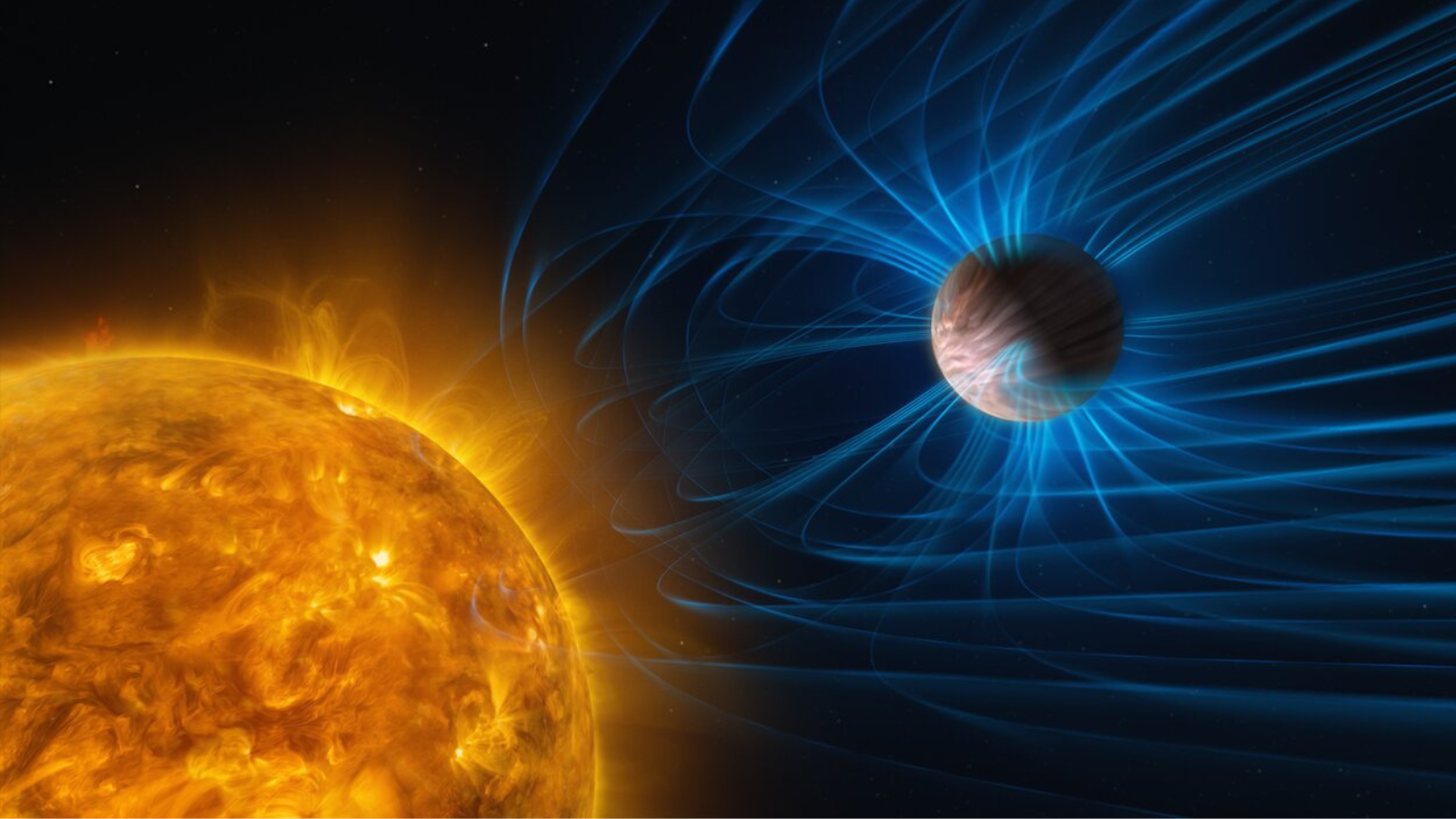
    A star in the foreground with a planet toward the left with magnetic fields shown around it in blue.

    This illustration shows magnetic activity in an exoplanet. (Image credit: ESO/M. Kornmesser, L. Calçada)

    Astronomers have discovered the first evidence of magnetic fields around planets beyond the solar system, and they did so by studying the worlds’ high-speed, violent winds. This marks the first direct measurement of exoplanet magnetic field strength, and represents a major step forward in exoplanet research.

    Because life on Earth was made possible thanks to our planet’s magnetosphere protecting it from harmful solar radiation, the research could also be beneficial to the hunt for life beyond the solar system.

    Using the Very Large Telescope (VLT) and the Gemini North telescope, the team behind this discovery measured the speed of winds of seven extremely hot Jupiter-like gas giant exoplanets that are tidally locked to their stars, meaning they have a permanently raging hot “dayside” and a cooler, space-facing “nightside.” The team found winds racing at speeds of between 4,470 miles per hour (7,194 kilometers per hour) and a staggering 15,530 mph (24,993 kph). For comparison, the fastest winds recorded on our solar system’s Jupiter reached only around 930 mph (1,496 kph). The scientists think it is the magnetic fields of these exoplanets that are governing these winds.

    “This breakthrough opens a completely new window on exoplanet research. It’s the first time we can compare the magnetic environments of other worlds — a key step toward ultimately understanding which planets can stay alive, keep their water, and perhaps even, one day, host life as we know it,” team member Julia Seidel, an astronomer at the Laboratoire Lagrange, Observatoire de la Côte d’Azur, France, said in a statement.

    Space

    The hotter the planet, the more savage its winds

    The team wasn’t even really thinking about magnetic fields starting this research. The initial aim was to discover if all hot planets had winds that behaved the same. However, the researchers’ curiosity was piqued when they discovered that wind speeds seemed to vary with the temperature of a planet. Strangely, the team found that the cooler the world was, the faster and more violent its winds were.

    “This is totally counterintuitive because, all things being equal, hot planets have more energy to accelerate the winds!” team member Vivien Parmentier said in the statement. “Something must happen that slows down the wind speeds for hotter objects.”

    An illustration showing four planets with different temperatures and wind speeds. The bottom two have magnetic fields shown in blue.

    The planets shown here are gas giants like Jupiter, but they are tidally locked: one side is constantly facing the star and is therefore much hotter than the other side. This temperature difference drives powerful winds from the day side to the night side. We expect these winds to be faster on planets that are hotter overall, as they have more energy to power the winds. This is shown in the top row of the diagram: the hotter planet to the right has faster winds, indicated here with a speed meter. In the bottom row of the diagram, the hotter planet to the right has slower winds than the colder planet. (Image credit: ESO/M. Kornmesser, L. Calçada)

    Parmentier and colleagues concluded that this counterintuitive, inverse relationship between temperature and wind speed was the result of global magnetic fields on these worlds. These fields work as a brake, slowing down charged particles. That means wind speeds could be used to infer the strength of these exoplanets’ magnetic fields.

    The team found the seven exoplanets had magnetic fields around four times as strong as that of the solar system gas giant Saturn and around half the strength of the magnetic field of Jupiter. This means these worlds could also feature stunning and dramatic colorful auroras that put Earth’s northern and southern lights in the shade.

    “Here on Earth, we know the beauty of the northern and southern lights, where particles from the sun hit our magnetic field and are guided toward the poles, colliding with gases in the atmosphere to produce colourful displays of green, pink, and purple,” team member Bibiana Prinoth of the European Southern Observatory (ESO) in Garching, Germany, said in the statement. “I like to imagine that some of these worlds have a sky filled not only with stars, but with vast curtains of colourful light dancing across a planet that’s half in perpetual day and half in endless night.”

    The team’s research was published on Tuesday (June 2) in the journal Nature Astronomy.


    Source link

    Author

    • Admin

      NewsPublicly.com is News & Articles Platform that creating SEO-focused articles on travel, lifestyle, and digital trends.

    Admin
    • Website

    NewsPublicly.com is News & Articles Platform that creating SEO-focused articles on travel, lifestyle, and digital trends.

    Related Posts

    Trouble near the Milky Way: The Large Magellanic Cloud is ripping its smaller neighbor galaxy apart

    June 7, 2026

    10 best Spanish beaches to see the total solar eclipse 2026

    June 7, 2026

    ‘Rick and Morty’ creators on their inspirations as season 9 tackles the multiverse, evolution, and a kung-fu fight in a Trader Joe’s parking lot (interview)

    June 7, 2026
    Leave A Reply Cancel Reply

    Demo
    Top Posts

    The Blue Moon rises on May 30— Where and when to see the second full moon of the month

    May 30, 202640 Views

    New SOCOM rifle allows barrel swapping and cartridge changes

    June 1, 202632 Views

    “Inside Gemini Robotics 1.5: How Robots Learn to Reason & Act

    November 22, 202525 Views

    525 pounds of cocaine seized after Nebraska K9 alerts troopers on I-80

    May 28, 202624 Views
    Don't Miss

    Orforglipron Added to Insulin Glargine Improves Glycemic Control and Reduces Weight in Uncontrolled Type 2 Diabetes: ACHIEVE-5 Trial

    June 8, 20261 Min Read0 Views

    Orforglipron Added to Insulin Glargine Improves Glycemic Control and Reduces Weight in Uncontrolled Type 2…

    Weis Markets adds Instacart AI-powered shopping carts to stores

    June 8, 2026

    Inflation poses bigger risk than growth this fiscal as monsoon and crude weigh on rural demand: Nuvama

    June 8, 2026

    Smartworks leases 400 seats to Japanese NBFC subsidiary in Mumbai

    June 8, 2026
    Stay In Touch
    • Facebook
    • Twitter
    • Instagram
    • YouTube
    • LinkedIn
    • WhatsApp

    Subscribe to Updates

    Get the latest creative news from SmartMag about art & design.

    Demo
    NEWSPUBLICLY
    Facebook X (Twitter) Instagram LinkedIn

    Home

    • About Us
    • Leadership
    • Advertise & Partner With Us
    • Pitch Your Story
    • Media Kit & Pricing
    • Career
    • FAQs

    Guidelines

    • Editorial & Submission
    • Partnership
    • Advertising & Sponsor
    • Intellectual Property Policy
    • Community & Comment
    • Security & Data Protection
    • Send Your Opinion

    Quick Links

    • Cookie Policy
    • Payment & Billing Terms
    • Refund & Cancellation
    • Copyright Policy
    • Complaint & Support
    • Sitemap
    • Contact Us

    Subscribe Us

    Get the latest news and updates!

    Copyright © 2026 Newspublicly (DIGITALIX COMMUNICATION). All Rights Reserved.
    • Privacy Policy
    • Terms of Use
    • Disclaimer