

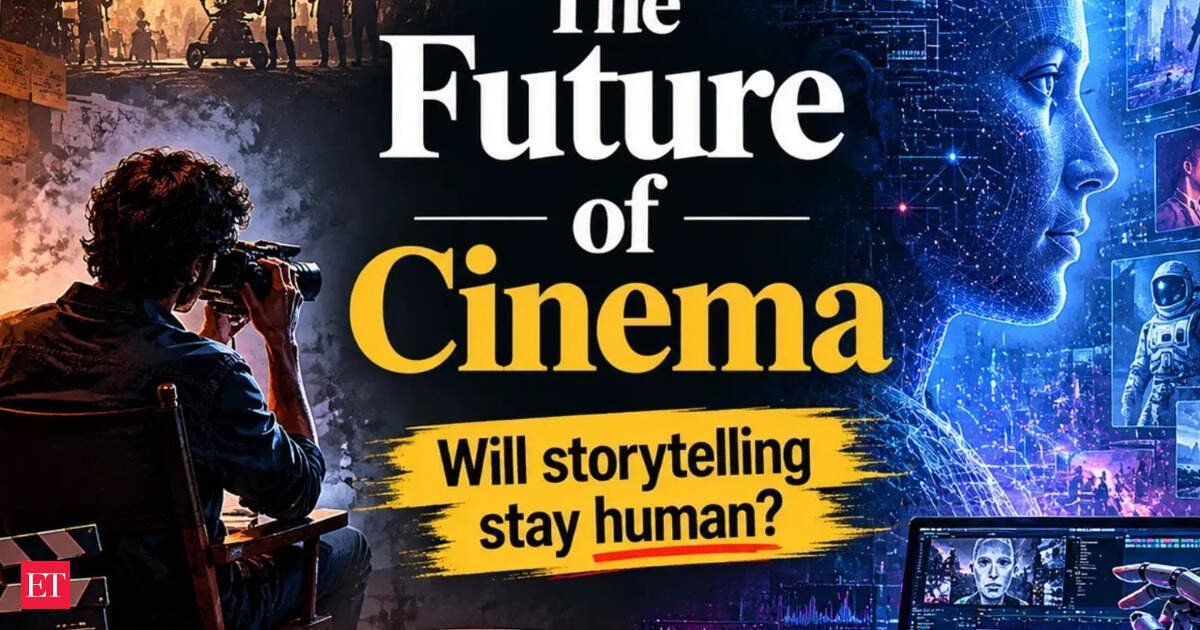
Now, a similar anxiety is emerging around storytelling itself.
Also Read: From bit role, AI’s now the hero of entertainment industry
As artificial intelligence (AI) rapidly enters the entertainment industry, filmmakers, writers, actors and executives are confronting an uncomfortable possibility: what happens when stories are no longer driven primarily by human creativity, but by systems optimised for scale, speed, engagement and intellectual property extraction?
That future is already taking shape.

More than a decade after the release of Raanjhanaa — a tragic romance that became a cult favourite — producer Eros International released a new version of the film in August last year, where the protagonist survives at the end. The altered cut used AI to replace Dhanush’s death scene with a hospital-bed recovery sequence.
The backlash was immediate. Director Aanand L. Rai said the alternate ending had “stripped the film of its soul,” while Dhanush warned that such interventions threatened “the integrity of storytelling and the legacy of cinema.”But audiences still showed up. According to a 2026 Reuters investigation, 35% of available tickets for the Tamil AI-altered re-release were sold during its release month — 12 percentage points higher than the Indian box office occupancy average that year. Encouraged by that response, Eros Media World is now reportedly reviewing its 3,000-title catalogue to identify films suitable for AI-assisted adaptation and alternate endings.
For years, the debate around AI in entertainment has revolved around a familiar fear: will AI replace writers, actors and filmmakers? But that question may already be outdated.

According to The New York Times, China has entirely AI-generated “microdramas” that are now being produced with no actors, no cameras and almost no crews. In India, filmmakers are using AI to compress years of production work into months. Streaming platforms are deploying voice cloning and AI dubbing tools across languages at industrial scale. And in Hollywood, where resistance to AI remains strongest, even the Oscars have been forced to define what counts as “human” creativity.
The question is no longer whether AI will reshape storytelling. It already has.
The invisible takeover
According to a January 2026 McKinsey report, studios and production houses are already using AI tools that can break down scripts, generate shot lists, estimate budgets, visualise scenes, localise dialogue and automate editing tasks. Executives interviewed for the report said some companies were already seeing productivity gains of 5-10% in certain workflows.
In practical terms, work that once took days can now be done in hours.
AI-assisted tools are helping writers generate alternate story ideas, storyboard artists create visual references, editors sift through footage faster and VFX teams automate repetitive tasks. Streaming platforms are increasingly using machine learning not just to predict what audiences want to watch, but what kinds of stories are most likely to succeed commercially.
Some of these changes are subtle enough that audiences may never notice them.
That invisibility is partly why AI has advanced so quickly inside entertainment. And economics, more than artistic philosophy, is driving this transition.
India’s AI storytelling experiments
If Hollywood represents caution, India increasingly represents acceleration.
A Reuters investigation published earlier this year described Bengaluru AI studios where the noise of traditional film sets has been replaced by “the quiet hum of a coding floor.” At Collective Artists Network, filmmakers are already generating large-scale mythology projects using AI tools, including adaptations of the Ramayana and Mahabharata.
The economics are hard to ignore.
“AI is slashing production costs to one-fifth of what they used to be for traditional filmmaking in genres such as mythology and fantasy,” Rahul Regulapati, head of Collective’s AI studio Galleri5, was quoted by Reuters as saying. Production timelines, he added, have fallen to roughly a quarter of previous schedules.
Part of the reason India is moving so aggressively is economic pressure.
India remains the world’s largest film-producing country, but audience behaviour has changed dramatically after the pandemic. Reuters reported that annual moviegoing fell to 832 million admissions in 2025 from more than 1 billion in 2019, even as studios became increasingly dependent on a handful of blockbuster hits and rising ticket prices.
AI offers something the industry desperately wants right now — scale at lower cost and quicker than ever before.
Consulting firm EY estimates AI could increase revenue for Indian media and entertainment companies by 10% while reducing costs by 15% over the medium term.
Unlike Hollywood, India also lacks strong entertainment unions capable of slowing or regulating adoption. In the US, the 2023 strikes by the Writers Guild of America and SAG-AFTRA were partly driven by fears over AI replacing creative labour. In India, studios are moving much faster.
Why studios are betting on AI anyway
Streaming fractured audiences. Social media shattered attention spans. Content costs continue to rise while profit margins tighten.
The McKinsey report estimates that AI could influence roughly 20% of original content spending within the next five years. AI-driven disruption could redistribute as much as $60 billion in annual industry revenue after widespread adoption.
For producers, the appeal is obvious.
Why spend months and massive budgets on physical sets, localisation and animation when AI can do these digitally and dramatically compress production timelines?
Also Read: Amazon greenlights AI-generated shows for children
Some argue that AI is doing something even more fundamental. It is changing the economics of creative risk itself.
“The cost of taking risk has fundamentally changed,” Dipankar Mukherjee, co-founder & CEO, Studio Blo, told ET Online. The Mumbai-based company had recently announced AI-generated projects with filmmaker Shekhar Kapur and Hollywood collaborators.
“Stories that were riskier to fund, locations that were logistical nightmares, creative decisions that impacted the bottom line — all of that is becoming possible because of AI,” Mukherjee said.
Vikram Malhotra, founder of Abundantia Entertainment, was quoted by Reuters as saying that content generated or assisted by AI could account for one-third of the company’s revenue within three years.
The shift is attracting global technology companies too.
Google has partnered with Bollywood director Shakun Batra to experiment with AI-powered filmmaking using Veo video-generation tools. Microsoft is providing AI computing infrastructure for Collective’s projects, while Nvidia executives have appeared at India’s emerging AI film festivals promising to reduce computing costs for creators.
The future entertainment industry may increasingly belong not just to filmmakers, but to the companies building the computational infrastructure underneath filmmaking itself.
The rise of AI-native entertainment
The next generation of entertainment companies may look less like traditional film studios and more like hybrids of media firms, technology platforms and intellectual property engines.
That transition is already visible in India.
Vijay Subramaniam, CEO, Collective Artists Network, believes AI is fundamentally restructuring entertainment businesses.
“At a structural level, AI is reducing friction across the system,” Subramaniam told ET Online. “Costs come down, timelines compress, and creators can attempt things that previously required massive infrastructure.”
Collective is developing AI-assisted mythology projects around figures such as Hanuman, Krishna, Shiva and Durga, while also building AI-native digital personalities designed to exist across advertising, social media and films simultaneously.
That flexibility is already shaping new business models.
Also Read: AI-led content, micro-dramas, live events to drive M&E growth: Deloitte
Advertising is currently the fastest-growing commercial category because brands can immediately see the economic advantage of AI-generated campaigns, according to both Subramaniam and Mukherjee.
But executives believe the larger long-term value lies in ownership.
“The larger value will come from IP ownership — films, franchises, digital characters, licensing and globally scalable storytelling formats,” Subramaniam said.
Mukherjee, on the other hand, believes celebrity cloning and synthetic identity licensing may emerge as major business models over the next decade.
Who owns an AI-generated story?
As AI becomes more deeply embedded in entertainment pipelines, the industry is starting to wonder who actually owns machine-assisted creativity.
Studios including Disney and Universal Pictures have already sued AI companies over allegations that image-generation models reproduced protected characters at scale.
The deeper concern is whether AI allows these companies to absorb decades of human creativity, remix it through proprietary systems and then sell it back to audiences at industrial scale.
Entertainment lawyer Schuyler Moore was quoted by Vanity Fair as saying that studios are already “putting their toes in the water” with AI while independent creators are “jumping in headfirst.”
The bigger anxiety, however, is who ultimately controls the output.
“It’s important for people to remember that behind every AI, there’s a company,” filmmaker and AI entrepreneur Bryn Mooser told Vanity Fair. “The question is whether the companies try to own it.”
Protecting the human touch
Across Hollywood, studios, unions and filmmakers are now attempting to draw boundaries around how AI can be used creatively.
The Writers Guild of America secured protections preventing studios from crediting AI as a writer or forcing screenwriters to use generative tools. The Academy of Motion Picture Arts and Sciences — in short, the Oscars — has also introduced rules emphasising that human creators must remain at the centre of the creative process for major awards eligibility.
Also Read: Two sides to every story: Entertainment Inc hearing AI’s version
Even among the industry’s strongest AI advocates, there remains broad agreement that machines still struggle with emotional and cultural intelligence.
“AI can generate possibilities, but it still doesn’t truly understand why something emotionally resonates,” Subramaniam said. “Technology can accelerate execution, but it cannot replace perspective.”
Mukherjee put it more bluntly: “Intent is human.”
That tension may ultimately define the future relationship between AI and storytelling.
In a world flooded with infinite synthetic content, human imperfection itself may become culturally valuable.
Subramaniam believes scarcity itself will change.
“Attention and authenticity will become incredibly valuable,” he said. “People won’t remember content because it was generated quickly. They’ll remember content because it made them feel something.”
Mukherjee, despite building one of India’s most ambitious AI entertainment companies, insists the future is not entirely machine-driven.
“The post-AI world is not post-apocalyptic,” he said. “Human creative and human craft is not going anywhere.”
Then he added, almost as both warning and hope: “May there be a hundred Christopher Nolans for every Studio Blo.”