

Divya wakes up at 4 a.m. Her husband leaves for the garment factory in Kurla before the sun is up, and food must be ready before he goes. After cooking comes dusting, wiping, filling and storing water, and the shower. By 6.30 a.m., her two children are awake, the youngest needs bathing, tiffins need packing, and by the time she sends them to school the clock strikes 7.30.
Divya has barely sat down in peace since she started TB treatment at Shatabdi Hospital. A resident of Govandi, she first suspected something was wrong four months before she received a diagnosis. She had been treated for TB once before, in 2010, and when the lumps reappeared on the back of her neck she told her doctor. He said it was dandruff. When the pain became unbearable, a second doctor gave her something for the pain, and that did not work either. “I finally went to a female doctor in my area,” she says, “and she diagnosed me with TB.”
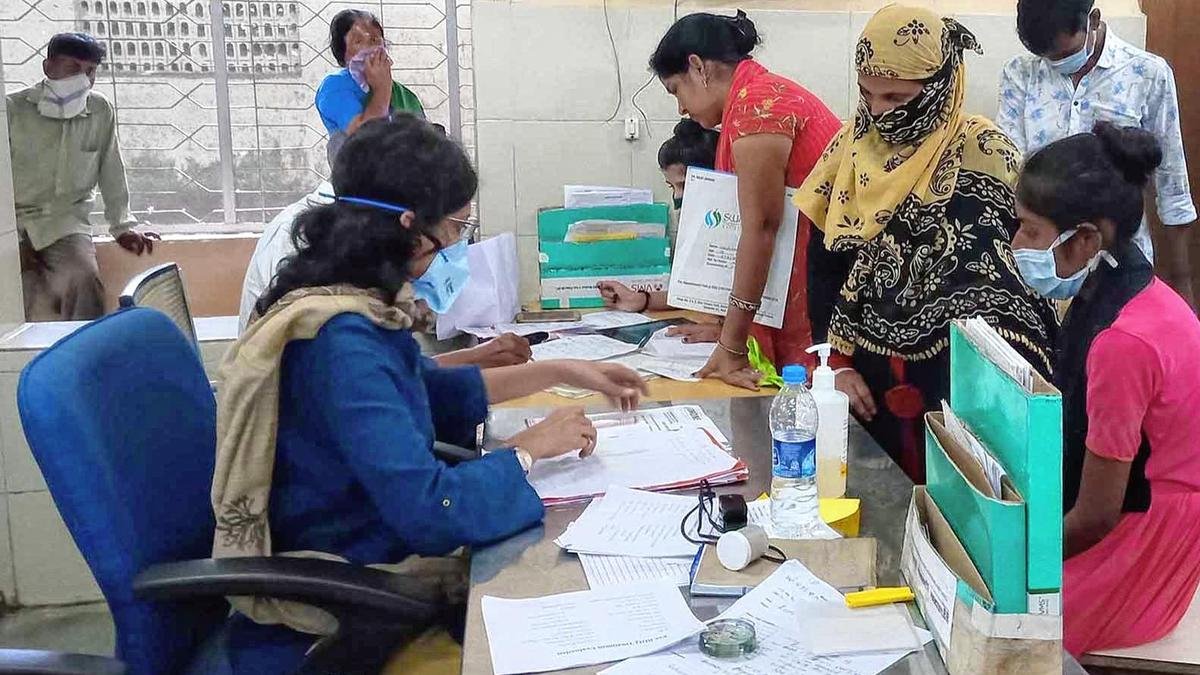
She took the medications for two months but something still did not feel right, and when she finally went to Shatabdi Hospital and was properly tested, she had developed multidrug-resistant TB.
Incorrect treatment – wrong drugs, improper doses, single medications instead of combination therapy can turn standard curable TB into MDR-TB. The India TB Report 2023 notes that women experience diagnostic delays of up to two to three months due to fears of stigma, and that 40% of female TB patients in an ICMR study reported facing discrimination, including job loss or family rejection.

Cooking without fainting was an everyday struggle until Divya learnt to time her medicines with her schedule.
| Photo Credit:
Nidhi Kadere
A study drawing on 80 qualitative interviews with poor women working in informal arrangements at DOTS centres in Bengaluru found that TB symptoms were routinely normalised as workplace health problems, and misread by medical personnel as work-related conditions, confounding early accurate diagnosis.
“There were many days when I would faint while something was cooking on the stove and the whole house would turn black with smoke. My neighbours had to break the door to come in and check. The drugs were so strong that my teeth would fall into the food while I was eating,” she says. She eventually took up a job as a school bus attendant to save for dental implants. India’s free TB programme does not account for out-of-pocket expenses incurred during months and years of treatment.
Losing a workday
Three kilometres away in Mankhurd, Rehana Shaikh is already on the bus. She left home at 6.30 a.m. and is a domestic worker covering two households in Chembur, paid by the day. She has pulmonary TB, drug-sensitive, and is being treated at the DOTS centre at Shatabdi Hospital. Standard drug-sensitive TB takes six months to treat, and under Directly Observed Treatment Shortcourse Therapy, patients visit a clinic three to five times a week during the initial phase, amounting to over 40 to 70 total visits. “The clinics open at 10 a.m., so I have to take a half day to collect my medicines three times a week. I cannot do it after work since the clinic closes at 5 p.m., sometimes 4 p.m. I can’t choose between illness and losing my salary,” Rehana says.

A few months after she started her treatment, Rehana’s husband contracted TB. To look after her husband at the hospital, she had to leave work and stay in the compound provided by the Sewri hospital for relatives of TB patients on the hospital premises
| Photo Credit:
Nidhi Kadere
The TB medication makes her dizzy, a low constant unsteadiness she manages by keeping still and not carrying too much weight. She arrives at the clinic by 9.45 a.m. By the time the clinic opens, they tell her they are short on medicines. She takes the bus back and reaches her employer in Chembur by noon, having lost the morning. In a job paid by attendance, losing the morning means losing the wages, and this happens twice a week.
India’s National Time Use Survey 2024, a government survey of 4.54 lakh individuals published by the Ministry of Statistics and Programme Implementation in February 2025, tells us that women spend 305 minutes every day on unpaid domestic work compared to men’s 88. Four out of 10 women aged 15 to 59 are their household’s primary caregiver, spending 140 minutes daily on that work against 74 minutes for men.
The medication makes her weaker over the weeks. Due to the weakness, she has to take more breaks and gets late for work. This in turn affects her income, which is already below minimum wage, shrinking further with each half day she takes.
A 2024 study in PLOS Global Public Health following 1,482 TB patients across four states including Maharashtra found that between 30 and 61 % faced catastrophic costs, defined as treatment expenses exceeding 20 % of annual household income, and that for more than half, those costs began before a single dose of treatment was taken. Another cost analysis found that indirect costs, lost wages, lost time and lost productivity , constitute 93.4 % of what TB actually costs an Indian patient. The medicine is the smallest part of the bill. Rehana returns home at 7 p.m., cooks, and sleeps by 11. Tomorrow she has to go for a test again.
The long commute
The road from Kanjurmarg to Sewri TB Hospital takes Amita through the spine of the city. A homemaker in her late thirties living in a one-room tenement, she has extrapulmonary TB, a type that affects the lymph nodes, which do not appear on a standard chest X-ray and are harder to diagnose and easier to dismiss. Her treatment is at Sewri TB Hospital, Mumbai’s oldest dedicated TB facility, treating the city’s poor since 1941. The commute is over an hour and a half each way on a good day — Central Railway from Kanjurmarg to Kurla, a change to the Harbour Line, Sewri station, and then a 15-minute walk or a bus to the hospital gate.

TB OPD is open from 8:30am to 11:30am Monday to Saturday (sign at Sewri TB hospital)
| Photo Credit:
Nidhi Kadere
She has no income of her own, and the decision of when she goes, how often, and whether she can afford the fare to and from the clinic this week is not entirely hers to make.
India’s National Family Health Survey 5, conducted between 2019 and 2021 across more than 600,000 households, found that nationally 21.5% of women said transport was a problem in accessing medical care, 23.2% cited distance, and overall 60% reported at least one barrier to healthcare. In Maharashtra, an analysis of the survey found that 56% of women identified transport as a major barrier to accessing care.
For Amita, the barrier is not just the bus. It is the permission to take it.
Waiting for care
A woman in an affluent neighbourhood in Bandra with the same disease and the same drug protocol has health insurance, paid leave, a private pulmonologist who sees her within minutes, and a household income that does not collapse when she misses a morning of work. TB patients in low and middle-income countries routinely dissolve savings, borrow money, or sell assets to cope with treatment costs. For Rehana, whose income is already below minimum wage, there are no savings to dissolve and no assets to sell.

Govandi and Mankhurd are home to large concentrations of Dalit and OBC households, communities pushed to the city’s edges by decades of displacement and urban planning that never considered them its intended beneficiaries. Research using data from 27,251 Indian households found that lower social class is associated with higher waiting times at health facilities, and that caste-related inequality in waiting time has worsened over time. Residents of these settlements rely almost entirely on public transport to access healthcare, and the eastern suburbs record the lowest accessibility scores for government healthcare facilities in the entire city.The areas have one of the highest TB burdens and the highest concentration of informal women workers.
The sociologist Javier Auyero argued in Patients of the State that waiting is not a passive exercise for all; it is how the state exercises power over people who cannot afford to pay to bypass it. Low-income communities in India routinely wait for employment, basic services and subsidised goods, delays that expose an unequal distribution of resources and power. Women are more likely than men to work part-time, earn less, and remain outside health insurance or retirement protections. Their time is the invisible part of the iceberg on which the city’s economy stands.
The Nikshay Poshan Yojana provides a direct benefit transfer of Rs. 1,000 per month to registered TB patients for the duration of treatment. A move that can help women barely make up for the lost wages and out-of-pocket expenses.
A Chennai study found that when DOTS clinics offered evening hours, treatment completion rates among working patients rose to near-universal, with almost one-fifth of patients previously missing treatment because of their work schedule.
Yet Mumbai’s DOTS centres operate from 10 a.m. to 5 p.m., and evening hours have not been systematically introduced. India’s National Tuberculosis Elimination Programme set a target of eradicating TB by 2025.
We are already in the middle of 2026.
Divya looks at the clock. It is 11 p.m.
(Nidhi Kadere is a freelance journalist who writes on health, gender and governance )