

Close Menu

    Subscribe to Updates

    Get the latest news information from worldwide businesses.

    What's Hot

    How CBSE’s OSM fails its efficiency test

    May 26, 2026

    Seeing double with the Artemis 2 rocket boosters photo of the day for May 26, 2026

    May 26, 2026

    What is Billy Idol’s net worth? Fortune explored after legendary rocker delivers passionate speech following Lifetime Achievement Award win at AMAs

    May 26, 2026
    Facebook Instagram YouTube LinkedIn X (Twitter)
    Trending
    • How CBSE’s OSM fails its efficiency test
    • Seeing double with the Artemis 2 rocket boosters photo of the day for May 26, 2026
    • What is Billy Idol’s net worth? Fortune explored after legendary rocker delivers passionate speech following Lifetime Achievement Award win at AMAs
    • Ferrari (RACE) stock plunges 6% on Luce EV backlash — don’t panic!
    • Aurobindo’s Eugia Unit-I Receives OAI Classification After 4 USFDA Observations
    • AI warfare is already here
    • 7-Eleven data breach affects over 185,000 people’s personal data
    • Saatvik Green Energy bags Rs 171-cr solar modules supply order
    Newspublicly
    • About Us
    • Advertise & Partner with us
    • Pitch Your Story
    • Contact Us
    Facebook Instagram LinkedIn X (Twitter)
    Subscribe
    • Home
    • World News
      • Asia
      • India
      • USA
      • UK & Europe
      • Middle East
    • Economy & Business
      • Global Economy
      • Corporate & Industry
      • Finance & Markets
      • Policy & Trade
    • Technology
      • Gadgets & Devices
      • Software & Apps
      • AI & Machine Learning
      • Robotics & Automation
    • Health & Medicine
      • Fitness & Nutrition
      • Research & Innovation
      • Disease & Treatment
      • Doctors, Clinics & Patient Care
    • Travel & Tourism
    • Automobile
      • Electric & Hybrid Vehicles
      • Auto Industry Insights
    • Sports
    • More
      • Education
      • Real Estate
      • Environment & Climate
      • Space & Astronomy
      • War & Conflicts
    Newspublicly
    Home»More»Space & Astronomy»Unusual red northern lights over Japan suggest some solar storms are stronger than we thought
    Space & Astronomy

    Unusual red northern lights over Japan suggest some solar storms are stronger than we thought

    AdminBy AdminMay 26, 2026No Comments4 Mins Read0 Views
    Share
    Facebook Twitter LinkedIn Copy Link WhatsApp


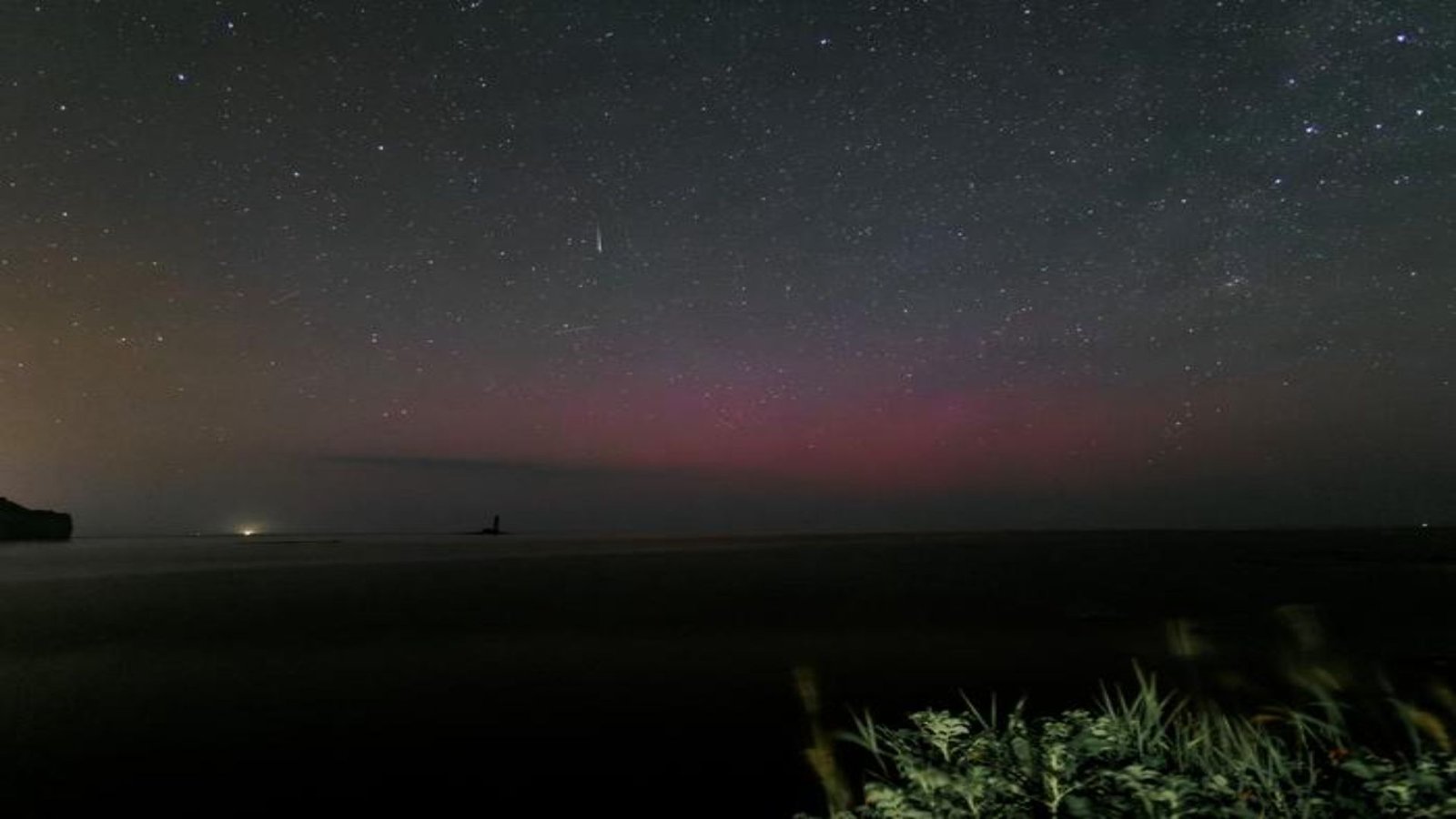
    A rare crimson aurora glowing over northern Japan may be a sign that some solar storms are more powerful than scientists once believed.

    Researchers studying faint red auroras observed above Japan in June 2024 found that the displays stretched far higher into Earth’s atmosphere than expected, reaching altitudes between roughly 310 and 500 miles (500 to 800 kilometers) — which is unusually high for a storm that was not considered especially severe by conventional geomagnetic indices, according to a statement from Hokkaido University.

    The discovery suggests that even “moderately intense” geomagnetic storms — which are a disturbance in Earth’s magnetic field caused by charged particles and magnetic energy from the sun — may carry far more energy than previously thought, challenging scientists’ understanding of how these space weather events develop and how their strength is measured.


    You may like

    A view of the night sky over a dark ground. There are stars in the sky and there's a faint red glow lower closer to the horizon.

    Low-latitude aurora observed on June 28, 2024, in Yoichi, Hokkaido, Japan, shows a rare red glow stretching across the night sky during a geomagnetic storm that scientists say reached unexpectedly high altitudes in Earth’s upper atmosphere. (Image credit: Tomohiro M. Nakayama)

    “I was really surprised because I didn’t expect such tall auroras to appear even during moderately intense storms,” Tomohiro M. Nakayama, lead author of the study, said in the statement. “This suggests that these storms may actually be stronger than conventional indices indicate.”

    Auroras are usually seen near the poles as bright, shimmering lights produced when charged particles from the sun collide with gases in Earth’s upper atmosphere. When they appear farther south, in areas like Japan, they are generally linked to strong geomagnetic storms and occur at lower altitudes of around 124 to 249 miles (200 to 400 kilometers).

    The unusual auroras were photographed over Hokkaido, Japan, where observers captured diffuse red glows hanging low over the horizon. Unlike the vivid green curtains commonly associated with the northern lights, these auroras appeared as soft crimson veils spread across the night sky.

    This contrast in auroras is because different gases — and different altitudes — produce different colors. Green auroras, the most common type, form when energetic particles excite oxygen atoms about 60 to 150 miles (100 to 250 km) above Earth. Red auroras also come from oxygen, but they occur much higher in the atmosphere, where the air is extremely thin and oxygen atoms can release a dim red glow before colliding with other particles. Blue and purple auroras are typically linked to nitrogen molecules.

    Space

    Red auroras are generally faint and usually occur at very high altitudes, making them less commonly seen compared to green displays. They are also more often associated with especially strong geomagnetic storms capable of pushing auroral activity farther from the poles.

    What’s more is that Japan sits much farther south than the regions where auroras are usually visible. While powerful solar storms can occasionally push the auroral oval toward lower latitudes, scientists did not expect such extensive high-altitude red emissions during a storm categorized as only moderate.

    The team analyzed five auroral events recorded between June 2024 and March 2025, combining observations from Hokkaido with satellite data and photographs captured by citizen scientists across Japan. By measuring the elevation angles of the auroras in the images and tracing them along Earth’s magnetic field lines, the team reconstructed how high the glowing structures extended into the atmosphere. Their analysis suggests that an unusually dense solar wind — streams of charged particles flowing from the sun and interacting with Earth’s magnetic field — may have fueled the rare crimson auroras even without an officially “extreme” geomagnetic storm, according to the statement.

    The study comes as the sun remains near the peak of Solar Cycle 25, a period of heightened solar activity that has already produced spectacular aurora displays across the globe. In May 2024, one of the strongest geomagnetic storms in decades pushed auroras deep into mid-latitude regions around the world. Understanding these unexpected auroras could improve forecasts of dangerous space weather, which can disrupt satellites, GPS systems, communications and even power grids during extreme solar storms.

    “As the number of satellites in low Earth orbit continues to grow, understanding these effects is increasingly important,” Nakayama said in the statement.

    Their findings were published May 19 in the Journal of Space Weather and Space Climate.


    Source link

    Author

    • Admin

      NewsPublicly.com is News & Articles Platform that creating SEO-focused articles on travel, lifestyle, and digital trends.

    Admin
    • Website

    NewsPublicly.com is News & Articles Platform that creating SEO-focused articles on travel, lifestyle, and digital trends.

    Related Posts

    Seeing double with the Artemis 2 rocket boosters photo of the day for May 26, 2026

    May 26, 2026

    Could a cosmic uncertainty principle help explain dark matter?

    May 26, 2026

    HBO’s ‘Lanterns’ does have some green in it after all, as latest trailer shows Hal Jordan unleashing the power of the ring (video)

    May 26, 2026
    Leave A Reply Cancel Reply

    Demo
    Top Posts

    “Inside Gemini Robotics 1.5: How Robots Learn to Reason & Act

    November 22, 202525 Views

    How US Tariffs Are Reshaping the Global Growth Landscape?

    November 21, 202518 Views

    Pakistani Journalist Laughing at Tejas Fighter Jet Crash at Dubai Airshow Sparks Massive Outrage Worldwide

    November 23, 202517 Views

    Vibe-Coding Boom: How Non-Coders Build Apps With AI Agents

    November 22, 202515 Views
    Don't Miss

    How CBSE’s OSM fails its efficiency test

    May 26, 20267 Mins Read0 Views

    When CBSE announced Class 12 results for 2026 on May 13, two things stood out…

    Seeing double with the Artemis 2 rocket boosters photo of the day for May 26, 2026

    May 26, 2026

    What is Billy Idol’s net worth? Fortune explored after legendary rocker delivers passionate speech following Lifetime Achievement Award win at AMAs

    May 26, 2026

    Ferrari (RACE) stock plunges 6% on Luce EV backlash — don’t panic!

    May 26, 2026
    Stay In Touch
    • Facebook
    • Twitter
    • Instagram
    • YouTube
    • LinkedIn
    • WhatsApp

    Subscribe to Updates

    Get the latest creative news from SmartMag about art & design.

    Demo
    NEWSPUBLICLY
    Facebook X (Twitter) Instagram LinkedIn

    Home

    • About Us
    • Leadership
    • Advertise & Partner With Us
    • Pitch Your Story
    • Media Kit & Pricing
    • Career
    • FAQs

    Guidelines

    • Editorial & Submission
    • Partnership
    • Advertising & Sponsor
    • Intellectual Property Policy
    • Community & Comment
    • Security & Data Protection
    • Send Your Opinion

    Quick Links

    • Cookie Policy
    • Payment & Billing Terms
    • Refund & Cancellation
    • Copyright Policy
    • Complaint & Support
    • Sitemap
    • Contact Us

    Subscribe Us

    Get the latest news and updates!

    Copyright © 2026 Newspublicly (DIGITALIX COMMUNICATION). All Rights Reserved.
    • Privacy Policy
    • Terms of Use
    • Disclaimer