

Close Menu

    Subscribe to Updates

    Get the latest news information from worldwide businesses.

    What's Hot

    Central Bank of India ‘blessed’ with liquidity, now we are building the capability to deploy it better: CMD Kalyan Kumar

    May 21, 2026

    Quantum stocks soar as the Trump administration looks to be buying in

    May 21, 2026

    AI plane’s tail scrapes runway while going around at Bengaluru | India News

    May 21, 2026
    Facebook Instagram YouTube LinkedIn X (Twitter)
    Trending
    • Central Bank of India ‘blessed’ with liquidity, now we are building the capability to deploy it better: CMD Kalyan Kumar
    • Quantum stocks soar as the Trump administration looks to be buying in
    • AI plane’s tail scrapes runway while going around at Bengaluru | India News
    • Kentucky cold case leads to arrests in woman’s 1992 disappearance
    • Maharashtra SSC 2026 Result: Most students with 90% and above from Mumbai division | Education News
    • ‘Stop lying!’ Conspiracy theorist confronts Artemis 2 astronauts, accuses them of faking their moon mission
    • Following Cale Makar injury, Paul Bissonnette makes bold prediction for Avs-Golden Knights series 
    • These 5 Cars Made Up 20% Of EV Sales Globally Last Year
    Newspublicly
    • About Us
    • Advertise & Partner with us
    • Pitch Your Story
    • Contact Us
    Facebook Instagram LinkedIn X (Twitter)
    Subscribe
    • Home
    • World News
      • Asia
      • India
      • USA
      • UK & Europe
      • Middle East
    • Economy & Business
      • Global Economy
      • Corporate & Industry
      • Finance & Markets
      • Policy & Trade
    • Technology
      • Gadgets & Devices
      • Software & Apps
      • AI & Machine Learning
      • Robotics & Automation
    • Health & Medicine
      • Fitness & Nutrition
      • Research & Innovation
      • Disease & Treatment
      • Doctors, Clinics & Patient Care
    • Travel & Tourism
    • Automobile
      • Electric & Hybrid Vehicles
      • Auto Industry Insights
    • Sports
    • More
      • Education
      • Real Estate
      • Environment & Climate
      • Space & Astronomy
      • War & Conflicts
    Newspublicly
    Home»Health & Medicine»Research & Innovation»Scientists discover a strange “inside-out” planetary system that shouldn’t exist
    Research & Innovation

    Scientists discover a strange “inside-out” planetary system that shouldn’t exist

    AdminBy AdminMay 21, 2026No Comments4 Mins Read0 Views
    Share
    Facebook Twitter LinkedIn Copy Link WhatsApp


    Children often learn the order of the planets in our Solar System using quirky memory phrases like “My Very Educated Mother Just Served Us Nachos.” These sayings help recall Mercury, Venus, Earth, Mars, Jupiter, Saturn, Uranus, and Neptune.

    In our Solar System, the planets fall into two broad groups. The inner planets closest to the Sun, from Mercury through Mars, are rocky worlds. Farther out are the giant gaseous planets, from Jupiter to Neptune.

    Astronomers have long believed this arrangement reflects a common pattern throughout the Universe. According to leading theories of planet formation, rocky planets form near their star while gas giants develop farther away where cooler conditions allow thick atmospheres to build up. Observations of many planetary systems have generally supported this idea.

    But a newly studied star system called LHS 1903 may challenge that understanding.

    A Strange Planetary System Around LHS 1903

    LHS 1903 is a small, cool red dwarf star known as an M-dwarf. It is dimmer and cooler than our Sun. Researchers led by Thomas Wilson from the University of Warwick in the United Kingdom combined observations from several space and ground-based telescopes to examine planets orbiting the star.

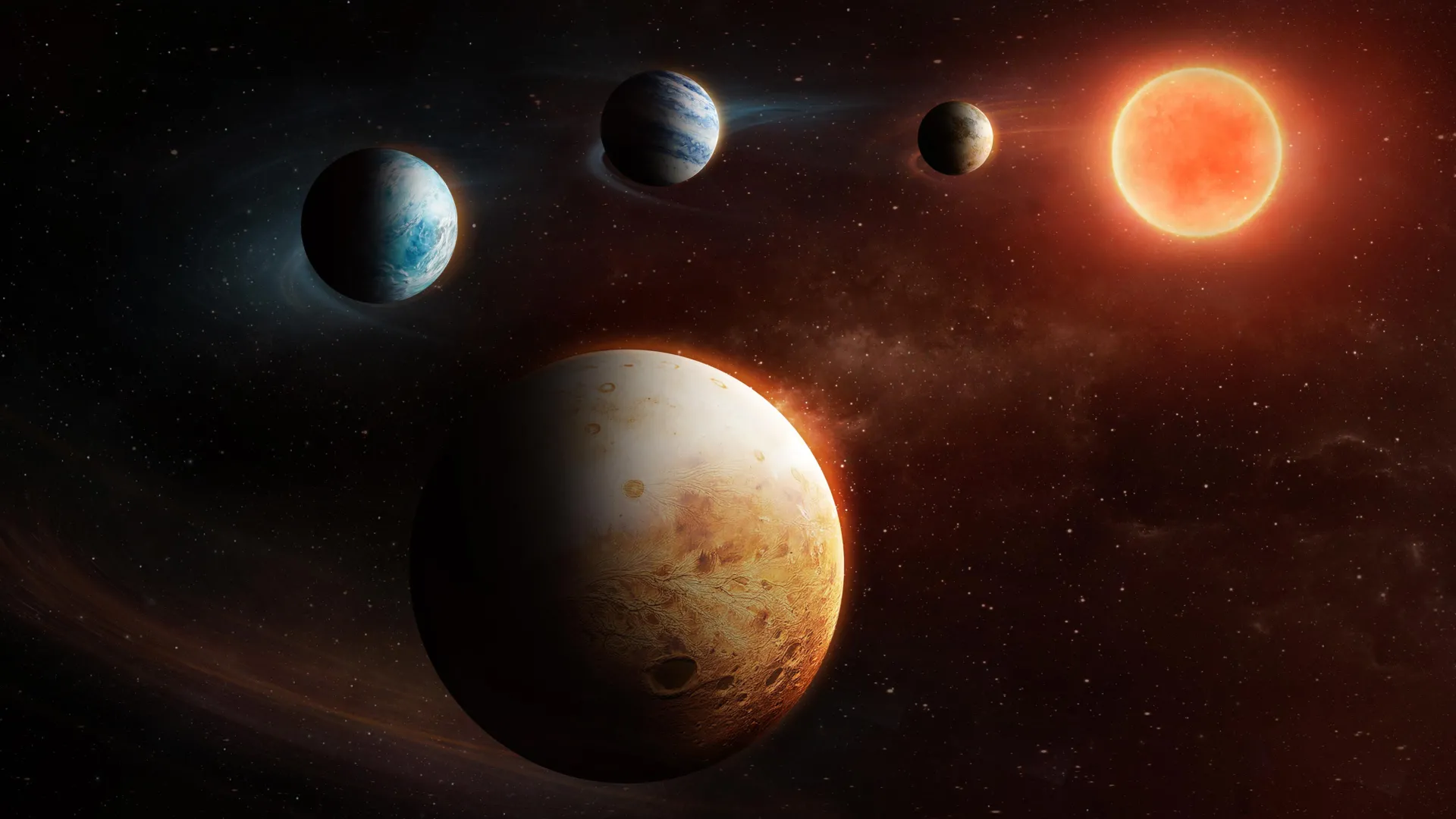
    The team identified three planets at first. The closest planet appeared rocky, while the next two seemed gaseous. That arrangement matched what scientists expected to see.

    Then researchers analyzed data from the European Space Agency’s CHaracterising ExOPlanet Satellite (Cheops) and uncovered something unexpected. A fourth planet orbiting farther from the star appeared to be rocky as well.

    “That makes this an inside-out system, with a planet order of rocky-gaseous-gaseous-and then rocky again. Rocky planets don’t usually form so far away from their home star,” says Thomas.

    Current models suggest rocky planets form near stars because intense radiation strips away gas surrounding developing planetary cores. Farther away, cooler temperatures allow gas to accumulate into thick atmospheres, creating giant gaseous planets.

    ESA Cheops project scientist Maximilian Günther says the discovery highlights how much scientists still do not understand about planetary origins.

    “Much about how planets form and evolve is still a mystery. Finding clues like this one for solving this puzzle is precisely what Cheops set out to do.”

    Scientists Test Possible Explanations

    Researchers did not immediately conclude that existing planet formation theories were wrong. Instead, they explored whether other events could explain the unusual system.

    One possibility was that the outer rocky planet had once possessed a thick atmosphere that was later blasted away by a collision with a massive asteroid, comet, or another large object. Another idea was that the planets may have changed positions over time.

    Using simulations and calculations of the planets’ orbital behavior, the team ruled out those explanations.

    Their investigation instead pointed toward a more unusual possibility. The planets around LHS 1903 may not have formed simultaneously. Instead, they may have developed one after another.

    Under standard theories, planets form within giant discs of gas and dust called protoplanetary discs. Multiple planetary embryos emerge at roughly the same time and gradually evolve over millions of years into full planets.

    But in this system, researchers believe the star may have produced its planets sequentially rather than all at once. Scientists proposed this idea, known as inside-out planet formation, about a decade ago, but evidence supporting it has been limited until now.

    A Rocky Planet Born Late

    The discovery becomes even more intriguing because the outer rocky planet may have formed under very different conditions than its neighboring worlds.

    “By the time this outer planet formed, the system may have already run out of gas, which is considered vital for planet formation. Yet here is a small, rocky world, defying expectations. It seems that we have found first evidence for a planet which formed in what we call a gas-depleted environment,” says Thomas.

    The unusual rocky planet could represent a rare cosmic oddity, or it might reveal a broader trend astronomers have not yet recognized. Either way, scientists say the system cannot easily be explained using current theories alone.

    Rethinking Planet Formation

    “Historically, our planet formation theories are based on what we see and know about our Solar System,” Isabel Rebollido who is currently a Research Fellow at ESA points out. “As we are seeing more and more different exoplanet systems, we are starting to revisit these theories.”

    As telescopes become more powerful, astronomers continue discovering increasingly unusual planetary systems across the galaxy. These strange worlds are forcing researchers to reconsider assumptions about how planets form and evolve.

    The findings may also reshape how scientists view our own Solar System. Rather than representing a universal blueprint, its orderly structure could be just one example among many wildly different planetary arrangements in the cosmos.


    Source link

    Author

    • Admin

      NewsPublicly.com is News & Articles Platform that creating SEO-focused articles on travel, lifestyle, and digital trends.

    Admin
    • Website

    NewsPublicly.com is News & Articles Platform that creating SEO-focused articles on travel, lifestyle, and digital trends.

    Related Posts

    Jupiter’s lightning may be 100x more powerful than Earth’s

    May 21, 2026

    Physicists finally solve the strange mystery of “breathing” lasers

    May 21, 2026

    Scientists discover strange “narwhal” waves that trap light beyond known limits

    May 21, 2026
    Leave A Reply Cancel Reply

    Demo
    Top Posts

    “Inside Gemini Robotics 1.5: How Robots Learn to Reason & Act

    November 22, 202525 Views

    How US Tariffs Are Reshaping the Global Growth Landscape?

    November 21, 202518 Views

    Pakistani Journalist Laughing at Tejas Fighter Jet Crash at Dubai Airshow Sparks Massive Outrage Worldwide

    November 23, 202517 Views

    Vibe-Coding Boom: How Non-Coders Build Apps With AI Agents

    November 22, 202515 Views
    Don't Miss

    Central Bank of India ‘blessed’ with liquidity, now we are building the capability to deploy it better: CMD Kalyan Kumar

    May 21, 20264 Mins Read0 Views

    Central Bank of India has drawn up a plan to expand its operations by launching…

    Quantum stocks soar as the Trump administration looks to be buying in

    May 21, 2026

    AI plane’s tail scrapes runway while going around at Bengaluru | India News

    May 21, 2026

    Kentucky cold case leads to arrests in woman’s 1992 disappearance

    May 21, 2026
    Stay In Touch
    • Facebook
    • Twitter
    • Instagram
    • YouTube
    • LinkedIn
    • WhatsApp

    Subscribe to Updates

    Get the latest creative news from SmartMag about art & design.

    Demo
    NEWSPUBLICLY
    Facebook X (Twitter) Instagram LinkedIn

    Home

    • About Us
    • Leadership
    • Advertise & Partner With Us
    • Pitch Your Story
    • Media Kit & Pricing
    • Career
    • FAQs

    Guidelines

    • Editorial & Submission
    • Partnership
    • Advertising & Sponsor
    • Intellectual Property Policy
    • Community & Comment
    • Security & Data Protection
    • Send Your Opinion

    Quick Links

    • Cookie Policy
    • Payment & Billing Terms
    • Refund & Cancellation
    • Copyright Policy
    • Complaint & Support
    • Sitemap
    • Contact Us

    Subscribe Us

    Get the latest news and updates!

    Copyright © 2026 Newspublicly (DIGITALIX COMMUNICATION). All Rights Reserved.
    • Privacy Policy
    • Terms of Use
    • Disclaimer