

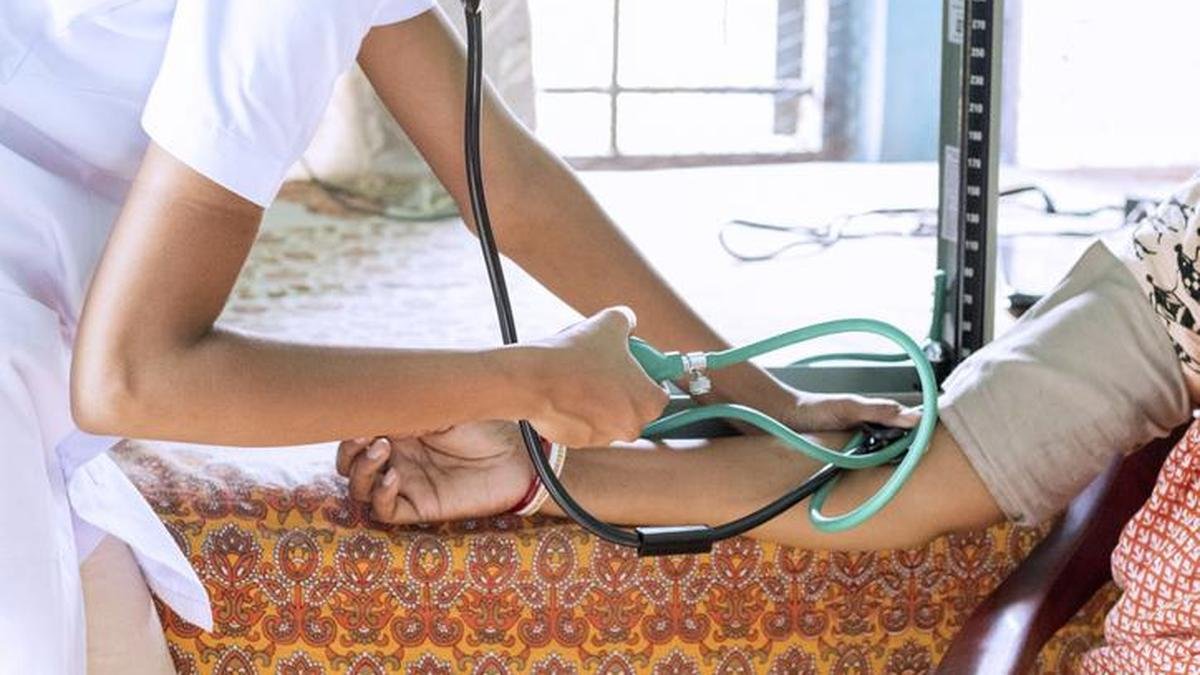
Routine screening is the only way to find a condition that will not come looking for you |Image used for representational purpose only
| Photo Credit: Getty Images
India has a quiet crisis. Of the 188.3 million adults living with hypertension, only 15% have it under control. The rest feel fine. They go to work, sleep well, and see no reason to visit a doctor. Their blood pressure, meanwhile, keeps climbing.
This is what makes hypertension unlike almost every other serious illness. There is no pain, no fatigue that could not be explained away, no clear signal that something is building. The condition moves quietly through vessel walls, the heart, and the kidneys for years while the person carrying it remains entirely unaware. For many, the first indication arrives as a stroke. For others, , it arrives as a heart attack.
Symptoms do exist, and when they appear they matter. Shortness of breath, persistent headaches, blurred vision, dizziness, and nosebleeds can all indicate that pressure has reached a dangerous level or that damage has already begun. Nausea, burning eyes, and faintness appear regularly in patient accounts. During a stroke, sudden weakness, vision problems, a severe headache, and dizziness are the warning signs. In practice, most of these are dismissed as stress or tiredness before anyone thinks to check a blood pressure reading. For the majority of people with hypertension, though, these symptoms never even appear. The disease runs its course without a signal, until it cannot be ignored.

The scale undetected disease
Only 37% are aware of their condition. That means the overwhelming majority of people living with hypertension in India are doing so without knowing it. The gap between how many people have the condition and how many are managing it, is, above everything else, a detection problem.
The disease does not belong to any particular group. Daily salt intake in India runs to 10 g per person on average, more than double what is recommended. Roughly a third of adults are physically inactive, and one in every four Indians now has obesity. Blood pressure rises quietly against this backdrop, year after year, in households that have no particular reason to suspect a problem.

When the risk is high
For people already managing diabetes, the risk is considerably more serious. India has 101 million people living with the condition. When diabetes and hypertension occur together, the kidneys take the worst of it. The risk of kidney damage rises to six times the baseline when both conditions are present, and hypertension is already the second most common cause of chronic kidney disease in India. The progression from elevated blood pressure to kidney failure can be fast and entirely silent. For these patients, the choice of treatment carries consequences well beyond what a blood pressure reading alone conveys.
Staying on treatment once diagnosed is its own challenge. Research from urban India found that in more than a third of uncontrolled cases, patients had stopped taking their medication, with financial pressure and the difficulty of changing daily habits accounting for much of the rest. This is not a failure of willpower. It is a predictable response to managing a condition that offers no symptoms, no feedback, and no immediate reason to keep taking a pill every day for years. The system around the patient needs to provide what the body does not.

What consistent control requires
The most encouraging aspect is that the tools to address it already exist in India. Simple home monitoring and regular clinical contact can drastically improve outcomes. The economic case is equally hard to argue with. The benefits of improved hypertension treatment outweigh the costs by 18 to 1. For India specifically, 4.6 million deaths could be averted by 2040 if the progress scenario is achieved. Those are not aspirational projections. They describe what happens when a health system does something that is, in clinical terms, not complicated: find the condition early, treat it with medicines that work, and follow up consistently over time.
A blood pressure reading takes under a minute. The technology is inexpensive, the protocols are established, and the evidence is clear. What has consistently been underestimated is the cost of not looking. In a country where most people with hypertension have no idea they have it, routine screening is not a precaution. It is the only way to find a condition that will not come looking for you.
(Dr. Rajesh Matta is a consultant interventional cardiologist and TAVI specialist, Apollo Hospital Navi Mumbai. drrajeshmatta@gmail.com)
Published – May 18, 2026 03:00 pm IST