

Close Menu

    Subscribe to Updates

    Get the latest news information from worldwide businesses.

    What's Hot

    This Week In Space podcast: Episode 210 — ESCAPADES at Mars

    May 16, 2026

    Turtle Beach made a good SteelSeries headset clone that’s $50 less

    May 16, 2026

    Govt imposes import curbs on silver amid push to tighten precious metals inflows

    May 16, 2026
    Facebook Instagram YouTube LinkedIn X (Twitter)
    Trending
    • This Week In Space podcast: Episode 210 — ESCAPADES at Mars
    • Turtle Beach made a good SteelSeries headset clone that’s $50 less
    • Govt imposes import curbs on silver amid push to tighten precious metals inflows
    • Memorial Day sales mark down fridges and dishwashers. Too bad many Americans aren’t buying them right now.
    • Estoril Praia vs Benfica Prediction and Betting Tips
    • Another African country targets fossil-free electric transit by 2030
    • Neha Bhasin on Breaking the “Toxic Cycle” of Body Hate
    • Scientists find hidden brain nutrient deficit that may fuel anxiety
    Newspublicly
    • About Us
    • Advertise & Partner with us
    • Pitch Your Story
    • Contact Us
    Facebook Instagram LinkedIn X (Twitter)
    Subscribe
    • Home
    • World News
      • Asia
      • India
      • USA
      • UK & Europe
      • Middle East
    • Economy & Business
      • Global Economy
      • Corporate & Industry
      • Finance & Markets
      • Policy & Trade
    • Technology
      • Gadgets & Devices
      • Software & Apps
      • AI & Machine Learning
      • Robotics & Automation
    • Health & Medicine
      • Fitness & Nutrition
      • Research & Innovation
      • Disease & Treatment
      • Doctors, Clinics & Patient Care
    • Travel & Tourism
    • Automobile
      • Electric & Hybrid Vehicles
      • Auto Industry Insights
    • Sports
    • More
      • Education
      • Real Estate
      • Environment & Climate
      • Space & Astronomy
      • War & Conflicts
    Newspublicly
    Home»More»Space & Astronomy»NASA’s Psyche spacecraft is flying to a metal asteroid. So, why did it just visit Mars?
    Space & Astronomy

    NASA’s Psyche spacecraft is flying to a metal asteroid. So, why did it just visit Mars?

    AdminBy AdminMay 16, 2026No Comments5 Mins Read0 Views
    Share
    Facebook Twitter LinkedIn Copy Link WhatsApp


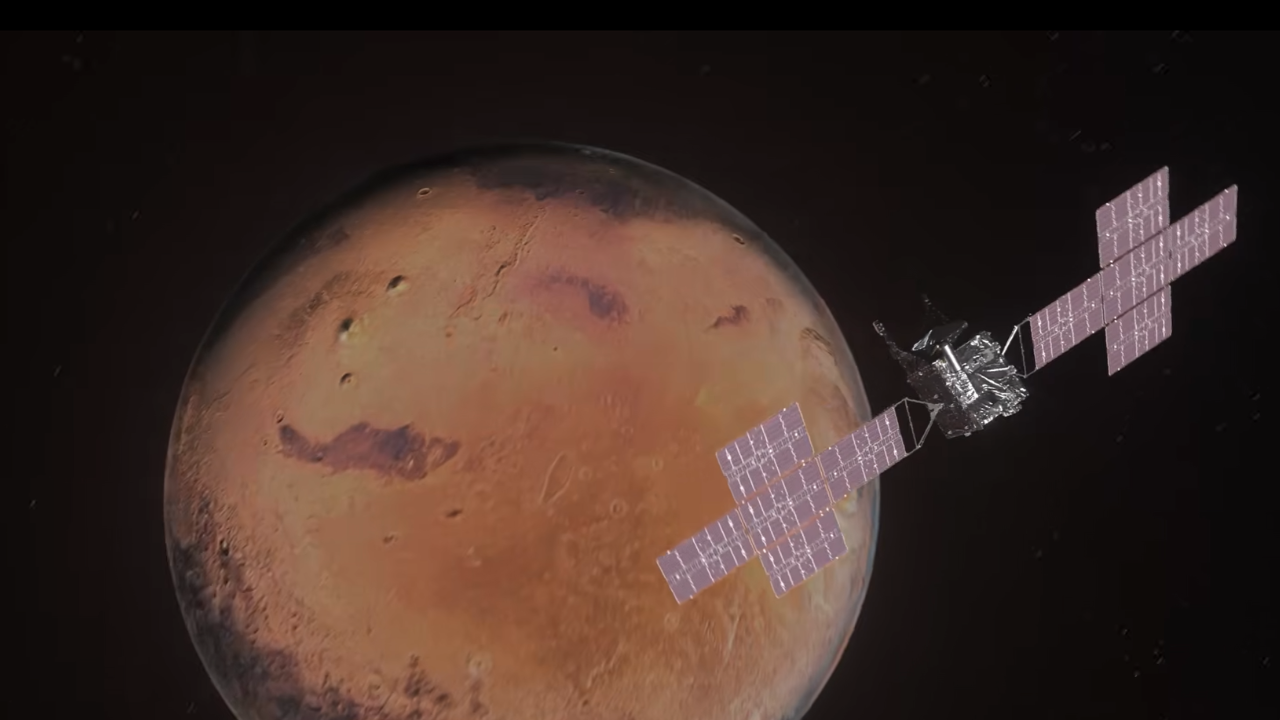
    NASA’s Psyche spacecraft flew by Mars on Friday (May 15), diving closer to the Red Planet than either of its tiny moons. But the precisely timed maneuver was not designed to study Mars,

    Instead, the Psyche spacecraft zipped by Mars to use the planet as a celestial slingshot on its journey to its namesake, the metal-rich asteroid Psyche.The spacecraft passed within about 2,800 miles (4,500 kilometers) of Mars, which had appeared steadily larger and brighter in Psyche’s view since early May.

    On Friday, Psyche hurtled past the planet at roughly 12,333 mph (19,848 kph), according to NASA. The flyby boosted Psyche’s speed and, more importantly, shifted its trajectory toward its destination, the asteroid 16 Psyche, which orbits the sun between Mars and Jupiter.


    You may like

    Scientists believe the 173-mile-wide (280 km) space rock may be the exposed metallic core of a shattered protoplanet — a primordial building block of the rocky worlds whose outer crust and mantle were likely stripped away in catastrophic collisions billions of years ago. If so, the mission could offer humanity its first direct glimpse of material normally buried deep inside planets like Earth.

    A Mars assist

    Friday’s flyby marked one of the mission’s most important milestones, conserving precious fuel while placing the spacecraft on course to reach the asteroid in 2029.

    The maneuver was an example of one of the most important techniques in modern spaceflight known as the gravity assist. By carefully flying past a moving planet, spacecraft can gain speed, alter direction and conserve propellant, allowing missions to travel farther and faster than rockets alone would permit.

    The concept can seem almost counterintuitive, as though spacecraft are somehow getting energy for free. A spacecraft accelerates as it falls toward a planet, then slows again while climbing back out of the planet’s gravity well. Intuitively, those gains and losses should cancel each other out.

    Space

    What makes the maneuver possible, however, is not simply the planet’s gravity, but the planet’s own motion around the sun.

    Mars is hurtling through space carrying enormous momentum as it orbits the sun. By approaching the planet at a carefully calculated angle and departing in another, Psyche effectively stole a tiny fraction of that orbital energy.

    The exchange follows Newton’s Third Law — every action has an equal and opposite reaction — as the spacecraft gains momentum by borrowing an infinitesimally small amount from Mars, a transfer imperceptible to the planet but transformative for the mission.


    What to read next

    Mars as a bright crescent as seen by the Psyche spacecraft as it heads for a Red Planet rendezvous

    Mars as a bright crescent as seen by the Psyche spacecraft just before its Red Planet flyby on May 15, 2026. (Image credit:  NASA/JPL-Caltech/ASU)

    “It’s smart, it’s cheap, and it’s phenomenally clever … it’s a bit like interplanetary billiards,” Shadan Ardalan, a NASA scientist who was involved with the agency’s Juno mission to Jupiter, previously told Space.com.

    Gravity assists have long been used to explore humanity’s cosmic backyard. The technique dates back to the dawn of the Space Age in 1959, when the Soviet spacecraft Luna 3 used the moon’s gravity to swing behind it and photograph the lunar far side for the first time.

    Many of humanity’s most ambitious robotic missions would also have been impossible without such maneuvers. NASA’s Voyager probes famously used a once-every-176-years alignment of the outer planets in the late 1970s to slingshot from Jupiter to Saturn, with Voyager 2 continuing onward to Uranus and Neptune in a historic grand tour of the outer solar system. Cassini relied on gravity assists with Earth, Venus and Jupiter to build up the speed needed to reach Saturn, while New Horizons swung past Jupiter to shave a few years off its journey to Pluto.

    Most recently, NASA’s historic Artemis 2 mission adopted a similar principle, following a “free-return” trajectory that used the moon’s gravity to arc the crew of four back toward Earth without requiring major engine burns after looping around the lunar far side.

    On to the asteroid belt

    On Friday, the Mars encounter gave Psyche the equivalent of roughly a 2-kilometer-per-second change in velocity relative to the sun, according to a paper published in October detailing the maneuver.

    Psyche uses solar-electric propulsion, relying on its solar panels to convert sunlight into electricity and slowly push the spacecraft forward by releasing charged xenon gas. The system is highly efficient, but it generates only a small amount of thrust over long periods of time.

    Achieving the same boost in speed and shift in trajectory using propulsion alone would have been extraordinarily expensive and likely impractical, requiring enormous amounts of propellant — more than the spacecraft could realistically carry — while also adding weight and dramatically increasing launch costs.

    The Mars flyby allowed the spacecraft to use the planet’s gravity to do much of the work instead, saving fuel for the rest of the journey.

    Like a baseball launched off a bat, Psyche now leaves Mars carrying new momentum and a reshaped trajectory, bound for a metallic world that may reveal what lies hidden inside planets themselves. It should arrive at asteroid 16 Psyche in July 2029.


    Source link

    Author

    • Admin

      NewsPublicly.com is News & Articles Platform that creating SEO-focused articles on travel, lifestyle, and digital trends.

    Admin
    • Website

    NewsPublicly.com is News & Articles Platform that creating SEO-focused articles on travel, lifestyle, and digital trends.

    Related Posts

    This Week In Space podcast: Episode 210 — ESCAPADES at Mars

    May 16, 2026

    New moon of May 2026 brings stunning views of the Milky Way, Venus and Mars

    May 16, 2026

    Astronomers find images of interstellar comet 3I/ATLAS taken before its official discovery hiding in Rubin Observatory data

    May 16, 2026
    Leave A Reply Cancel Reply

    Demo
    Top Posts

    “Inside Gemini Robotics 1.5: How Robots Learn to Reason & Act

    November 22, 202524 Views

    How US Tariffs Are Reshaping the Global Growth Landscape?

    November 21, 202518 Views

    Pakistani Journalist Laughing at Tejas Fighter Jet Crash at Dubai Airshow Sparks Massive Outrage Worldwide

    November 23, 202517 Views

    Vibe-Coding Boom: How Non-Coders Build Apps With AI Agents

    November 22, 202515 Views
    Don't Miss

    This Week In Space podcast: Episode 210 — ESCAPADES at Mars

    May 16, 20264 Mins Read0 Views

    ESCAPADES at Mars – Dr. Robert Lillis of the Mars ESCAPADE Mission – YouTube Watch…

    Turtle Beach made a good SteelSeries headset clone that’s $50 less

    May 16, 2026

    Govt imposes import curbs on silver amid push to tighten precious metals inflows

    May 16, 2026

    Memorial Day sales mark down fridges and dishwashers. Too bad many Americans aren’t buying them right now.

    May 16, 2026
    Stay In Touch
    • Facebook
    • Twitter
    • Instagram
    • YouTube
    • LinkedIn
    • WhatsApp

    Subscribe to Updates

    Get the latest creative news from SmartMag about art & design.

    Demo
    NEWSPUBLICLY
    Facebook X (Twitter) Instagram LinkedIn

    Home

    • About Us
    • Leadership
    • Advertise & Partner With Us
    • Pitch Your Story
    • Media Kit & Pricing
    • Career
    • FAQs

    Guidelines

    • Editorial & Submission
    • Partnership
    • Advertising & Sponsor
    • Intellectual Property Policy
    • Community & Comment
    • Security & Data Protection
    • Send Your Opinion

    Quick Links

    • Cookie Policy
    • Payment & Billing Terms
    • Refund & Cancellation
    • Copyright Policy
    • Complaint & Support
    • Sitemap
    • Contact Us

    Subscribe Us

    Get the latest news and updates!

    Copyright © 2026 Newspublicly (DIGITALIX COMMUNICATION). All Rights Reserved.
    • Privacy Policy
    • Terms of Use
    • Disclaimer