

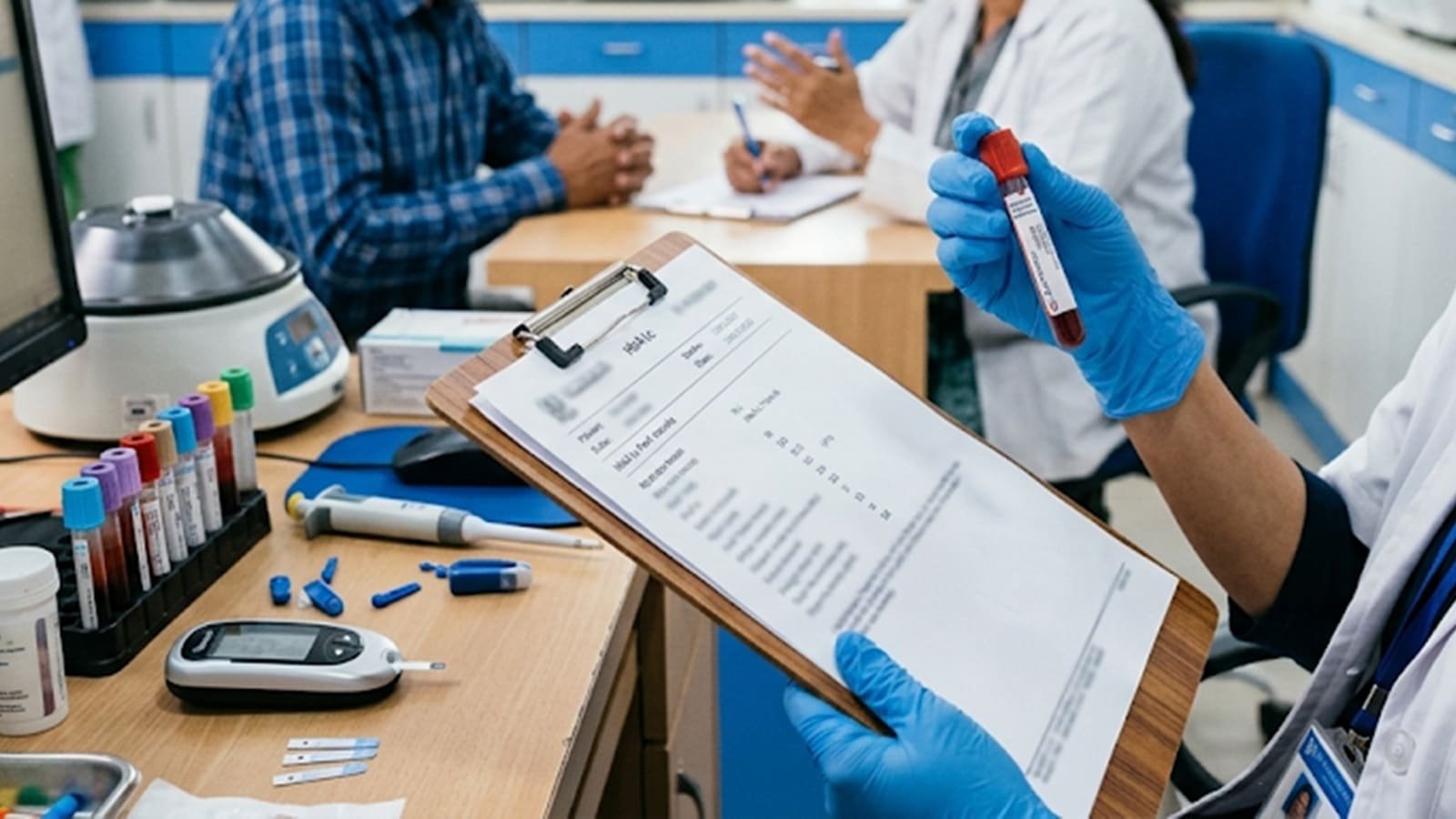
HbA1c tests are widely used to assess long-term blood sugar control and play a major role in diagnosing and monitoring diabetes. However, misconceptions about what can affect HbA1c readings continue to circulate online, particularly around whether extremely high blood sugar levels themselves can make the test unreliable.
Neurologist Dr Sudhir Kumar recently addressed this topic in a detailed post on X, where he attempted to separate theory from clinical reality. He wrote, “Myth-busting: HbA1c & extreme hyperglycemia ❌ Myth: “Very high blood sugar makes HbA1c unreliable in routine practice.” ✅ Truth: It is biochemically possible, but rarely clinically relevant.” Explaining the science behind it, he noted that glucose initially forms a reversible intermediate known as labile HbA1c, which reflects short-term glucose exposure over hours or days rather than long-term control. According to him, “In extreme hyperglycemia, this fraction can transiently increase.” He added that while very high glucose levels can, in theory, interfere with HbA1c measurement and may occasionally make results appear spuriously high or even unmeasurable, this is uncommon in real-world settings.

DISCLAIMER: This article is based on information from the public domain and/or the experts we spoke to. Always consult your health practitioner before starting any routine.
Dr Kumar further explained that modern laboratory methods have significantly reduced such interference, writing, “Modern lab methods largely eliminate this interference”, and that this is “NOT a common reason for misleading HbA1c.” Instead, he stressed that other underlying conditions affecting red blood cells are much more important when interpreting HbA1c values. He listed “Iron deficiency anaemia → falsely ↑ HbA1c,” “Hemolysis → falsely ↓ HbA1c,” and “Haemoglobin variants, CKD → distort results” as more clinically relevant causes of inaccurate readings. Summing up his point, he wrote, “Extreme hyperglycemia can theoretically affect HbA1c. But RBC-related factors are far more important in practice.”
His explanation raises important questions about how HbA1c tests actually work, what can distort the results, and when patients or doctors should interpret readings with caution. To better understand this, we spoke with an expert.
How reliable is the HbA1c test in routine diabetes care?
Kanikka Malhotra, Consultant Dietitian and Diabetes Educator, tells indianexpress.com, “The HbA1c test is a genuinely useful tool in diabetes care. It reflects your average blood sugar over roughly three months by measuring how much sugar has attached to your red blood cells. Think of it as a report card rather than a daily grade. For monitoring how well your diabetes is being managed, it remains dependable. However, treating it as the absolute truth can be misleading.”
Several factors can push the number higher or lower than your actual sugar control. Malhotra mentions, “Iron deficiency anaemia, which is very common in India, especially among women, can falsely raise HbA1c because red blood cells live longer and collect more sugar. On the other hand, conditions that destroy red blood cells quickly, such as sickle cell disease or certain inherited haemoglobin variants, can make the reading appear falsely low. Kidney disease, recent blood transfusions, and even vitamin B12 deficiency can also distort results. This is why your doctor should always read your HbA1c in the context of your full health picture, not in isolation.”
Myth-busting: HbA1c & extreme hyperglycemia
❌ Myth: “Very high blood sugar makes HbA1c unreliable in routine practice.”✅ Truth: It is biochemically possible, but rarely clinically relevant.
What is the science behind this?
🔸Glucose first forms a reversible intermediate…— Dr Sudhir Kumar MD DM (@hyderabaddoctor) May 3, 2026
Why do conditions related to red blood cells affect HbA1c readings more significantly?
This surprises many patients, Malhotra admits, but the science behind it is straightforward. HbA1c is not a direct measure of sugar in your blood. It is a measure of how much sugar has stuck to haemoglobin, the protein inside red blood cells, over the lifespan of those cells, which is roughly 90 to 120 days.
Story continues below this ad
She adds, “So if anything changes the lifespan or number of your red blood cells, the HbA1c reading shifts even if your actual blood sugar is perfectly normal. In iron deficiency anaemia, red blood cells live longer than usual, giving sugar more time to attach and inflating the reading. In hemolytic conditions where red blood cells are destroyed faster, the cells have less time to accumulate sugar, producing a falsely low result. Interestingly, extremely high blood sugar alone does not distort the test the same way because the test is designed to handle a wide range of glucose concentrations. The real wild card is always the red blood cell, not the sugar level itself.”
When should patients and doctors consider additional tests alongside HbA1c?
Dr Kumar advises patients not to discard the HbA1c test but to contextualise it, noting that if you have anaemia or kidney issues, it may not tell the whole story. There are clear situations where additional testing becomes essential.
According to Malhotra, if your HbA1c result seems inconsistent with how you feel or with your home glucose readings, that gap deserves investigation. “For instance, if your daily readings are running high but your HbA1c appears reassuringly normal, a red blood cell disorder may be the explanation. Similarly, if you have been diagnosed with anaemia, chronic kidney disease, liver disease, or any inherited haemoglobin condition, your doctor should not rely on HbA1c alone.”
In these cases, a fasting blood glucose test, a post-meal glucose test, or a continuous glucose monitoring report can provide a clearer picture. “The Oral Glucose Tolerance Test remains particularly valuable for initial diagnosis. Always discuss symptoms, trends, and lifestyle changes with your doctor because numbers only tell part of the story,” concludes Malhotra.
Story continues below this ad
DISCLAIMER: This article is based on information from the public domain and/or the experts we spoke to. Always consult your health practitioner before starting any routine.