

Close Menu

    Subscribe to Updates

    Get the latest news information from worldwide businesses.

    What's Hot

    TechCrunch Mobility: Uber bets on its former CEO

    July 26, 2026

    Crypto exchanges to collect tax residency, ID details of users under new CBDT framework

    July 26, 2026

    Russia crude prices swing wildly amid Iran war

    July 26, 2026
    Facebook Instagram YouTube LinkedIn X (Twitter)
    Trending
    • TechCrunch Mobility: Uber bets on its former CEO
    • Crypto exchanges to collect tax residency, ID details of users under new CBDT framework
    • Russia crude prices swing wildly amid Iran war
    • Global wheat rally revives India’s export prospects as government allows 5 million tonnes of wheat exports after a four-year ban
    • Suspect in Berlin Pride attack killed in police operation, reports say
    • ‘Congress backed from outside, credit goes to youth’: Revanth Reddy on CJP protest | India News
    • Fast-growing pastime comes with hidden danger, ER doctors warn
    • Barcelona star could be used in different position if key defender Ronald Araujo leaves the club: Reports
    Newspublicly
    • About Us
    • Advertise & Partner with us
    • Pitch Your Story
    • Contact Us
    Facebook Instagram LinkedIn X (Twitter)
    Subscribe
    • Home
    • World News
      • Asia
      • India
      • USA
      • UK & Europe
      • Middle East
    • Economy & Business
      • Global Economy
      • Corporate & Industry
      • Finance & Markets
      • Policy & Trade
    • Technology
      • Gadgets & Devices
      • Software & Apps
      • AI & Machine Learning
      • Robotics & Automation
    • Health & Medicine
      • Fitness & Nutrition
      • Research & Innovation
      • Disease & Treatment
      • Doctors, Clinics & Patient Care
    • Travel & Tourism
    • Automobile
      • Electric & Hybrid Vehicles
      • Auto Industry Insights
    • Sports
    • More
      • Education
      • Real Estate
      • Environment & Climate
      • Space & Astronomy
      • War & Conflicts
    Newspublicly
    Home»Health & Medicine»Research & Innovation»After 100 years, scientists finally uncover hidden rule behind cosmic rays
    Research & Innovation

    After 100 years, scientists finally uncover hidden rule behind cosmic rays

    AdminBy AdminMay 14, 2026No Comments3 Mins Read0 Views
    Share
    Facebook Twitter LinkedIn Copy Link WhatsApp


    For more than 100 years, scientists have been trying to understand cosmic rays, incredibly powerful particles that travel across the universe at extreme energies. Despite decades of research, many questions about where they come from and how they are accelerated remain unanswered. Now, researchers working with the DAMPE (Dark Matter Particle Explorer) space telescope have uncovered an important new clue. Their findings, published in Nature, reveal a common feature shared by these mysterious particles and could help scientists better understand their origins.

    Cosmic rays are the highest energy particles ever observed in nature. They carry far more energy than particles produced by even the most advanced accelerators on Earth. Scientists believe they are created by some of the universe’s most violent events, including supernova explosions, jets from black holes, and pulsars.

    Launched in December 2015, the DAMPE space telescope was designed to investigate the nature of cosmic rays and explore possible connections to dark matter. The mission includes major contributions from the astrophysics group at the Department of Nuclear and Particle Physics (DPNC) at the University of Geneva (UNIGE).

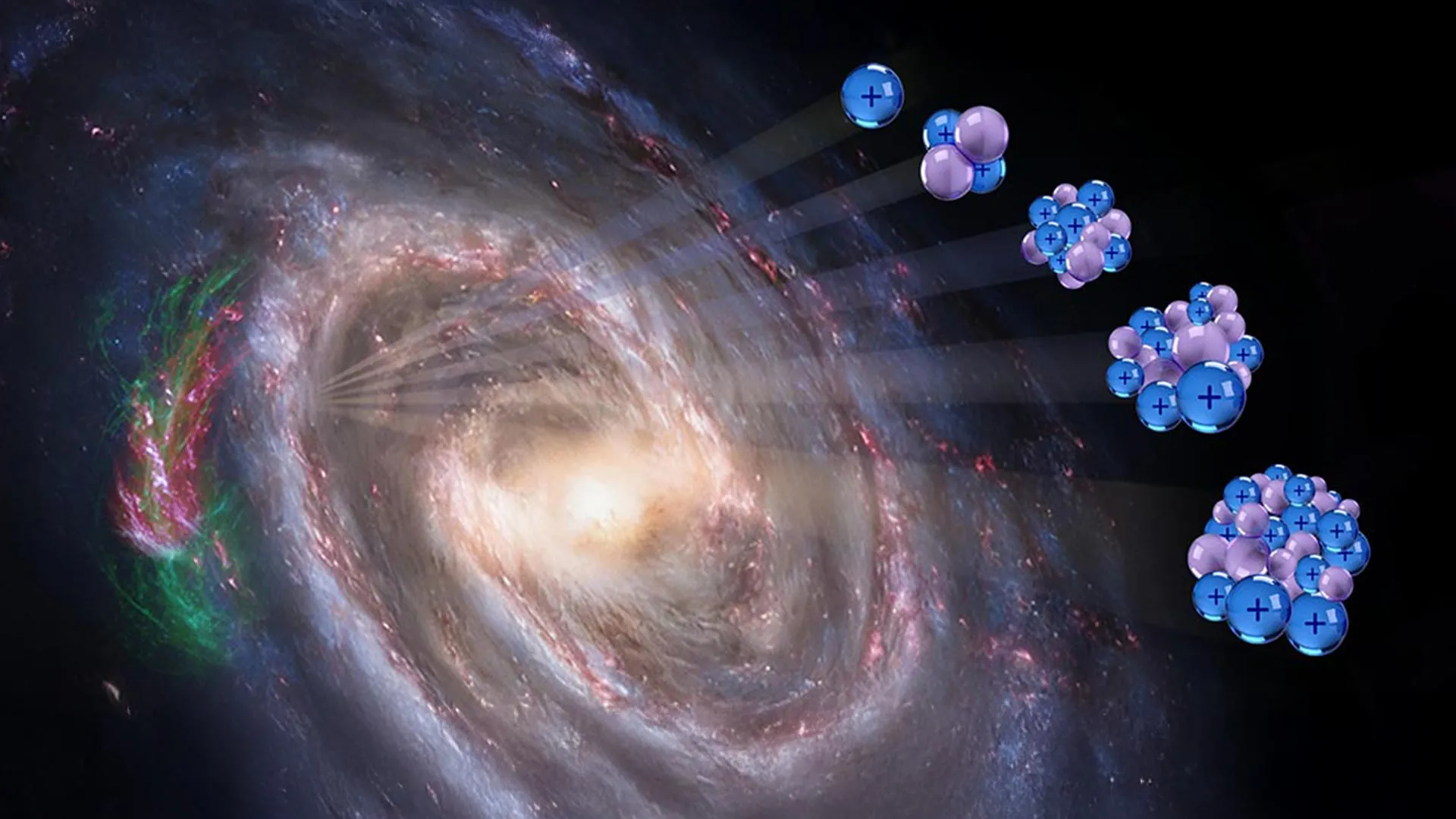
    By examining highly precise data collected by DAMPE, researchers discovered a universal pattern in the energy spectra of primary cosmic ray nuclei, ranging from lightweight protons to much heavier iron nuclei.

    “Cosmic rays are primarily composed of protons, but also of helium, carbon, oxygen, and iron nuclei,” explains Andrii Tykhonov, associate professor at the DPNC in the Faculty of Science at UNIGE, and co-author of the study. “These particles are also categorised according to their energy: low, up to a few billion electron-volts; intermediate, from a few billion to several hundred billion electron-volts; and high, from 1,000 billion electron-volts and beyond.”

    Scientists Discover a Shared Cosmic Ray Pattern

    The research showed that for every type of nucleus studied, the number of particles begins dropping much faster after reaching a certain threshold. Scientists refer to this effect as “spectral softening.”

    Normally, higher-energy cosmic rays become less common as energy increases. However, the DAMPE observations revealed that the decline becomes dramatically steeper beyond a rigidity of roughly 15 TV (teraelectron-volts). Rigidity describes how strongly a particle’s path resists being bent by magnetic fields.

    Because this same feature appears across many different types of particles, the findings strongly support theories suggesting that cosmic ray acceleration and movement through space are controlled by rigidity. At the same time, the data largely rules out competing explanations based on energy per nucleon (energy divided by the number of nucleons in the particle). According to the researchers, the confidence level against those alternative models reaches 99.999%.

    AI and Advanced Detectors Help Drive the Discovery

    Researchers from Geneva played a major role in the breakthrough. The team developed sophisticated artificial intelligence methods to reconstruct particle events detected by the telescope. They also contributed to important measurements involving proton and helium fluxes and helped analyze carbon nuclei data.

    In addition, the Geneva group led the development of one of DAMPE’s key instruments, the Silicon-Tungsten Tracker (STK). This detector is essential for accurately tracing particle paths and determining the electrical charge of incoming cosmic rays.

    The findings mark an important advance in understanding how cosmic rays are created and how they travel through the galaxy. Scientists say the new results place tighter limits on existing models of particle acceleration in astrophysical sources and improve our understanding of how high-energy particles move through interstellar space.


    Source link

    Author

    • Admin

      NewsPublicly.com is News & Articles Platform that creating SEO-focused articles on travel, lifestyle, and digital trends.

    Admin
    • Website

    NewsPublicly.com is News & Articles Platform that creating SEO-focused articles on travel, lifestyle, and digital trends.

    Related Posts

    Hidden genetic diversity helped inbred brown tree snakes conquer guam

    July 26, 2026

    Inside the Backrooms: The internet’s creepiest place is becoming a tourist attraction

    July 26, 2026

    A hidden Alzheimer’s tipping point may decide who gets dementia

    July 26, 2026
    Leave A Reply Cancel Reply

    Demo
    Top Posts

    The Blue Moon rises on May 30— Where and when to see the second full moon of the month

    May 30, 202640 Views

    New SOCOM rifle allows barrel swapping and cartridge changes

    June 1, 202633 Views

    “Inside Gemini Robotics 1.5: How Robots Learn to Reason & Act

    November 22, 202527 Views

    525 pounds of cocaine seized after Nebraska K9 alerts troopers on I-80

    May 28, 202624 Views
    Don't Miss

    TechCrunch Mobility: Uber bets on its former CEO

    July 26, 20268 Mins Read0 Views

    Welcome back to TechCrunch Mobility, your hub for the future of transportation and now, more…

    Crypto exchanges to collect tax residency, ID details of users under new CBDT framework

    July 26, 2026

    Russia crude prices swing wildly amid Iran war

    July 26, 2026

    Global wheat rally revives India’s export prospects as government allows 5 million tonnes of wheat exports after a four-year ban

    July 26, 2026
    Stay In Touch
    • Facebook
    • Twitter
    • Instagram
    • YouTube
    • LinkedIn
    • WhatsApp

    Subscribe to Updates

    Get the latest creative news from SmartMag about art & design.

    Demo
    NEWSPUBLICLY
    Facebook X (Twitter) Instagram LinkedIn

    Home

    • About Us
    • Leadership
    • Advertise & Partner With Us
    • Pitch Your Story
    • Media Kit & Pricing
    • Career
    • FAQs

    Guidelines

    • Editorial & Submission
    • Partnership
    • Advertising & Sponsor
    • Intellectual Property Policy
    • Community & Comment
    • Security & Data Protection
    • Send Your Opinion

    Quick Links

    • Cookie Policy
    • Payment & Billing Terms
    • Refund & Cancellation
    • Copyright Policy
    • Complaint & Support
    • Sitemap
    • Contact Us

    Subscribe Us

    Get the latest news and updates!

    Copyright © 2026 Newspublicly (DIGITALIX COMMUNICATION). All Rights Reserved.
    • Privacy Policy
    • Terms of Use
    • Disclaimer