


Every one of the world’s 50 hottest cities was located inside India at the end of April—a global weather-tracking anomaly, according to a major air-quality monitoring platform.
As an unusual early-season heat wave gripped the country, average peak temperatures across the most sweltering cities hit around 112 degrees Fahrenheit on April 27, data from the company AQI revealed.
In Banda, the northern India city that topped the heat list, the coolest it got that day was 94.5 degrees.
Temperatures have marginally decreased since, though peak temperatures are still nearing or exceeding 100 degrees in many areas. Forecasters say more bouts of extreme heat are on the horizon for May and June, particularly as the El Niño weather pattern overtakes India. Though the country is no stranger to scorching temperatures, research shows extreme heat events are forecast to become more frequent and severe in much of India as climate change accelerates.
This extreme heat is fueling simultaneous health, labor and financial crises across the country, according to a recent white paper published by Harvard University’s Salata Institute for Climate and Sustainability. While the country scrambles to adapt, experts say solutions can be deceptively complex—and some heat wave responses even drive more warming.
A Systemic Heat Issue
With more than 1.4 billion residents, India is the most populated country in the world. It’s also one of the hottest, and a few factors leave the vast majority of its people deeply vulnerable to health and welfare risks posed by heat waves like the event in April.
For one, just 8 percent of households have access to air conditioning. Most must rely on passive cooling strategies such as shade or reflective roofs to mitigate heat impacts at home.
But the problem also follows many people to work: Roughly three-fourths of the country’s workforce is engaged in heat-exposed fields such as agriculture and construction. And informal or gig workers constitute as much as 90 percent of the labor force, leaving many without contracts that include basic standard rights or protections, according to the paper from the Salata Institute’s Climate Adaptation in South Asia research cluster.
“Heat is a systems-wide issue. … It’s related to health, it’s related to housing, related to labor, infrastructure and finance,” paper co-author Kartikeya Bhatotia told me. He’s a climate fellow at the Lakshmi Mittal and Family South Asia Institute at Harvard University. Climate change, he added, “increases the urgency of these issues because it increases the baseline of danger.”
The paper underscores the many layered ways heat touches society in India, from crop losses to exacerbated infectious disease patterns. In the desert salt plains of Gujarat—India’s largest salt producer—workers routinely labor in temperatures above 110 degrees Fahrenheit, forced to stagger their schedules to harvest in the early mornings or after sunset to avoid peak heat, Phys.org reports.
Government officials are struggling to quantify the true scope of heat-related deaths in the country, The New York Times reports. But one report estimates more than 17,000 people died from heat waves there between 2000 and 2020.
Complex Solutions
The recent Harvard paper also explores why most heat mitigation strategies and adaptation policies are falling short, especially as climate change stokes higher temperatures.
One example the researchers give is parametric insurance, which offers predetermined payouts for outdoor workers when temperatures hit a certain level so they do not have to lose income when it’s too hot to work. This strategy can help avoid public health risks and facilitate quick payouts, the paper’s authors wrote, but “runs the risk of being portrayed as a standalone fix.”
They added that it can be complicated to determine if conditions on a given day will meet payout requirements or what metrics should trigger payouts because people face different heat-health risks based on factors such as age. The researchers also noted that parametric insurers could face major losses as climate change accelerates if they don’t raise premium prices, similar to other insurance models.
India has pioneered heat action plans across its major cities, which aim to implement better early warning systems, emergency aid and infrastructure changes. But the study’s authors argue that “the very ambition of their scope creates a weakness.”
“Without careful integration into existing workflows of government, they risk being overwhelmed by the conflicting priorities of daily administration and, eventually, ignored,” the report says.
Expanding air conditioning access across India might seem like the most straightforward solution. But this can pose a different climate conundrum.
Data shows the late-April heat wave drove a spike in electricity demand in India, likely due to an uptick in air conditioning usage, experts say. With liquefied natural gas and petroleum gas supplies already short due to the Iran war, the country ramped up its use of coal to meet demand, CNBC reports.
Though renewable energy sources in India have risen in recent years—with more than half of total installed power generation capacity coming from non-fossil-fuel sources, as of February—coal still reigns supreme as the single largest electricity producer in the country.
Frequent and intense heat waves could perpetuate this fossil fuel demand, which would in turn drive more global warming—a catch-22 seen in other parts of the world as well.
“Definitely there exists a challenge in recommending how cooling can be deployed in the most efficient way [so] that it doesn’t worsen the problem,” Bhatotia said, “but also addresses the very real and urgent issues of heat.”
More Top Climate News
President Donald Trump on Monday tapped former Navy SEAL Cameron Hamilton to run the Federal Emergency Management Agency, Scott Dance reports for The New York Times. If that name sounds familiar to you, it’s because Hamilton was acting administrator of the agency last year before the Trump administration booted him after he testified to Congress that FEMA should not be eliminated. Trump previously moved to abolish FEMA but has since walked that back and instead seeks an overhaul to shift much of the post-disaster responsibilities to state and local governments. Pushback from Democrats is expected because Hamilton has much less experience leading disaster management efforts than prior FEMA administrators, critics argue.
Climate change could increase the risk of rodent-borne diseases such as hantavirus spilling over to humans, Zoya Teirstein reports for Grist. A group of people on a cruise ship departing from Argentina in April were infected with the hantavirus, and three have died. Officials believe it may have first been contracted during a birding trip at a landfill in Argentina, where rodents are known to congregate. Hantavirus cases in the country have surged this year, and though scientists are not yet certain why, research suggests that climate-fueled extreme weather may be changing rat behavior and pushing infected rodents closer to humans.
Environmental groups filed a motion to intervene in a lawsuit that aims to overturn vessel speed restriction rules along the East Coast of the U.S. Vessel strikes are one of the leading causes of death for the endangered North Atlantic right whale. To protect them, the National Oceanic and Atmospheric Administration has imposed seasonal boat speed limits since 2008 on vessels 65 feet and longer in parts of the region. In 2022, a boat captain and the vessel owner who hired him were cited for violating this rule by exceeding the 10-knot speed limit, and fined $15,000. The men filed a suit against NOAA, arguing the agency did not have the authority to issue the rule in the first place. Separately, the Trump administration said in March that it is planning a “deregulatory action” on the vessel speed reduction rule that aims to “reduce unnecessary regulatory and economic burdens.”
Postcard From … Colorado
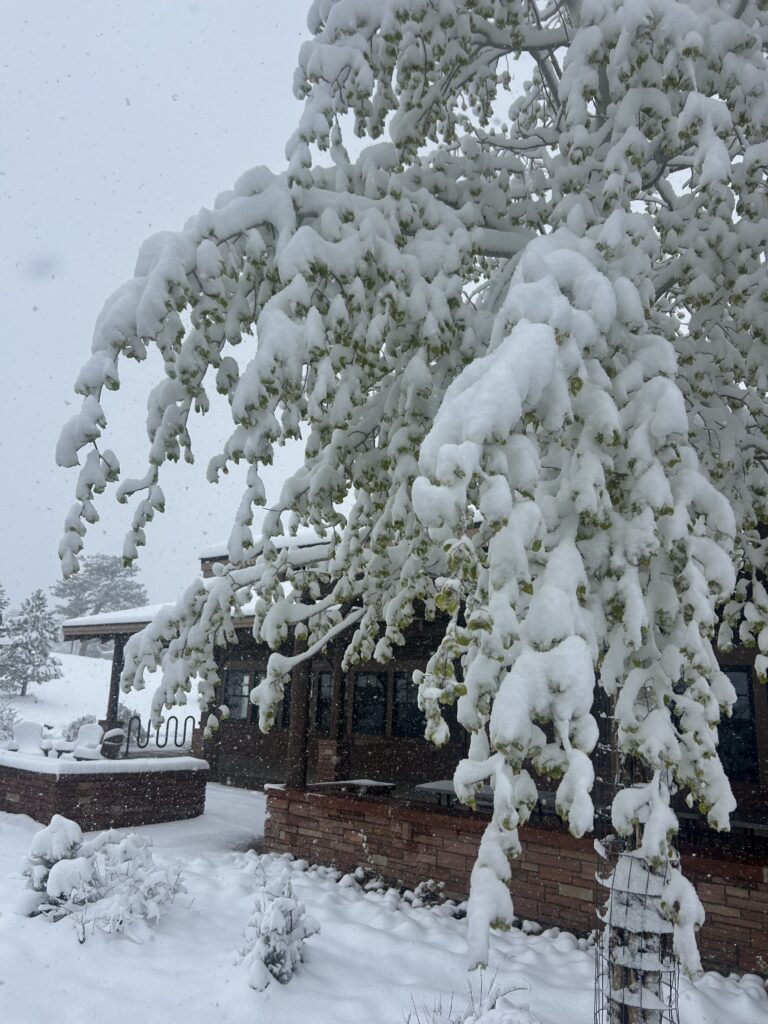

Last week, Inside Climate News staff meeting in Colorado for a retreat were greeted by a late-season snowstorm that dumped nearly three feet in some areas outside Rocky Mountain National Park.
Although snow in May felt a little unusual, the storm itself was a welcome reprieve for the state, which is in the midst of one of the worst snowdroughts in recent history (as I reported in March). Unfortunately, much of the snow melted in a few days. Experts say snowpack in the state is still very low, and it will take much more precipitation in May to mitigate the most severe fire threats and fill water reserves.
Still, seeing elk frolicking in the wintry mix brought a smile to all of our faces.
About This Story
Perhaps you noticed: This story, like all the news we publish, is free to read. That’s because Inside Climate News is a 501c3 nonprofit organization. We do not charge a subscription fee, lock our news behind a paywall, or clutter our website with ads. We make our news on climate and the environment freely available to you and anyone who wants it.
That’s not all. We also share our news for free with scores of other media organizations around the country. Many of them can’t afford to do environmental journalism of their own. We’ve built bureaus from coast to coast to report local stories, collaborate with local newsrooms and co-publish articles so that this vital work is shared as widely as possible.
Two of us launched ICN in 2007. Six years later we earned a Pulitzer Prize for National Reporting, and now we run the oldest and largest dedicated climate newsroom in the nation. We tell the story in all its complexity. We hold polluters accountable. We expose environmental injustice. We debunk misinformation. We scrutinize solutions and inspire action.
Donations from readers like you fund every aspect of what we do. If you don’t already, will you support our ongoing work, our reporting on the biggest crisis facing our planet, and help us reach even more readers in more places?
Please take a moment to make a tax-deductible donation. Every one of them makes a difference.
Thank you,

Reporter
Kiley Price is a reporter at Inside Climate News, with a particular interest in wildlife, ocean health, food systems and climate change. She writes ICN’s “Today’s Climate” newsletter, which covers the most pressing environmental news each week.
She earned her master’s degree in science journalism at New York University, and her bachelor’s degree in biology at Wake Forest University. Her work has appeared in National Geographic, Time, Scientific American and more. She is a former Pulitzer Reporting Fellow, during which she spent a month in Thailand covering the intersection between Buddhism and the country’s environmental movement.