

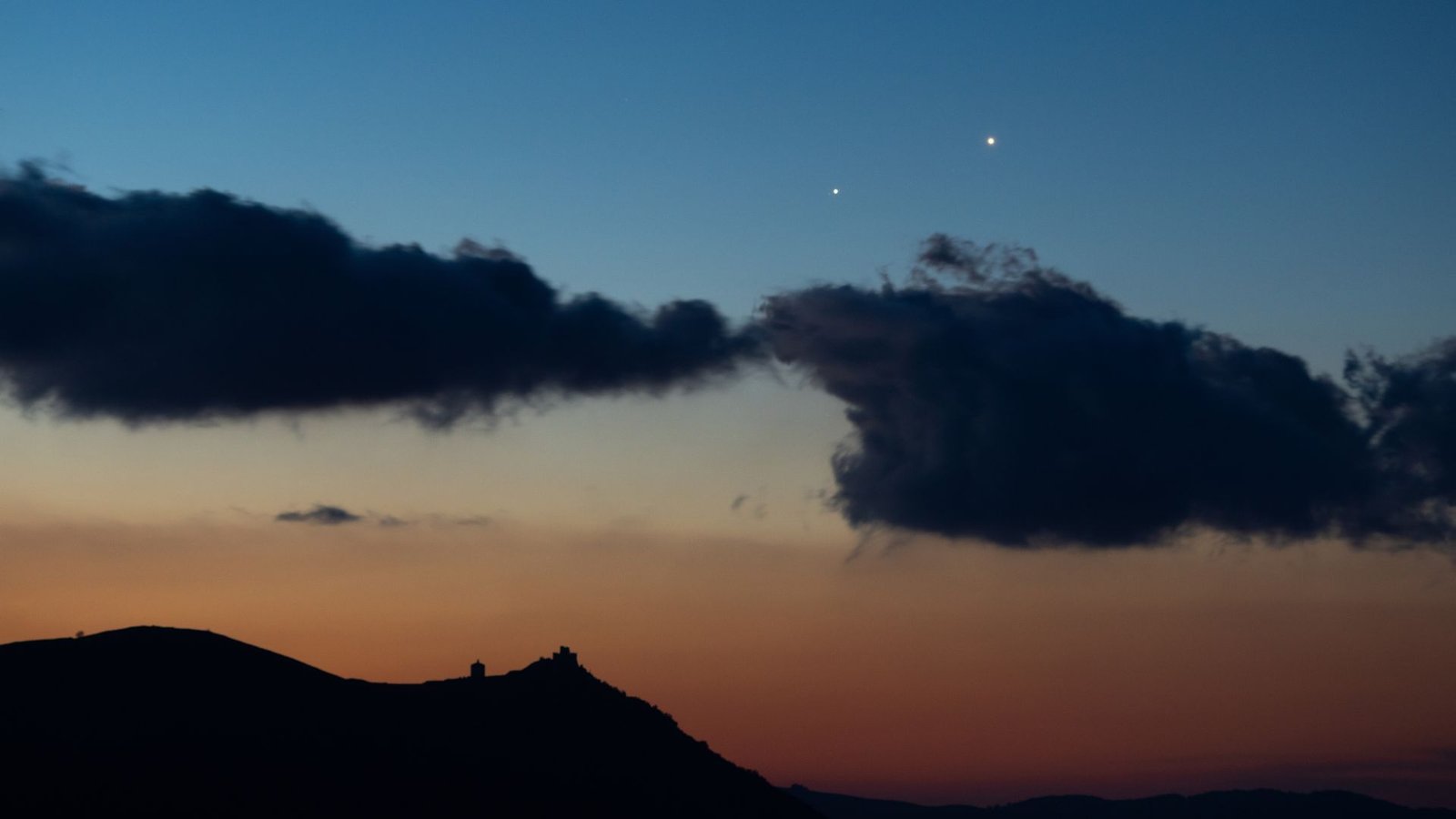
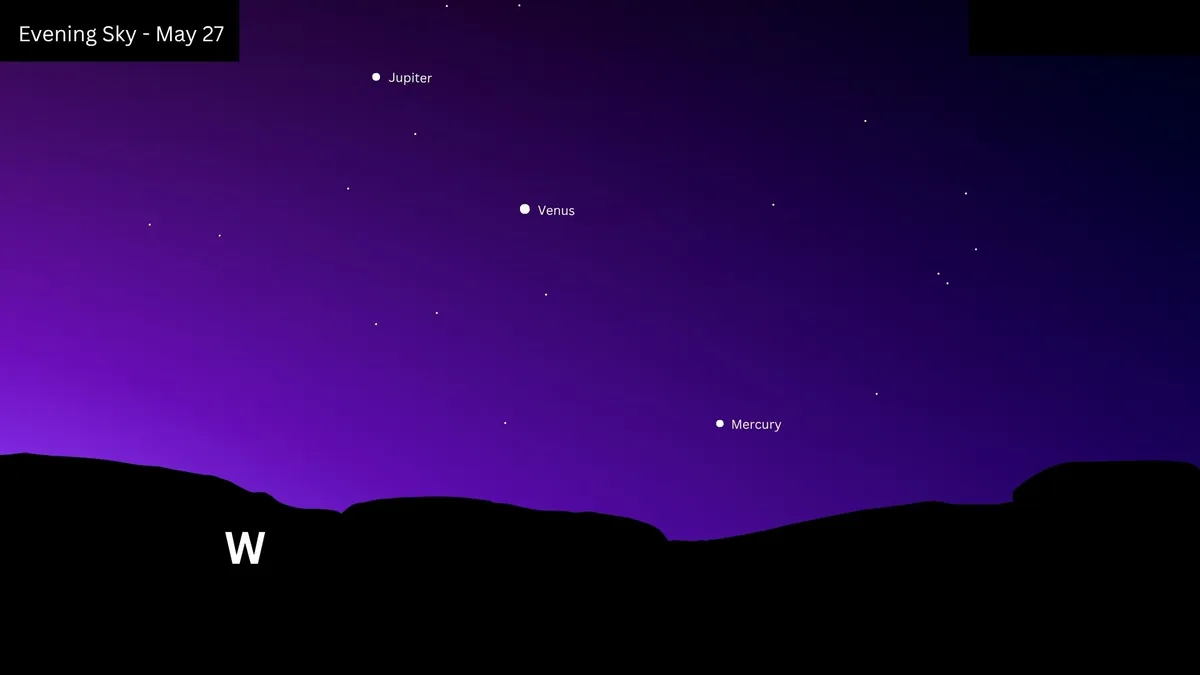
Don’t miss Jupiter, Venus and Mercury put on a spectacular show as they line up in the evening sky on May 27, creating a ‘planetary bridge’ between the constellations of Gemini and Taurus.
Jupiter will shine as a steady point of light roughly 30 degrees above the western horizon at sunset, with Venus appearing as a bright star-like object to its lower right. Mercury will complete the line-up, glistening close to the horizon, but will prove a greater challenge to spot in the glow of the setting sun.
Wait until the sun is safely below the horizon before turning your binoculars or a small telescope on Jupiter. Don’t forget, you can use a trusted resource like Time and Date’s daylight tracker to discover exactly when the sun will set from your location.
With clear skies and a small telescope or pair of binoculars, you should be able to spot four bright points of light clustered around the gas giant‘s glowing disk, representing the four large Galilean moons Io, Europa, Ganymede and Callisto.
Celestron Inspire 100AZ
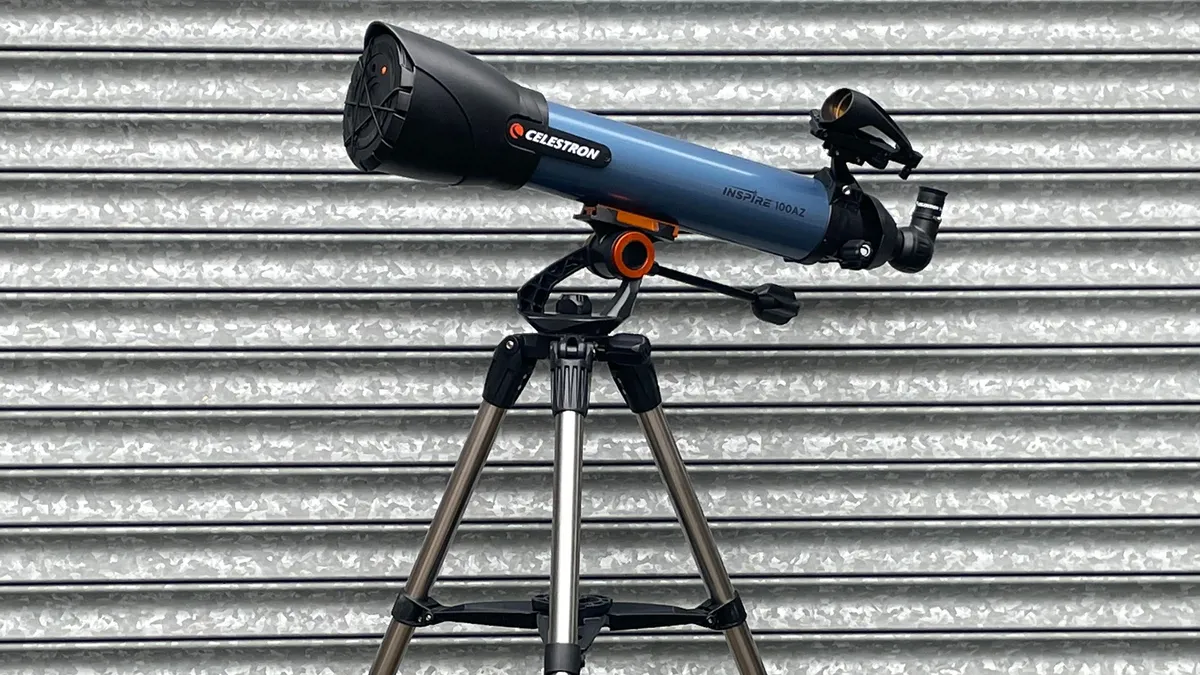
The Celestron Inspire 100AZ is, in our opinion, the best telescope for viewing the planets, for beginners. It’s an affordable model that provides crisp views of the moon and planets and it provides an opportunity to do some basic astrophotography. It features a 70mm aperture, a 660mm focal length, it comes with a stable tripod and a smartphone adaptor for astrophotography. Why not take a look at our Celestron Inspire 100AZ review?
A 4-inch scope should allow you to pick out the moon-like phases of Venus, while a larger 6 to 8-inch telescope will help reveal the multicoloured cloud bands that line Jupiter’s atmosphere, along with colossal storms that dwarf the most ferocious weather systems of Earth.
Mercury will set less than 90 minutes after the sun on May 27 for viewers in the U.S., with Venus slipping below the western horizon roughly an hour later. Jupiter, meanwhile, will linger later in the western sky, finally disappearing shortly before midnight alongside the bright stars Castor and Pollux, which represent the heads of the celestial twins in the constellation Gemini.
Want to get a closer look at Jupiter and the other worlds of the solar system? Then be sure to check out our roundups of the best telescopes and binoculars for exploring the night sky, while photographers should read up on our picks for the top cameras and lenses for astrophotography.
Editor’s Note: If you snap a photo of the planetary line-up and want to share it with Space.com’s readers, then please send your image(s) alongside your comments, name and location to spacephotos@space.com.