

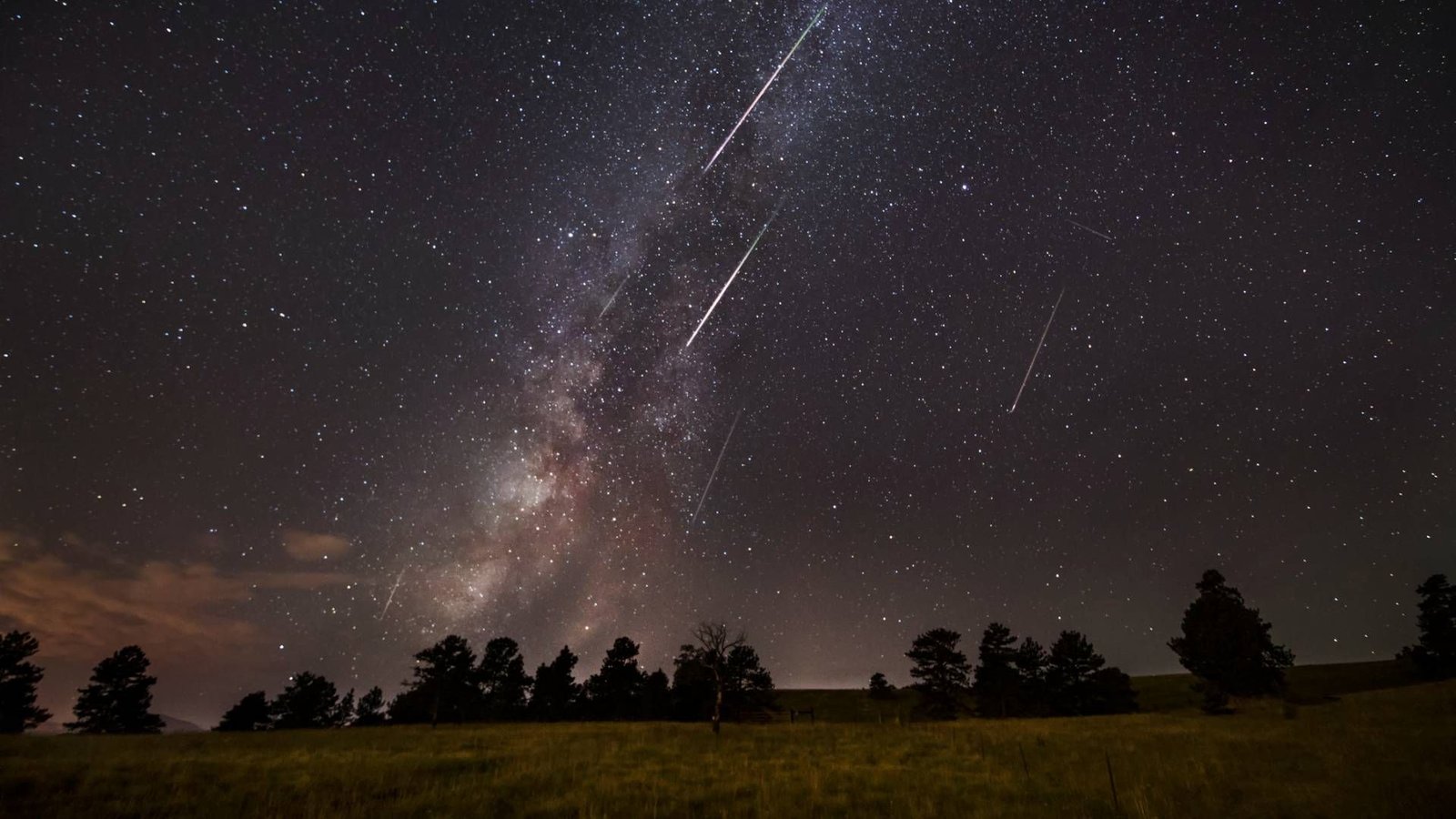
Aug. 12, 2026, offers a rare double-header for skywatchers across northeastern North America: a partial solar eclipse during the afternoon followed, hours later, by the peak of the Perseid meteor shower beneath dark summer skies. The eclipse is part of a total solar eclipse happening in eastern Greenland, western Iceland and northern Spain.
“The neat thing about seeing a partial eclipse, especially one that is total somewhere else, is that you get to join in with the whole event that’s going on,” Tyler Nordgren, astronomer and eclipse artist at Space Art Travel Bureau, told Space.com. “It is a worldwide event, and you can get a sense of the three‑dimensional nature of the universe.”
Together, the two events make a perfect excuse for an overnight astronomy road trip — whether that means heading into the mountains, camping beside a lake or escaping to a remote coastline. Pack a reclining camp chair, warm layers and plenty of bug spray, but before you do anything else, book a campsite because peak Perseids night can be one of the busiest camping nights of the year.
Do take precautions with the solar eclipse. “It will not be safe to look at with the naked eye, and it will not be safe to photograph with a camera that doesn’t have a solar filter on it,” Nordgren explained. “If you’ve got eclipse glasses left over from 2024, take them out, point them at a bright light bulb, and make sure there is no light coming through any pin pricks or scratches.”
Eclipse timings and sightlines are from Xavier Jubier’s Interactive Google Maps; cloud cover is from Time and Date, and Bortle and sky quality meter (SQM) data come from the Light Pollution map. Bortle and SQM ratings indicate darker skies and better stargazing conditions.
REMEMBER: During a partial solar eclipse, it is never safe to look directly at the sun without proper solar viewing protection, such as certified eclipse glasses or approved solar filters. Read our guide on how to observe the sun safely.
1. Gros Morne National Park, Newfoundland

Location: Newfoundland, Canada
Max eclipse: 49% at 3:26 p.m. NDT
Sun position: 47° above the southwest horizon
Eclipse window: 2:20-4:28 p.m. NDT
Light pollution: 3.0 Bortle/SQM 21.89
Average August cloud cover: 74%
Gros Morne National Park combines relatively dark skies with the deepest eclipse in eastern North America, with nearly half of the sun obscured at maximum. Coastal viewpoints, lakeshores and elevated trails offer wide southwest-facing horizons for the afternoon eclipse, while the park’s low levels of artificial light make it well suited for Perseid viewing after midnight. The main drawback is Newfoundland’s often variable weather and relatively high average cloud cover.
2. Mount Carleton Dark-Sky Preserve, New Brunswick

Location: Mount Carleton Provincial Park, New Brunswick, Canada
Max eclipse: 31% at 2:50 p.m. ADT
Sun position: 54° above the southwest horizon
Eclipse window: 1:48–3:49 p.m. ADT
Light pollution: 2.2 Bortle/SQM 21.97
Average August cloud cover: 63%
Mount Carleton Provincial Park has some of the darkest skies in Atlantic Canada, with Bortle 2 conditions across much of the preserve. Open areas around Mount Carleton and nearby lakes provide unobstructed southwest views for the eclipse, while the remote setting is perfect for Perseid observing later that night. Campgrounds inside the park make it practical for an overnight trip.
3. Fundy Dark-Sky Preserve, New Brunswick

Location: Fundy National Park, Alma, New Brunswick, Canada
Max eclipse: 31% at 2:56 p.m. ADT
Sun position: 54° above the southwest horizon
Eclipse window: 1:54-3:54 p.m. ADT
Light pollution: 3.1 Bortle/SQM 21.88
Average August cloud cover: 56%
Fundy National Park offers reasonably dark skies and accessible observing locations along the Bay of Fundy coast. Open areas around Wolfe Lake and Chignecto Campground provide good visibility toward the southwest during the eclipse, while the surrounding dark-sky corridor supports decent Perseid observing conditions after dark. Coastal “Fundy fog” and changing maritime weather can occasionally affect visibility.
4. Kejimkujik National Park, Nova Scotia

Location: Nova Scotia, Canada
Max eclipse: 28% at 2:58 p.m. ADT
Sun position: 54° above the southwest horizon
Eclipse window: 1:57-3:56 p.m. ADT
Light pollution: 2.2 Bortle / SQM 21.96
Average August cloud cover: 49%
Kejimkujik National Park remains one of the darkest accessible observing sites in Atlantic Canada, with low light pollution and broad lake horizons that are well-suited to meteor observing. The partial eclipse here approaches 30%, and the park’s lakeside campgrounds provide convenient overnight access for Perseid watching later that evening. Compared with many coastal locations in the region, Kejimkujik also has somewhat lower average cloud cover.
5. Acadia National Park, Maine

Location: Bar Harbor, Maine, US
Max eclipse: 24% at 1:54 p.m. EDT
Sun position: 56° above the southwest horizon
Eclipse window: 12:56-2:50 p.m. EDT
Light pollution: 4.1 Bortle / SQM 21.58
Average August cloud cover: 50%
Acadia National Park combines relatively accessible dark skies with open coastal horizons facing the eclipse. Elevated viewpoints around Cadillac Mountain and the Schoodic Peninsula offer clear sightlines toward the southwestern sky, while overnight observers can expect reasonably dark conditions for Perseid viewing by northeastern U.S. standards. Summer crowds and vehicle access restrictions around Cadillac Summit mean you should make a plan well in advance.
6. Mont Mégantic Dark Sky Reserve, Quebec

Location: Le Haut-Saint-François, Quebec, Canada
Max eclipse: 22% at 1:49 p.m. EDT
Sun position: 57° above the southwest horizon
Eclipse window: 12:51-2:44 p.m. EDT
Light pollution: 3.4 Bortle / SQM 21.82
Average August cloud cover: 67%
Mont-Mégantic is one of the best-established astronomy sites in eastern North America, with protected dark skies and extensive observing infrastructure around the observatory and national park. Although the eclipse magnitude is moderate, the reserve’s dark nighttime conditions and elevated observing areas make it a strong location for Perseid observing after dark. Cloud statistics are less favorable than farther south in New England.
7. Adirondack Mountains, New York

Location: Hamilton County, New York, US
Max eclipse: 15% at 1:47 p.m. EDT
Sun position: 59° above the southwest horizon
Eclipse window: 12:54-2:38 p.m. EDT
Light pollution: 2.8 Bortle / SQM 21.90
Average August cloud cover: 57%
The Adirondacks offer some of the darkest skies in the northeastern U.S., particularly around remote lakes and higher-elevation observing sites. While the partial eclipse will be modest, the region’s low artificial light levels and broad rural horizons make it a strong overnight option for the Perseids. Public campgrounds and astronomy events at local observatories may fill quickly around peak Perseid night. Check the Adirondack Sky Center & Observatory for events.
8. Catskill Mountains, New York

Location: Catskill Mountains, Shandaken, New York, US
Max eclipse: 11% at 1:51 p.m. EDT
Sun position: 61° above the southwest horizon
Eclipse window: 1:02-2:37 p.m. EDT
Light pollution: 4.0 Bortle/SQM 21.59
Average August cloud cover: 65%
The Catskills provide relatively accessible dark skies within a few hours of major northeastern cities, making them a practical option for short-notice observing trips. The partial eclipse will be small, but reservoirs, ridgelines and open viewpoints offer decent southwest sightlines during the afternoon event. Overnight conditions are darker than much of the surrounding northeast region, particularly away from populated valleys.
9. Cherry Springs Dark Sky Park, Pennsylvania

Location: Cherry Springs State Park, Pennsylvania
Max eclipse: 7% at 1:46 p.m. EDT
Sun position: 62° above the south-southwest horizon
Eclipse window: 1:04-2:27 p.m. EDT
Light pollution: 3.2 Bortle / SQM 21.86
Average August cloud cover: 66%
Cherry Springs State Park is one of the best-known observing locations in the eastern US, with very dark skies and unusually open horizons in all directions. Although the eclipse itself will be very shallow, the park is among the best suited for the Perseids later that night, when low light pollution and established observing fields provide excellent meteor-viewing conditions. Expect heavy attendance around the shower peak.
10. Assateague Island National Seashore, Maryland

Location: Worcester County, Maryland, US
Max eclipse: 4% at 1:57 p.m. EDT
Sun position: 64° above the southwest horizon
Eclipse window: 1:20-2:33 p.m. EDT
Light pollution: 4.1 Bortle/SQM 21.59
Average August cloud cover: 55%
Assateague Island offers unobstructed coastal horizons and relatively low light pollution for the mid-Atlantic region. The partial eclipse here will be a technical affair, but the island’s open beaches provide excellent naked-eye conditions for Perseid observing after dark, especially looking away from nearby coastal development. However, humidity, sea haze and mosquitoes can be significant factors during August observing sessions.