





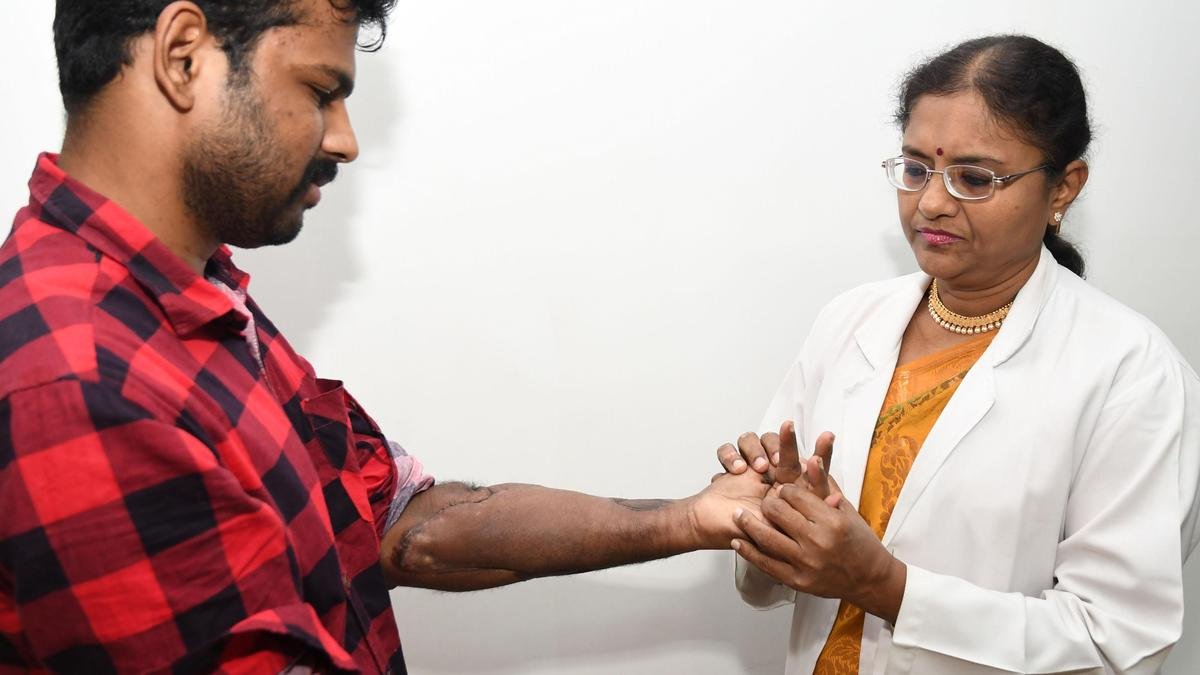
Nearly a decade after undergoing Tamil Nadu’s first double hand transplant at Chennai’s Government Stanley Medical College Hospital, R. Narayanaswamy, who lost both hands in an electrocution accident in 2015, says he is now able to function well with his transplanted hands and carry out daily activities independently.
Hand transplantation, a highly specialised form of vascularised composite allotransplantation, is among the most complex procedures performed in reconstructive microsurgery. The surgery involves transplanting a donor hand onto a recipient by reconnecting bones, blood vessels, nerves, tendons, muscles, and skin through advanced microsurgical techniques.
Unlike conventional prosthetic limbs, a transplanted hand may restore certain sensory functions such as touch and temperature perception because nerves can gradually regenerate after surgery. However, specialists caution that the procedure is medically demanding, involves lifelong immunosuppressive therapy, and requires prolonged rehabilitation and monitoring.

Why it’s needed
According to the World Health Organization, over 1.3 billion people worldwide live with significant disability, including disabilities related to limb loss caused by trauma, vascular disease, congenital conditions, infections, diabetes, and accidents. The WHO has also noted that there are major global gaps in access to rehabilitation and assistive technologies, particularly in low- and middle-income countries.
Although hand transplantation remains relatively rare globally because of its complexity and long-term risks, India is among the leading countries when it comes to performing bilateral hand transplant procedures, with several centres carrying out advanced reconstructive transplant surgeries.

Sensory recovery
Doctors say one of the key differences between hand transplantation and prosthetic limbs is the possibility of sensory recovery. S. Narayanamurthy, senior consultant and head of the department of plastic, aesthetic and reconstructive microsurgery, MGM Healthcare, Chennai, says transplanted hands can gradually become integrated into the patient’s body through nerve regeneration. “The biggest difference between using an advanced prosthesis and a hand transplant is when you do a hand transplant you get a hand that is full of life,” he says. He explains that while modern prosthetics can provide functional movement, they do not fully replicate tactile sensation.
“With a hand transplant there is a very high possibility that the patient will get back his own sensations,” Dr. Narayanamurthy says. “He can feel whatever he is going to touch, whereas in a prosthesis he will not be able to perceive what he is touching.”
G. Karthikeyan, director and senior consultant in plastic surgery, SIMS Hospital, Chennai, says sensation remains a major limitation in prosthetic technology.“Even the most advanced prosthetics cannot provide what is known as sensation in the hand, which is very important for tactile perception,” he says.
Specialists note that patient selection is critical. Younger patients with bilateral upper-limb amputations who can adhere to long-term physiotherapy and medical follow-up are often considered the most suitable candidates for transplantation.

Surgery and care
Hand transplantation requires extensive surgical coordination and careful donor-recipient matching. Blood group compatibility is essential to reduce rejection risks, and the donor limb must be transported rapidly to minimise tissue damage. The surgery itself can last between 12 and 15 hours and often requires multiple surgical teams working simultaneously. “We need at least four surgeons on each hand,” says Dr. Narayanamurthy. One of the technically demanding parts of the surgery involves reconnecting blood vessels measuring only one or two millimetres in diameter through microvascular anastomosis.
Postoperative monitoring is crucial because clotting, swelling, or vascular compromise can affect blood flow to the transplanted limb. Another major complication is reperfusion injury, in which the body reacts strongly to the transplanted tissue after blood supply is restored. Acute graft rejection also remains a major concern in the postoperative period and requires continuous surveillance.

Rehabilitation and follow-up
Specialists say surgery alone does not determine outcomes after hand transplantation. “When we do the surgery it is only half done,” says Dr. Narayanamurthy. “Results will be achieved only after follow-up physiotherapy.” Physiotherapy often begins within days after surgery and continues for months or years, focusing on movement, coordination, muscle strengthening, and sensory retraining. Nerve regeneration occurs slowly, usually at approximately one millimetre per day. “So this takes a few months for it to reach the fingers or the fingertips,” Dr. Narayanamurthy says.
Dr. Karthikeyan says the level of amputation significantly influences recovery timelines. “If the amputation level is closer to the hand, the return of nerve function and sensation is relatively quick, usually within three to five months,” he says. In amputations involving the arm, nerve regeneration may take up to a year.
Specialists add that patients must take lifelong immunosuppressive medication to prevent graft rejection. These drugs may themselves carry long-term risks, including increased susceptibility to infections, diabetes, and certain cancers.
Ethical and psychological considerations
Doctors say hand transplantation also involves significant psychological and ethical considerations. Patients must be counselled extensively before surgery regarding expectations, appearance, rehabilitation requirements, and lifelong medication use.
“There are other concerns that usually crop up like the pigment difference,” says Dr. Narayanamurthy, referring to skin tone mismatch between donor and recipient. He adds that acceptance of the transplanted limb as part of one’s own body is an important psychological aspect of recovery. Specialists also note unusual medico-legal considerations associated with donor fingerprints being transferred to the recipient. “The patient is going to receive the fingerprint of the donor,” Dr. Narayanamurthy says, stressing the importance of proper transplant documentation and registry systems.
Doctors say family support is equally important because patients may require assistance with daily activities, physiotherapy, and long-term medical care.
Ongoing research
Dr. Sunil Shroff, trustee of the MOHAN Foundation, says India has emerged as one of the global leaders in hand transplantation and has performed among the highest numbers of such procedures worldwide.
He also points to some of the unique ethical and aesthetic considerations associated with the procedure. “Many women receive hands from male donors. Initially, these hands may appear more muscular or darker and may not aesthetically match the recipient,” he says. “However, over time we have observed that the colour gradually changes and the hands also begin to appear more feminine, which is an interesting phenomenon.”
Researchers are now increasingly exploring ways to reduce the complications associated with lifelong immunosuppressive therapy . Current research is examining “immunoregulation,” aimed at modifying the immune response so the transplanted limb may be better tolerated by the body with fewer complications.
Specialists also say ongoing advances in microsurgery, rehabilitation science, and nerve regeneration research may improve long-term functional outcomes in future transplant procedures.


