

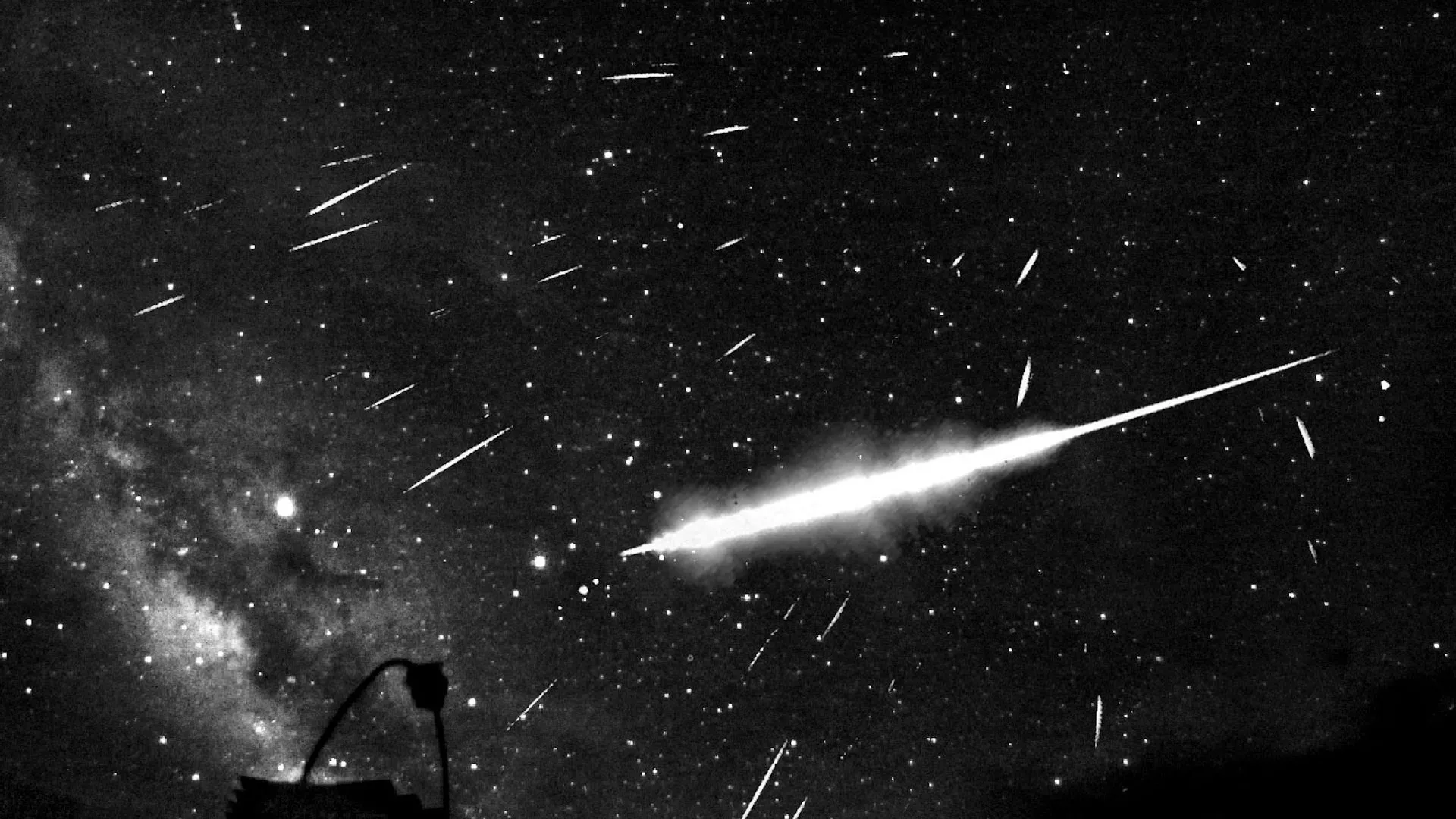
Every night around the world, thousands of automated sky cameras watch for flashes of light streaking across the atmosphere. I am one of the scientists who studies these meteors and what they can reveal about our solar system.
Popular movies and breaking news alerts usually focus on giant asteroids that could threaten Earth. Every few months, people also hear about another large space rock making a close flyby. But the much smaller particles that constantly enter Earth’s atmosphere every day can tell scientists an equally fascinating story.
My colleagues in planetary science and I analyze images from night sky camera networks to study cosmic dust, small asteroids and debris left behind by comets.
In research published in March 2026, I examined millions of meteor detections recorded by all sky camera systems in Canada, Japan, California and Europe. During that search, I identified a small cluster of recently formed meteors. The 282 meteors in this group appear to trace back to an asteroid that ventured dangerously close to the Sun.
How Meteors Form
When a tiny grain of rock from space enters Earth’s atmosphere, it rapidly heats up. Its outer layer vaporizes and becomes an electrically charged gas, causing the object to glow brightly. That glowing streak is what scientists call a meteor. Larger incoming objects, such as boulder sized rocks that create especially bright flashes, are known as bolides or fireballs.
These objects usually slam into the atmosphere at speeds exceeding 15 miles per second. For very small particles, the entire event lasts only a split second before the material completely burns up.
Most tiny fragments that create meteors originally come from comets, icy objects that formed in the cold outer solar system. As a comet approaches the Sun, its ice turns directly into gas and releases huge amounts of dust into space. This process gives comets their fuzzy appearance and explains why astronomers often refer to them as “dirty snowballs.”
Asteroids are different. They formed closer to the Sun early in the solar system’s history and are generally dry, rocky bodies without the icy material that produces comet tails.
What Makes an Asteroid “Active”?
Astronomers describe an asteroid or comet as “active” when it releases dust, gas or larger pieces of material into space. Several different forces can trigger this activity, including heat from the Sun, collisions or extremely rapid spinning that causes the object to break apart.
Studying this activity helps scientists understand how asteroids and comets physically evolve over time.
For comets, the main driver is usually sublimation of ice. This happens when solid ice changes directly into gas without first becoming liquid. Asteroids, however, can become active for a variety of reasons.
NASA’s OSIRIS-REx mission, which visited the asteroid Bennu, observed material erupting from the asteroid’s surface. Scientists believe heat stress and tiny impacts were among the most likely causes.
Other possible explanations for asteroid activity include rotational breakup, gravitational tidal forces during close planetary encounters and the release of trapped gases.
Astronomers often look for signs of activity using telescopes. A visible tail or a fuzzy cloud surrounding an object usually signals the presence of gas and dust. But meteor showers provide another powerful way to detect active objects in space.
Meteor Showers Can Reveal Hidden Asteroids
One of the best known active asteroids is 3200 Phaethon, the source of the Geminid meteor shower that peaks every December. During close passes near the Sun, Phaethon released large amounts of dust and debris. Over time, those fragments spread out along the asteroid’s orbit, creating the meteor stream Earth passes through each year.
Meteor showers occur whenever Earth moves through one of these streams of debris. Because of this, meteor showers can help astronomers uncover active asteroids and comets that might otherwise remain hidden.
When debris first separates from an asteroid or comet, the fragments stay tightly grouped together. Imagine squeezing a drop of food coloring into flowing water. At first, the color remains concentrated, but the movement of the water gradually spreads it apart.
A similar process happens in space. Gravitational pulls from planets slowly tug on the individual fragments in different ways, causing the once compact stream to spread out and eventually blend into the background dust filling the solar system.
Discovery of a Sun-Baked “Rock-Comet”
In my March 2026 study published in the Astrophysical Journal, I searched through millions of meteor observations looking for evidence of previously unknown asteroid activity near Earth. One cluster containing 282 meteors clearly stood out.
The discovery is exciting because it appears to capture an asteroid actively breaking down under intense solar heat. The newly identified meteor stream follows an extreme orbit that carries it nearly five times closer to the Sun than Earth’s orbit.
By studying how these meteors fragment in Earth’s atmosphere, scientists can tell they are somewhat fragile, although still stronger than typical comet material. The evidence suggests that extreme heating from the Sun is cracking the asteroid’s surface, releasing trapped gases and causing the body to slowly crumble apart.
This same process may explain much of the past activity seen from Phaethon and could also help explain why meteorites found on Earth vary so widely in composition and structure.
Searching for the Parent Asteroid
Finding a hidden asteroid that is actively falling apart is important because meteor observations can reveal objects that ordinary telescopes cannot detect.
In addition to solving scientific mysteries, studying this debris helps researchers better understand how asteroids and comets change over time. It also uncovers previously hidden populations of near Earth asteroids, which is valuable information for planetary defense efforts.
Scientists still have not identified the parent asteroid responsible for this newly discovered meteor shower. However, NASA’s NEO Surveyor mission, scheduled to launch in 2027, could help solve the mystery.
The spacecraft is specifically designed to detect dark, potentially hazardous asteroids that travel close to the Sun. That makes it an ideal tool for tracking down the source of this unusual meteor stream.