





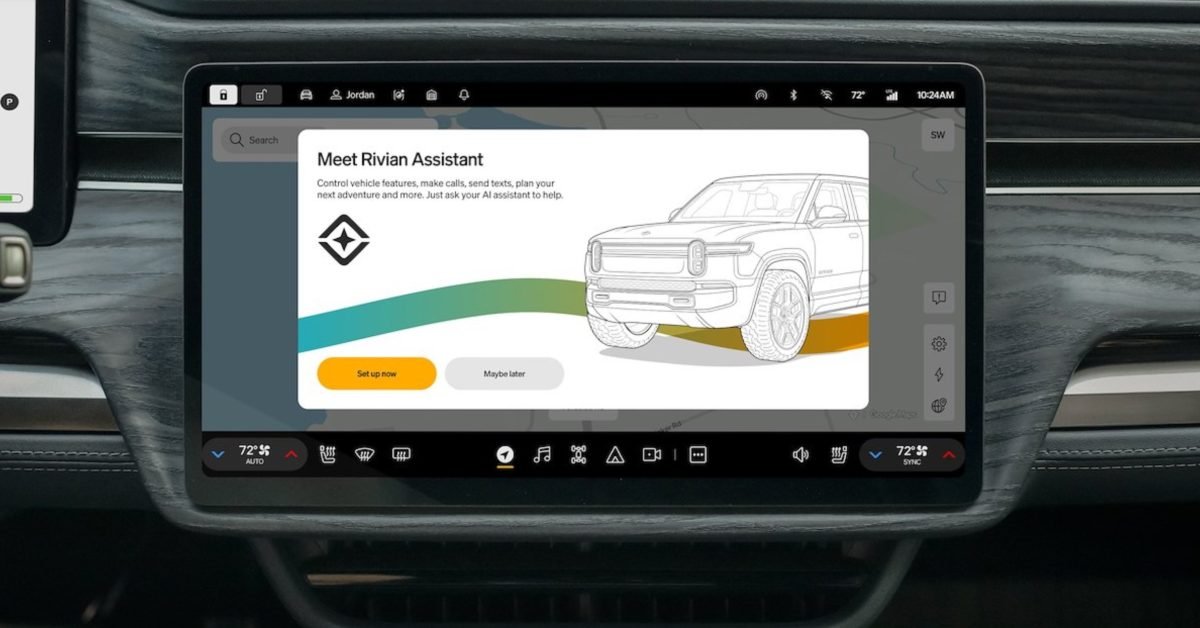
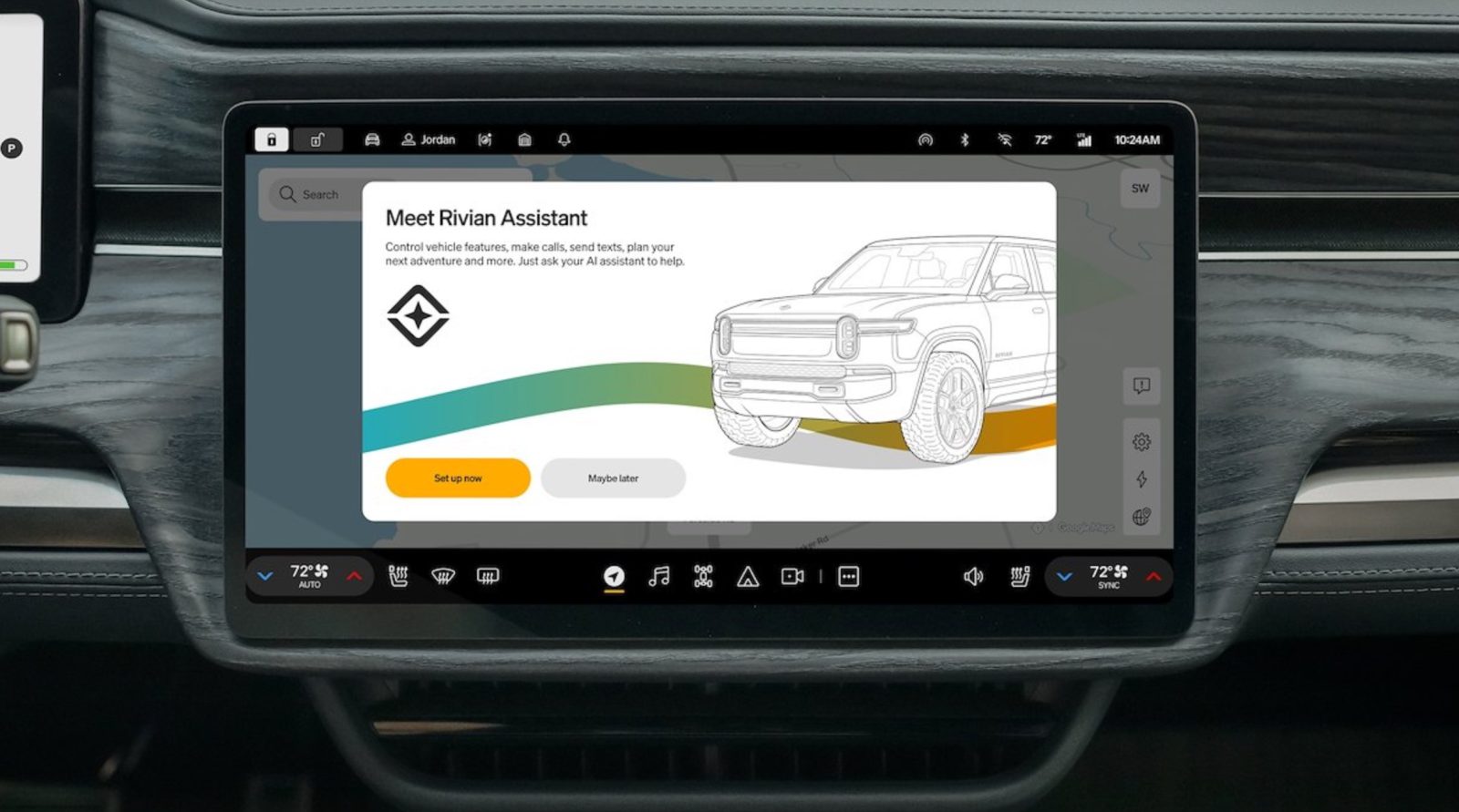

Rivian is rolling out its new AI-powered voice assistant to all Gen 1 and Gen 2 R1 owners as part of its latest over-the-air software update. The feature, activated by saying “Hey Rivian” or holding the left steering wheel button, requires an active Connect+ subscription.
The assistant is notable because it can actually control your vehicle’s core functions — something that Tesla’s competing Grok assistant still cannot do months after its own launch.
Built on Rivian Unified Intelligence
Rivian Assistant is built on what the company calls “Rivian Unified Intelligence,” a multi-modal AI framework that integrates custom large language models with an orchestration layer designed to understand both the vehicle’s systems and the driver’s personal context.
The company first previewed the technology at its AI and Autonomy Day in December 2025, where it also revealed an in-house silicon chip and Level 4 self-driving ambitions. The assistant is now the first consumer-facing product of that AI push.
Unlike phone-mirroring voice systems like Apple CarPlay’s Siri or Android Auto’s Google Assistant, Rivian Assistant is embedded directly into the vehicle’s hardware and software, giving it access to systems that phone-based assistants cannot reach.
What the assistant can do
Vehicle control is where the system differentiates itself most clearly. Owners can change drive modes, adjust ride height, open the front trunk, modify climate settings, and check EV-specific data like range-on-arrival estimates — all hands-free.
Context-aware commands go beyond simple keyword matching. Rivian says the assistant understands natural language and complex context, allowing multi-parameter commands like adjusting individual seat heating for specific passengers in a single request.
Navigation and media let you search for points of interest, get directions, and query information about currently playing media.
AI-powered messaging goes beyond basic dictation. The system can read incoming texts, summarize them, and help draft responses that Rivian claims will sound natural rather than robotic.

Vehicle knowledge means the assistant is trained on the owner’s manual, so it can answer troubleshooting questions about tires, features, and vehicle systems.
The assistant also handles general knowledge queries, including real-time weather and local news.
Agentic integrations starting with Google Calendar
Rivian describes its assistant as having an “agentic framework” — meaning it can chain multiple actions together across different services. The first third-party integration is Google Calendar.
Owners can ask the assistant to check their schedule, move meetings, and combine calendar actions with navigation and messaging in a single flow. For example, asking it to find a coffee shop on the way to your next appointment and text your contact an ETA.
The company says more third-party integrations are coming, though it hasn’t specified which services are next.
The Tesla comparison is unavoidable
Tesla launched its own “Hey Grok” voice assistant in its Spring 2026 update, powered by xAI’s Grok model. On paper, the two features sound similar. In practice, they are not.
Tesla’s Grok can handle navigation commands, answer general knowledge questions, and look up information from the vehicle’s manual. But critically, Grok still cannot control climate, media, or other core vehicle functions — a limitation that has been well-documented since its beta launch. Mercedes-Benz’s MBUX voice assistant has offered full vehicle control for years.
Rivian’s assistant launches with native control over drive modes, climate, ride height, the front trunk, cameras, and range data. That is a meaningful gap.
The assistant requires Connect+, which costs $14.99 per month or $149.99 per year. Tesla’s Grok requires Premium Connectivity. Both are subscription-gated, but Rivian delivers more vehicle-integrated functionality for a lower monthly price.
The assistant will also be available on the R2 when it begins customer deliveries in the coming weeks, as the new platform delivers 200 sparse TOPS of edge AI compute — hardware purpose-built for these capabilities.
Privacy controls
Rivian includes controls that let owners toggle off the “Hey Rivian” wake word, limit location sharing, and disable the memory feature. Personal context the assistant learns is saved to individual driver profiles, not shared across users.
The feature is available in English only and requires a cloud connection.
Electrek’s Take
Rivian is executing an impressive software strategy, and the assistant launch is the latest proof point. As the company reported in its Q4 2025 earnings, software-driven revenue growth is becoming a real part of the Rivian story, and features like this give Connect+ subscribers a tangible reason to keep paying.
The competitive contrast with Tesla is striking. Rivian launched a voice assistant that controls the vehicle from day one. Tesla launched Grok months ago and it still cannot adjust your climate or change a song. That’s not a minor gap — vehicle control is the entire reason you’d want a car-native assistant instead of just talking to your phone.
We should note that the “agentic” framing — chaining calendar, navigation, and messaging together — is genuinely useful if it works reliably. The question is execution. Voice assistants across the auto industry have a long history of promising natural language understanding and delivering frustration. Rivian will be judged on how well these multi-step flows actually work in the real world, not on a blog post.
Still, on paper, this is already one of the most capable voice assistants shipping in any EV right now. If Rivian can match the promise with consistent real-world performance, it becomes another strong differentiator as the R2 heads to market.



FTC: We use income earning auto affiliate links. More.