

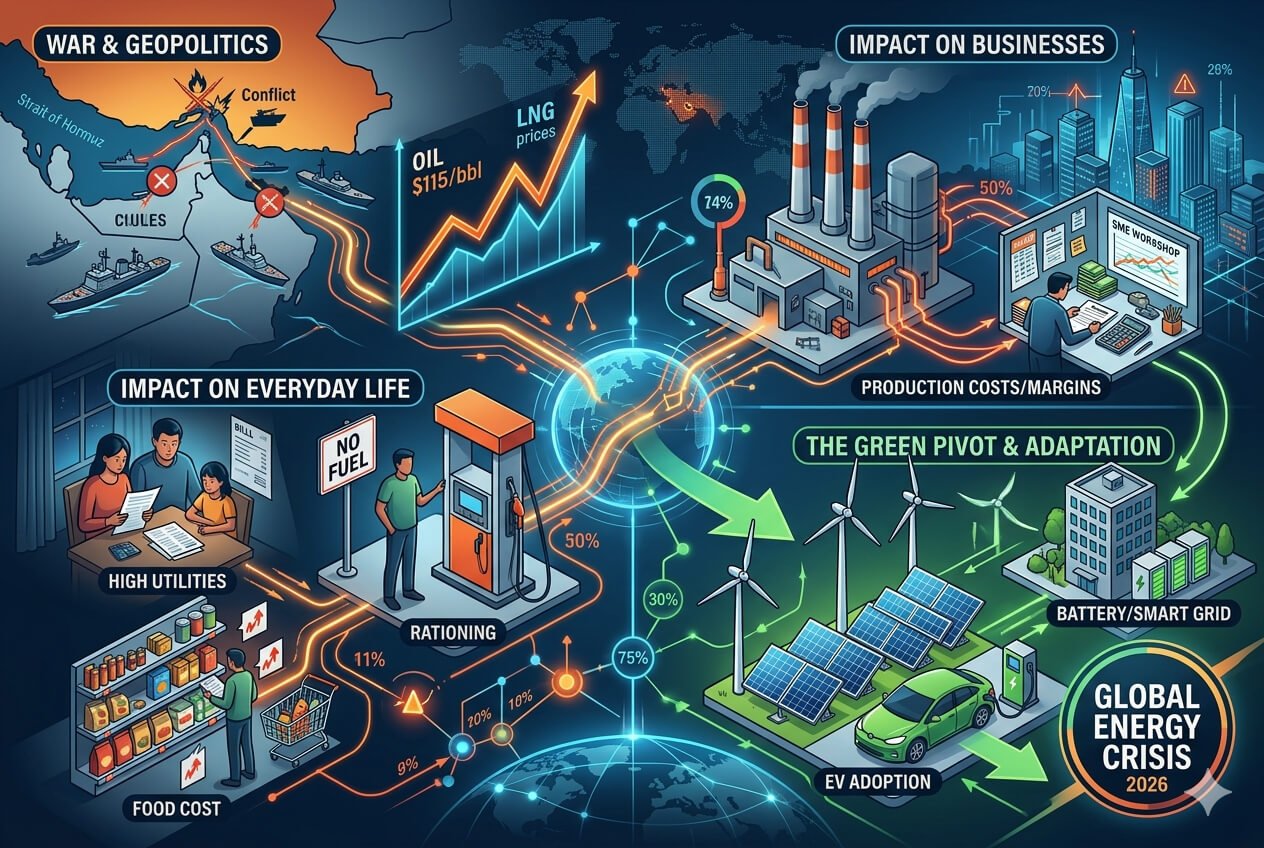
The year 2026 has arrived with a familiar, yet more intense, shadow over the global economy: a full-scale energy crisis. Unlike the localized shocks of previous decades, the current situation is a complex web of geopolitical tension and direct military conflict. From the kitchen table to the corporate boardroom, the surge in fuel and electricity prices is no longer just a headline—it is a daily hurdle.
In this post, we’ll break down what is happening, why the 2026 crisis feels different, and how it is reshaping the way we live and do business.
The Perfect Storm: Why Now?
The 2026 energy crisis didn’t happen in a vacuum. It is the result of a “perfect storm” where aging infrastructure, a bumpy transition to green energy, and—most critically—new and escalating wars have collided.
The most significant trigger has been the 2026 Iran War and the subsequent blockade of the Strait of Hormuz. For those unfamiliar with the geography of energy, the Strait of Hormuz is the world’s most vital “chokepoint.” Roughly 20% of the world’s petroleum and massive amounts of Liquefied Natural Gas (LNG) pass through this narrow waterway.
The Immediate Fallout:
- Crude Oil Surges: Brent crude prices, which were stable in early 2026, spiked by nearly 60% in a single month, crossing the $115 per barrel mark.
- The LNG Blackout: Major suppliers like Qatar have been forced to declare “Force Majeure” (a legal term for being unable to fulfill contracts due to unforeseeable events), effectively cutting off gas supplies to Asia and Europe overnight.
- Fertilizer Shortages: Because natural gas is a key ingredient in making urea (fertilizer), the energy crisis has instantly become a food crisis.
How it’s Hitting Everyday Life
For the average person, the “Global Energy Crisis” isn’t a graph on a screen—it’s the cost of a commute and the price of a loaf of bread.
1. The Cost of Mobility
In many parts of the world, “fuel rationing” has returned. Countries like South Korea and Thailand have experimented with license plate rationing, where you can only drive on certain days based on whether your plate ends in an odd or even number. For many, the family car has become a luxury item used only for emergencies.
2. “Energy-Saving” Becomes Mandatory
It’s not just about turning off the lights anymore. Governments are mandating:
- Temperature Limits: Public buildings and offices are restricted to 26°C (79°F) in the summer to save on air conditioning.
- Remote Work 2.0: Unlike the pandemic, where we worked from home for health, in 2026, many are working from home to save the office from massive heating and cooling bills.
3. The Grocery Store Shock
As energy prices rise, everything that requires transport or refrigeration becomes more expensive. In 2026, we are seeing double-digit inflation on basic staples like wheat and corn, largely because the fuel for tractors and the gas for fertilizers have tripled in price.
The Impact on Businesses: Adapt or Close
Businesses are currently divided into two camps: those that can pivot to energy efficiency and those that are being crushed by overhead costs.
Small and Medium Enterprises (SMEs)
For a local bakery or a small manufacturing plant, energy is often the second-highest expense after labor. With prices skyrocketing, many SMEs are facing a “margin squeeze.” They can’t raise prices enough to cover the energy costs without losing customers, leading to a wave of temporary closures.
The Industrial “Efficiency Gap”
Recent 2026 research from the OECD shows a staggering gap in how companies use energy. In the same industry, the most efficient firms are producing 20 times more value per unit of energy than the least efficient.
The Lesson for 2026: Efficiency is no longer a “green” choice; it is a survival strategy. Businesses are now investing heavily in “Smart Grids” and on-site battery storage to shield themselves from market volatility.
A Silver Lining? The Accelerated Green Transition
While the short-term reality is painful, the 2026 crisis is doing what decades of policy couldn’t: it is making fossil fuels economically unviable.
We are seeing a massive surge in:
- Solar and Wind: Since the “marginal cost” of sun and wind is zero, these sources have become the ultimate shield against war-related price spikes.
- Green Hydrogen: Industries like steel and cement, which can’t run on batteries, are finally seeing the “Green Hydrogen” revolution take off as an alternative to expensive natural gas.
- EV Adoption: The waitlist for electric vehicles has doubled in 2026 as people look for any way to escape the gas pump.
Final Thoughts: Navigating the New Normal
The Global Energy Crisis of 2026 is a harsh reminder of how interconnected our world is. A conflict in one corner of the globe can change the price of a commute in another.
What can you do?
- For Individuals: Focus on “passive” energy savings—insulation, LED upgrades, and shifting energy-heavy tasks (like laundry) to off-peak hours.
- For Businesses: Energy audits are now the most important document in your files. Identifying where you waste power is the quickest way to find “hidden” profit.
History shows that energy crises often lead to eras of great innovation. While 2026 is a year of hardship, it may also be the year the world finally breaks its addiction to volatile, conflict-prone fuel sources.
FAQs
What caused the 2026 crisis?
Military conflict in the Middle East and the blockade of the Strait of Hormuz.
Why are fuel prices so high?
Global supply dropped suddenly while demand remained high, causing oil prices to spike.
How does this affect food prices?
High gas prices make fertilizer more expensive, raising the cost of growing and moving food.
What is “Force Majeure”?
A legal clause allowing suppliers to cancel deliveries due to unavoidable events like war.
Is green energy helping?
Yes; solar and wind provide power that doesn’t rely on volatile international fuel markets.
What can businesses do?
Invest in energy efficiency, smart grids , and on-site battery storage to reduce reliance on the main grid.
