





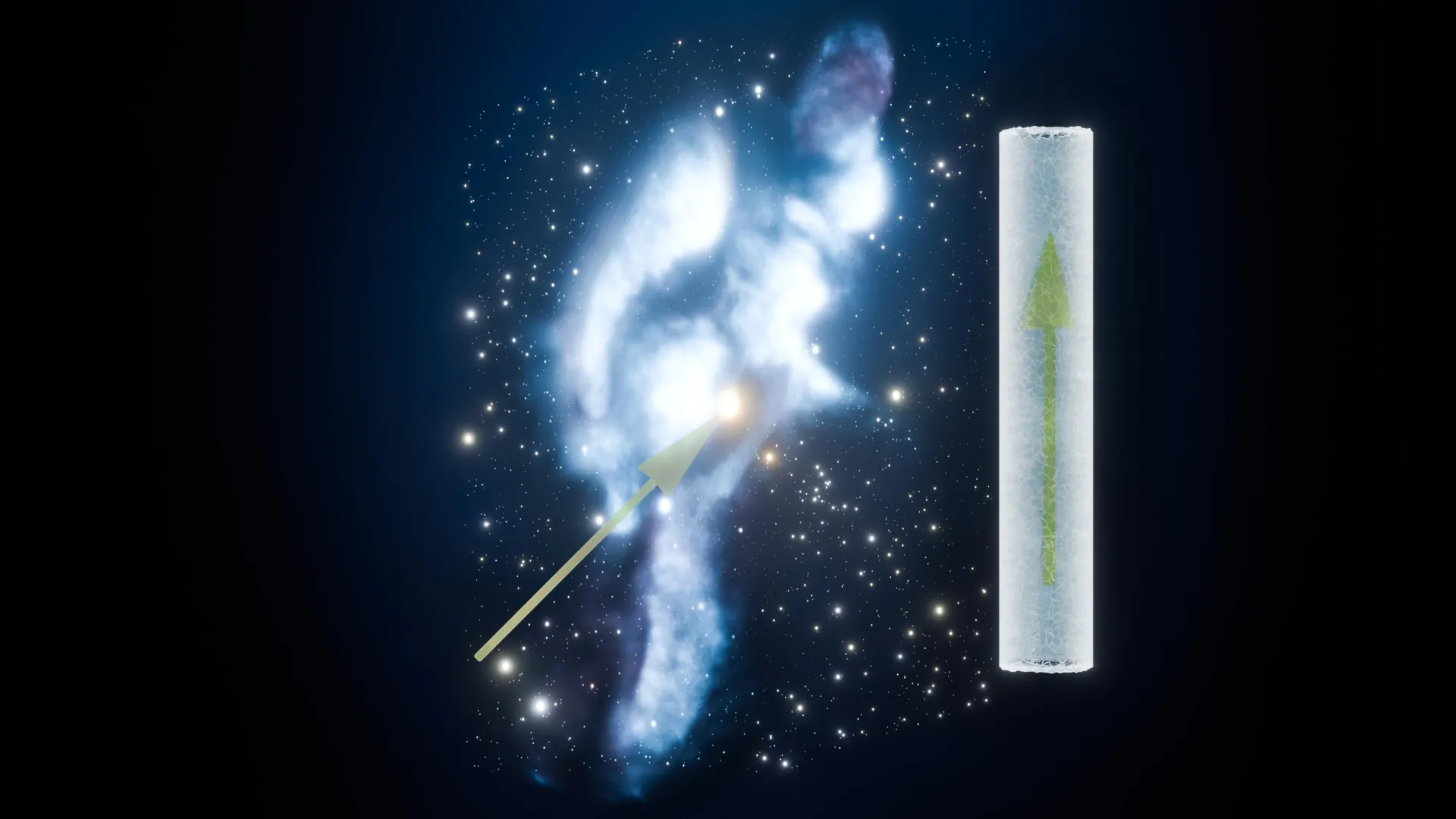
Scientists have uncovered new evidence that Earth is traveling through a cloud of ancient stellar debris left behind by a long ago exploding star. By studying Antarctic ice that formed tens of thousands of years ago, researchers detected traces of iron-60, a rare radioactive form of iron created during supernova explosions. The findings support the idea that the Local Interstellar Cloud surrounding our Solar System contains material from an ancient stellar blast.
The research was led by an international team from the Helmholtz-Zentrum Dresden-Rossendorf (HZDR), and the results were published in Physical Review Letters.
Rare Supernova Iron Found in Antarctic Ice
Iron-60 forms deep inside massive stars and is released into space when those stars explode as supernovae. Previous studies found evidence that Earth was exposed to iron-60 from nearby supernova explosions millions of years ago. However, no recent stellar explosions close to Earth are known, leaving scientists uncertain about the source of iron-60 discovered in relatively young Antarctic snow a few years ago.
“Our idea was that the Local Interstellar Cloud contains iron-60 and can store it over long time periods. As the Solar System moves through the cloud, Earth could collect this material. However, we couldn’t prove this at the time,” explains Dr. Dominik Koll from the Institute of Ion Beam Physics and Materials Research at HZDR.
To investigate further, Koll and Prof. Anton Wallner studied additional geological samples in recent years, including deep sea sediments up to 30,000 years old. Those samples also contained iron-60, but scientists still could not fully rule out other explanations.
The newly analyzed Antarctic ice samples are much older, dating back between 40,000 and 80,000 years. According to the team, the results strongly point to the Local Interstellar Cloud as the source of the radioactive material.
“This means that the clouds surrounding the Solar System are linked to a stellar explosion. And for the first time, this gives us the opportunity to investigate the origin of these clouds,” says Koll.
Solar System Traveling Through an Interstellar Cloud
Scientists believe the Solar System entered the Local Interstellar Cloud several tens of thousands of years ago and is expected to exit it again within the next few thousand years. Researchers say the Solar System is currently located near the cloud’s outer edge.
For the study, the team focused on an ice core covering the time period when the Solar System may have entered the cloud. The sample was provided by the Alfred Wegener Institute Helmholtz Centre for Polar and Marine Research (AWI) through the European EPICA ice drilling project.
When researchers compared the ice core results with earlier snow and deep sea sediment measurements, they discovered that less iron-60 reached Earth between 40,000 and 80,000 years ago than today.
“This suggests that we were previously in a medium with lower iron-60 content, or that the cloud itself exhibits strong density variations,” explains Koll.
The team found that the iron-60 signal changes significantly over periods of only tens of thousands of years, which is relatively rapid on cosmic timescales. This helped researchers rule out competing theories, including the idea that the material came from older supernova explosions that slowly faded over millions of years.
Extracting Tiny Traces of Iron-60
To carry out the study, researchers transported about 300 kilograms of Antarctic ice from AWI in Bremerhaven to Dresden for chemical processing. After extensive preparation, only a few hundred milligrams of dust remained.
Scientists then carefully separated the iron-60 while trying to avoid losing any material during the process.
At the DREsden Accelerator Mass Spectrometry (DREAMS) laboratory at HZDR, the team tested the prepared samples using two additional radioactive isotopes, beryllium-10 and aluminium-26. Because the expected levels of these isotopes in Antarctic ice are already well understood, researchers could verify that no iron-60 had been lost during preparation.
Detecting a Handful of Atoms
For the final measurements, scientists used the Heavy Ion Accelerator Facility (HIAF) at the Australian National University, which is currently the world’s only facility capable of detecting such extremely small quantities of iron-60. Using electric and magnetic filters, the machine separated atoms by mass until only a few iron-60 atoms remained from an original sample containing 10 trillion atoms.
“It’s like searching for a needle in 50,000 football stadiums filled to the roof with hay. The machine finds the needle in an hour,” explains Annabel Rolofs from the University of Bonn.
“Through many years of collaboration with international colleagues, we have developed an extremely sensitive method that now allows us to detect the clear signature of cosmic explosions that occurred millions of years ago in geological archives today,” summarizes Wallner.
Researchers are now planning to study even older ice cores from a time before the Solar System entered the Local Interstellar Cloud. The AWI is participating in the Beyond EPICA – Oldest Ice project, which aims to recover ice samples dating back even farther into Earth’s past.


