

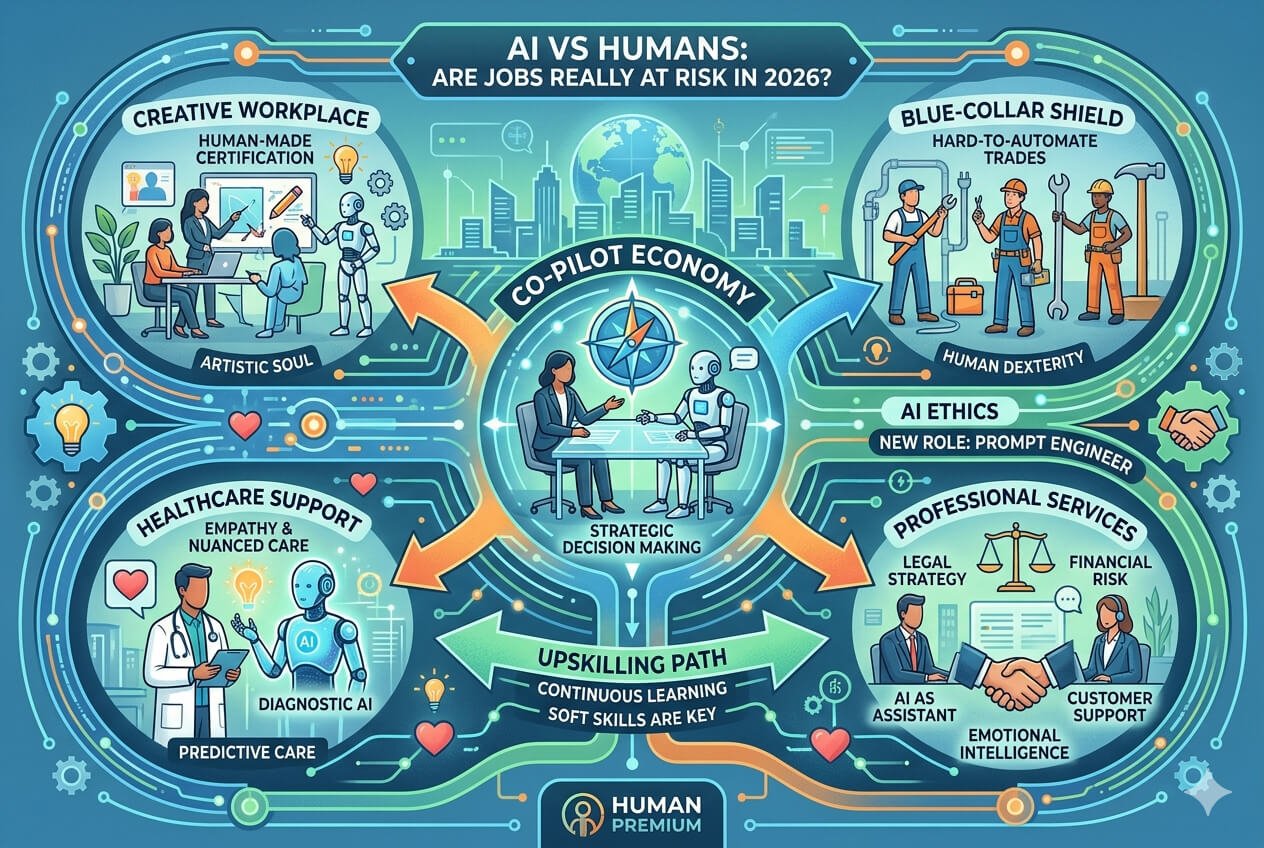
The conversation around artificial intelligence (AI) and its impact on jobs has been growing louder every year. By 2026, AI is no longer just a futuristic idea—it is a real, powerful force shaping industries, workplaces, and everyday life. From automated customer service bots to advanced data analysis tools, AI is changing how work gets done. But the big question remains: Are human jobs really at risk?
Let’s explore this topic in a simple and practical way.
The Rise of AI in the Workplace
AI has rapidly evolved in recent years. What once required human intelligence—like writing emails, analyzing data, or even creating art—can now be done by machines in seconds. Businesses are adopting AI because it helps them:
- Save time
- Reduce costs
- Improve efficiency
- Minimize human errors
For example, companies use AI chatbots to handle customer queries 24/7. In manufacturing, robots assemble products faster than humans. In offices, AI tools assist with scheduling, reporting, and decision-making.
This growing use of AI naturally raises concerns among workers. If machines can do the same tasks faster and cheaper, where does that leave humans?
Jobs That Are Most at Risk
Not all jobs are equally affected by AI. The roles that are repetitive, predictable, and rule-based are the most vulnerable. These include:
1. Data Entry and Administrative Work
Tasks like filling forms, organizing records, and processing basic information are now easily handled by AI systems.
2. Customer Support Roles
Many companies are replacing human agents with AI chatbots that can answer common questions instantly.
3. Manufacturing and Assembly Line Jobs
Robots have been used in factories for years, but they are becoming more advanced and affordable, reducing the need for human labor.
4. Basic Content Generation
AI can now write simple articles, product descriptions, and reports, which affects entry-level writing jobs.
However, it’s important to understand that “at risk” does not always mean “completely replaced.”
Jobs That Are Safer (For Now)
While AI is powerful, it still has limitations. Jobs that require creativity, emotional intelligence, and complex decision-making are much harder to automate.
1. Creative Roles
Writers, designers, artists, and filmmakers bring originality and human emotion into their work. AI can assist, but it often lacks true creativity.
2. Healthcare Professionals
Doctors, nurses, and therapists rely on empathy, experience, and human judgment—things AI cannot fully replicate.
3. Leadership and Management
Managing people, resolving conflicts, and making strategic decisions require human understanding and communication.
4. Skilled Trades
Electricians, plumbers, and mechanics perform physical tasks in unpredictable environments, which AI struggles to handle.
AI as a Job Creator
While AI may replace some jobs, it is also creating new ones. This is something many people overlook.
New roles emerging due to AI include:
- AI specialists and engineers
- Data analysts and scientists
- Cybersecurity experts
- AI ethics consultants
- Prompt engineers and AI trainers
In fact, many industries now need people who can work with AI, not compete against it.
The Shift: From Replacement to Collaboration
Instead of thinking “AI vs Humans,” it’s more accurate to think “AI + Humans.”
AI works best when it supports humans rather than replaces them. For example:
- A doctor uses AI to analyze medical reports faster
- A writer uses AI to brainstorm ideas
- A business owner uses AI to track customer behavior
In these cases, AI enhances human productivity instead of removing the human role.
Skills You Need in 2026 and Beyond
To stay relevant in the age of AI, workers need to adapt. The key is not to fear AI but to learn how to use it effectively.
Here are some important skills:
1. Digital Literacy
Understanding how AI tools work and how to use them in your field is essential.
2. Critical Thinking
AI can provide information, but humans must evaluate and make final decisions.
3. Creativity
Original ideas and innovation will always be valuable.
4. Emotional Intelligence
Skills like communication, empathy, and teamwork cannot be easily automated.
5. Lifelong Learning
The job market is changing fast, so continuous learning is necessary.
The Real Concern: Job Transformation
The biggest impact of AI is not job loss—it is job transformation.
Many roles are not disappearing; they are evolving. For example:
- Accountants now use AI tools for faster calculations
- Marketers use AI to analyze customer data
- Teachers use AI to create personalized learning plans
This means workers need to upgrade their skills rather than completely change careers.
Challenges and Concerns
Even though AI brings many benefits, there are real challenges:
1. Job Displacement
Some workers may lose jobs, especially in industries slow to adapt.
2. Skill Gap
Not everyone has access to training or education to learn new skills.
3. Economic Inequality
AI may benefit large companies more than small businesses or individual workers.
4. Ethical Issues
There are concerns about privacy, bias, and misuse of AI technology.
Governments, companies, and educational institutions must work together to address these issues.
What Can Individuals Do?
If you are worried about your job, here are some practical steps:
- Learn basic AI tools related to your field
- Take online courses to upgrade your skills
- Focus on tasks that require human thinking
- Stay updated with industry trends
- Be open to change and new opportunities
Remember, adaptability is more important than expertise in a single skill.
Final Thoughts
So, are jobs really at risk in 2026?
The honest answer is: some are, but many are evolving—and new ones are being created.
AI is not here to completely replace humans. Instead, it is reshaping how we work. People who resist change may struggle, but those who adapt and learn will find new opportunities.
The future of work is not about humans versus AI. It is about how humans can use AI to become more productive, creative, and efficient.
In the end, AI is just a tool—and like any tool, its impact depends on how we choose to use it.
FAQs
- Will AI replace all jobs?
- No; it automates specific tasks not entire professions.
- Which roles are most at risk?
- Highly repetitive data entry and basic administrative tasks.
- What are “Prompt Engineers”?
- Specialists who bridge the gap between human intent and AI output .
- Does AI help job growth?
- Yes; it creates new industries like AI ethics and human-machine management.
- Why is the “Human Premium” rising?
- People value authentic human empathy and creativity more as AI content grows.
- How can I stay employable?
- Focus on “soft skills” like leadership and learn to use AI as a co-pilot.
