

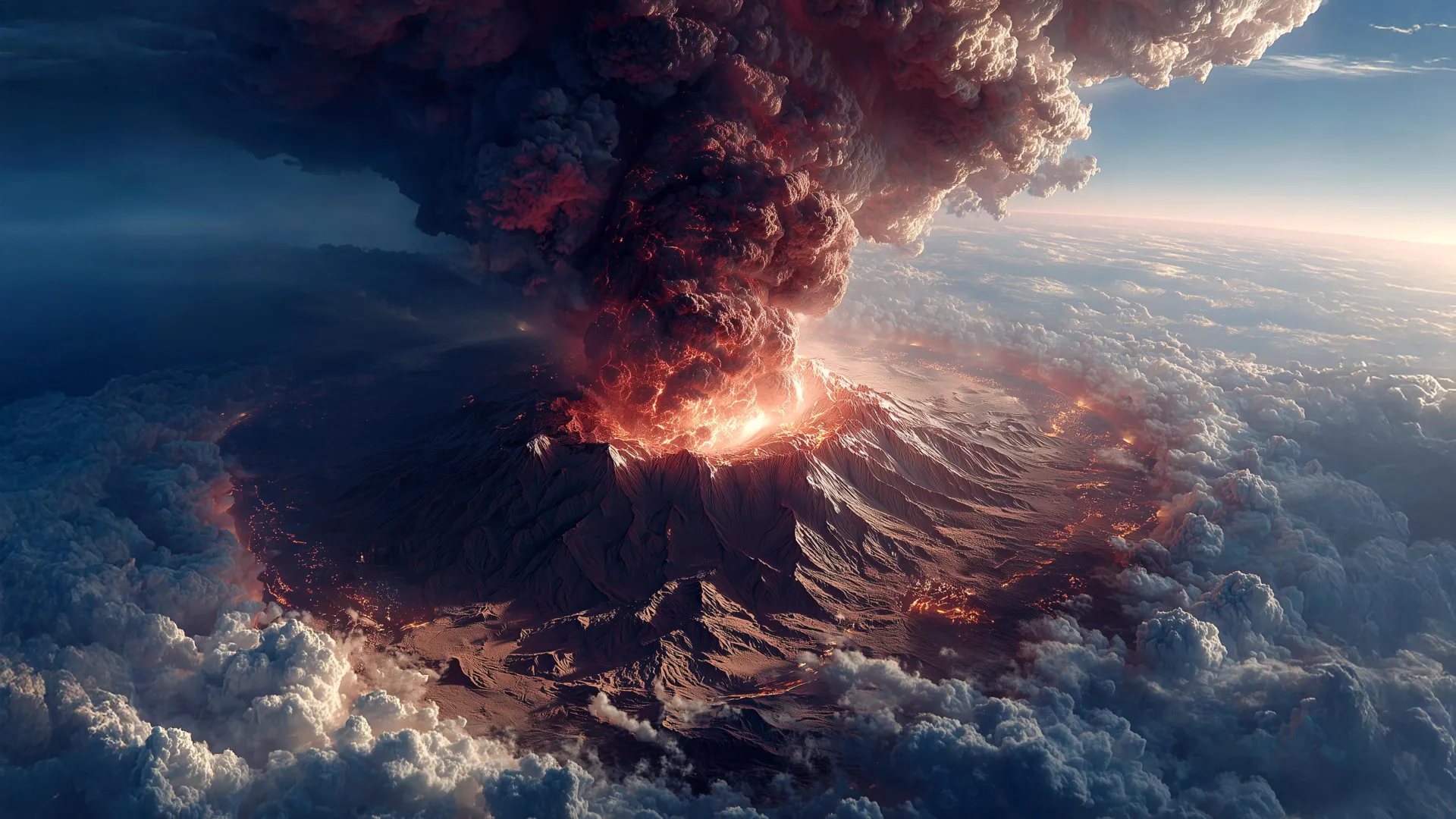
Seventy four thousand years ago, Earth experienced one of the most powerful volcanic disasters in the past 2.5 million years. The Toba supereruption, centered in what is now Indonesia, unleashed devastation on a staggering scale. The eruption was so enormous that scientists believe its effects reached nearly every corner of the planet.
For archaeologists who study ancient volcanic events, one question stands out above all others: How did humans survive? The Toba eruption was more than 10,000 times larger than the 1980 eruption of Mount St. Helens, yet our species endured.
The Toba Supereruption Changed the Planet
The eruption blasted 672 cubic miles (2,800 km3) of volcanic ash high into the stratosphere and left behind a gigantic crater measuring about (62 x 18 miles, or 100 x 30 kilometers). The skies may have darkened for years as volcanic material blocked sunlight around the globe, triggering severe cooling.
Closer to the eruption, conditions would have been catastrophic. Acid rain likely polluted drinking water, while thick ash buried vegetation and wildlife beneath heavy layers of debris.
Given those extreme conditions, it is remarkable that Homo sapiens survived at all.
Did Humanity Nearly Go Extinct?
People living closest to the volcano were probably wiped out completely. Scientists are still investigating how much the eruption affected humans living farther away.
For many years, researchers supported what became known as the Toba catastrophe hypothesis. According to this idea, the eruption caused a volcanic winter that lasted as long as six years and pushed the global human population down to fewer than 10,000 people.
Part of the evidence comes from human DNA. Genetic studies suggest modern humans spread into different parts of the world roughly 100,000 years ago and later experienced what scientists call a genetic bottleneck. A bottleneck happens when a disaster or disease sharply reduces population numbers, leaving behind far less genetic diversity.
Researchers continue to debate whether the Toba eruption caused this population decline or whether another factor was responsible. Climate records, environmental evidence and archaeological discoveries are helping scientists piece together what really happened.
Tiny Volcanic Glass Reveals Ancient Clues
One of the most important tools for studying the eruption is the volcanic material it left behind. Scientists call this material tephra, and they can trace its spread across landscapes using both visual and chemical analysis.
Some of the smallest fragments, known as cryptotephra, travel the farthest distances. These microscopic pieces of volcanic glass are invisible to the naked eye, making them extremely difficult to find.
Researchers carefully sift through dirt samples and use specialized tools called micromanipulators to isolate the tiny shards. The process can take months for a single archaeological site and often feels like searching for a needle in a haystack.
Each volcanic eruption produces tephra with a distinct chemical signature. Some samples contain more iron or different mineral combinations than others. By studying these chemical fingerprints, scientists can determine exactly which eruption produced a specific layer of ash.
In the field, archaeologists search for cryptotephra at sites containing evidence of ancient human activity, including tools, artwork and buried remains. After collecting samples, researchers bring them back to the lab, separate the microscopic glass from the soil and chemically analyze it to confirm whether it came from the Toba eruption.
How Archaeologists Track Human Survival
Finding Toba ash at an archaeological site is only the first step. Scientists then compare evidence of human activity from before and after the eruption.
Sometimes people appear to change how they lived after a volcanic disaster. They may begin using new stone tool technologies, switch food sources or adapt to changing environments. In other cases, sites are completely abandoned.
Climate and environmental records add another layer to the story by showing how temperatures, rainfall and vegetation changed after the eruption. Together, these clues help researchers understand how ancient humans responded to extreme environmental stress.
Evidence Shows Humans Adapted
Despite the scale of the disaster, many archaeological sites point to human resilience rather than collapse.
At Pinnacle Point 5-6 in South Africa, researchers found evidence of Toba cryptotephra in layers showing continuous human occupation before, during and after the eruption. Human activity at the site actually increased afterward, along with signs of new technological innovations.
Similar discoveries have been made at Shinfa-Metema 1 in Ethiopia. There, cryptotephra from Toba appears in layers that also contain evidence of ongoing human activity.
Researchers found that people adapted by following seasonal rivers and fishing in shallow waterholes during long dry periods. Around the same time, humans in the region also adopted bow and arrow technology. This flexibility may have helped them survive harsh environmental conditions linked to the eruption.
Comparable evidence has also emerged from archaeological sites in Indonesia, India and China. As more discoveries accumulate, many scientists now believe humans were far more adaptable than the original Toba catastrophe hypothesis suggested.
The eruption may not have caused the dramatic population collapse once proposed, but it still offers valuable insight into how humans respond to extreme disasters.
What Toba Can Teach Us Today
Humans today are far better prepared for volcanic disasters than people were 74,000 years ago. Modern monitoring programs, including the USGS Volcanic Hazards Program and the Global Volcanism Program, track active volcanoes using advanced technology and provide warnings about eruptions around the world.
Still, one lesson from Toba stands out clearly. Human survival has always depended on adaptability. By studying how ancient people responded to catastrophic eruptions, scientists hope to better understand which survival strategies mattered most and how those lessons could help us face future disasters.