

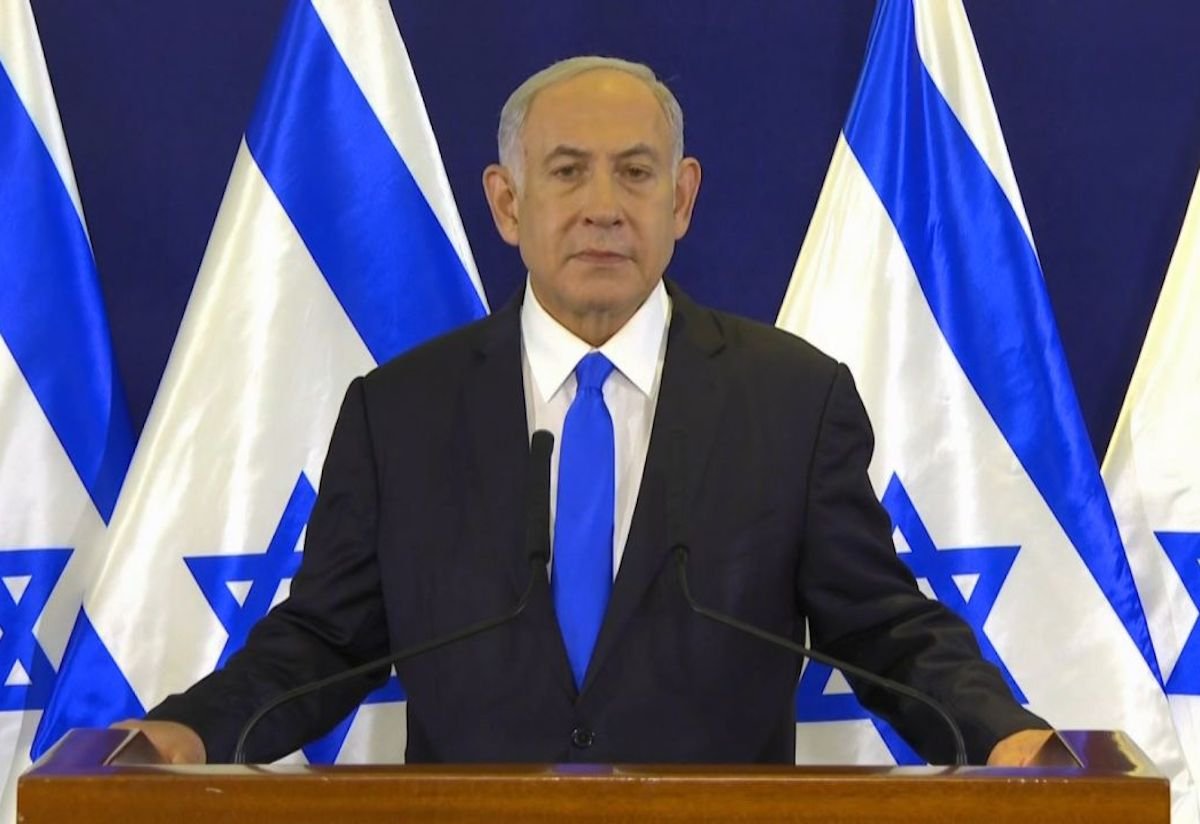
There is a familiar parlor game underway in Washington and Tel Aviv, played with renewed enthusiasm now that Naftali Bennett and Yair Lapid have once again merged their parties under the banner Beyachad, and the polls are showing — as they have for months — that Benjamin Netanyahu’s coalition can no longer assemble a Knesset majority.
The game goes by various names: “The Day After Bibi,” “Israel’s Reset,” “A New Chapter for the Region.” The premise is always the same. Once Netanyahu finally exits the political stage — defeated at the ballot box, pardoned into retirement or simply outlasted by his own mortality — the wheels of Middle East peace will start turning again.
Saudi normalization will be unfrozen. The Palestinians will get a serious interlocutor. Iran will be contained through diplomacy rather than bombs. The Abraham Accords will be expanded. The two-state solution, declared dead a thousand times, will be exhumed once more. It is a beautiful story. It is also, to put it as charitably as possible, nonsense.
This is not an argument that Netanyahu is a good prime minister, or that his particular blend of cynicism and longevity has not done real damage to Israeli democracy and to American interests in the region. He is, and it has.
But the pundits who treat his eventual departure as the magic key to regional transformation are committing the same analytical error they have committed for 30 years: they have mistaken a symptom for a cause.
Consider what the realistic post-Netanyahu coalition would actually look like. Bennett — the man cast in the New York Times as the great hope — has explicitly ruled out ceding any territory to the Palestinians and declared he will not govern with Arab parties.
Lapid, the centrist alternative, has spent the last year flailing in the polls because his electorate has moved sharply rightward since October 7. Gadi Eisenkot, the former Israel Defense Forces (IDF) chief of staff being courted as a dignified third leg of the opposition, prosecuted the Gaza campaign with as much vigor as anyone.
Avigdor Liberman, often imagined in the West as a moderating influence, is the man who once proposed transferring Israeli Arab citizens out of the country. This is the cast of characters from which our commentariat expects a Palestinian breakthrough?
The deeper point, which the personality-driven coverage obscures, is that Israeli public opinion has undergone a structural shift that no leadership change will reverse in the short term.
The trauma of October 7, 2023, was not metabolized by the Israeli electorate as an argument for compromise. It was metabolized as an argument that compromise — the Gaza disengagement above all — had been a catastrophic mistake. You can deplore this shift, as I do. You cannot wish it away by changing the man at the top.
And the personality-driven story is, of course, even more threadbare on the Palestinian side. Mahmoud Abbas is approaching ninety and presides over an Authority that controls a portion of the West Bank at the discretion of an Israeli army that arrests his security cooperation partners on a rotating basis.
Hamas, however degraded militarily, still commands genuine support among Palestinians who see no political horizon and increasingly see Fatah as a collaborationist relic. There is no “Palestinian Mandela” waiting in the wings. There is no unified address.
The premise of Oslo — that two coherent national movements could trade land for peace through their recognized leaderships — looks, from the vantage point of 2026, like a dispatch from another century.
Then there is the regional context, which the American foreign-policy class has a habit of forgetting. The Saudis have made clear, with the unmistakable clarity that comes from a kingdom that has watched American resolve evaporate from Kabul to Damascus, that normalization without movement on Palestinian statehood is now a non-starter.
This was true under Biden. It was true during the second Trump administration’s opening months. It will be true the day after Netanyahu signs his concession statement. Mohammed bin Salman is not waiting for a phone call from a kinder, gentler Israeli prime minister. He is waiting for an answer to the Palestinian question that the Israeli political system, in its current configuration, is structurally incapable of providing.
Iran, meanwhile, has emerged from the spring’s bombing campaign neither destroyed nor chastened, but radicalized. Whoever leads Israel will face the same Iranian nuclear threshold problem, the same Hezbollah rearming on the Lebanese border, the same Houthi disruptions in the Red Sea, the same Shia militias in Iraq.
The Iranian regime did not become Israel’s most committed adversary because of a personality clash with Netanyahu. It became so for reasons of ideology, regime preservation, and regional ambition that long predate his political career and will long survive it.
None of this is an argument for despair, and certainly not for resignation. It is an argument for the kind of mature realism that has been in short supply in both Washington and Jerusalem for at least a generation.
The departure of Netanyahu, when it comes — and it will come, sooner than his admirers fear and later than his detractors hope — should be welcomed for what it actually offers: a domestic political reset for a country that desperately needs one.
It will offer some improvement in Israel’s diplomatic standing, some easing of the worst pressures on the rule of law, some restoration of normal channels with European capitals. These are not small things, but they are not peace.
Peace, if that word still has any operational meaning, requires structural changes that no Israeli or Palestinian or American politician currently in the field is offering: a serious reckoning with the demographic and territorial realities west of the Jordan, a credible Palestinian political authority with the legitimacy to make and enforce hard decisions, a regional security architecture that does not depend on US military adventures the American public no longer wishes to fund.
None of these will arrive on inauguration day for Prime Minister Bennett, or Lapid or whichever permutation of the Israeli center-right ultimately assembles 61 seats. The Middle East has a habit of disappointing those who arrive bearing visions. The visions change; the disappointment does not. The names rotate; the conflict abides.
This article was originally published on Leon Hadar’s Global Zeitgeist and is republished with kind permission. Become a subscriber here.