

More than 1,000 earthquakes in just 10 days, two of them of magnitude 4.8. The seismic sequence that began on 14 August in Granada has once again raised a question that goes far beyond Andalusia: could Spain soon be hit by a major earthquake?

ADVERTISEMENT
ADVERTISEMENT
By 24 August, the National Geographic Institute (IGN) had recorded 1,075 tremors which were felt by the population. The two largest, with a magnitude of 4.8, were very shallow and were felt in more than 500 localities, from Andalusia to parts of Murcia, Castilla-La Mancha and even the Madrid region.
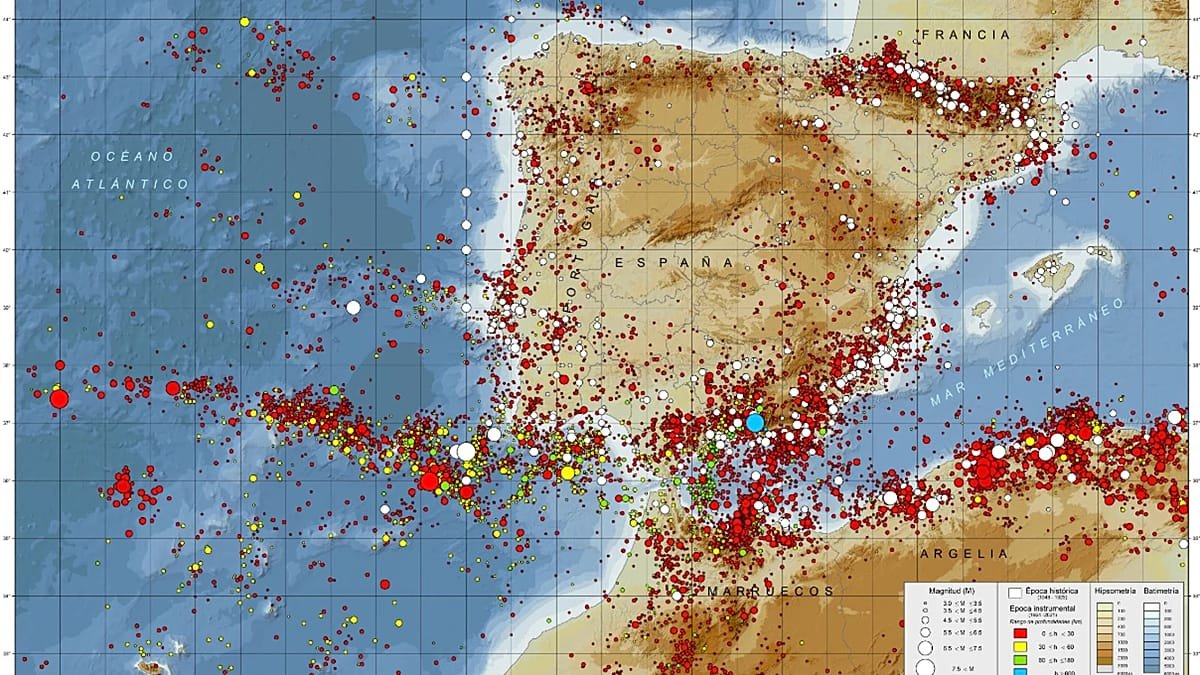
Spain has far more destructive precedents. The Arenas del Rey earthquake of 1884, with an estimated magnitude of 6.5, affected more than 100 population centres and left between 750 and 900 people dead. In 1954, Dúrcal recorded a magnitude-7.8 quake, but at a depth of around 650 kilometres, which greatly limited its effects at the surface.
Does this mean Spain should brace for another major earthquake?
“The occurrence of earthquakes with a magnitude above 4 in the south and southeast of Spain is nothing unusual,” emergency geologist Raúl Pérez López of the Spanish Geological and Mining Institute (IGME-CSIC) tells Euronews.
In this area there are faults capable of generating magnitude-5 and, in some cases, magnitude-6 earthquakes.
So what is the real risk of a major earthquake in Spain, which areas are most exposed, and how far in advance can we anticipate it?
140 years without a major earthquake: A ticking clock?
Some of the recent warnings have focused on the roughly 140 years that have passed since the 1884 earthquake. Pérez López adds a key nuance: a statistical average does not allow us to predict the next earthquake.
“We can divide the elapsed time by the number of earthquakes and say: every 100 years Spain experiences a major earthquake, because that is what the statistics tell us,” he explains. But seismic activity does not behave in a linear fashion: 200 years may pass without a major earthquake and then two may occur in quick succession.
“Even though we have gone 140 years without an earthquake, we do not know whether it is going to happen soon or in a long time”, he points out.
What does happen is that tectonic energy continues to build up. Spain is subjected to the push of the African and Eurasian plates and, the more time passes, the probability of a major earthquake may increase. But that does not mean it is imminent.
“There are faults that can trigger earthquakes, but we do not know whether it will be today, tomorrow or in 50 years’ time”, Pérez López sums up. “We have no way of knowing.”
The expert also warns of the false perception that can be created by the coincidence of several earthquakes in different parts of the world. Pérez López explains that the large tremors recently recorded in various countries may lead people to think there is some connection between them, but “from a scientific point of view that is not the case.”
More than 200 faults: Risk is not confined to Granada
According to Pérez López, the IGME has mapped more than 200 active faults in Spain. The big unknown is where and when the accumulated energy will eventually be released: “How is that energy going to be distributed or released across all the existing faults? We do not know.”
The highest level of risk is concentrated along the Mediterranean coast, “from Valencia to Cadiz,” because of the presence of faults and a history of destructive earthquakes. But the expert points out that significant tremors can also occur in the Pyrenees, the Catalan ranges and on intraplate faults found, for example, around Granada and Albacete.
History shows that major Spanish earthquakes are not confined to a single province either: Torrevieja suffered an estimated magnitude-6.6 tremor in 1829, and the Lorca earthquake of 2011, much smaller at magnitude 5.1, left nine people dead.
Preventing what we cannot predict
“Our best tool is prevention, without any doubt”, says Pérez López. The danger posed by an earthquake depends not only on its magnitude, but also on where it occurs, its depth and, above all, on how buildings respond.
“What kills people in earthquakes is the seismic intensity and the response of buildings”, he explains. That is why, even though it is not possible to predict the next tremor, hazard maps make it possible to estimate in the long term how much the ground may move and to adapt building practices to that level of risk.
The geologist cites the recent earthquakes in Venezuela and Colombia to illustrate how tremors of similar magnitude can have very different consequences. While he notes that the geological characteristics were not the same, he highlights the role played by the strength of buildings in explaining their impact.
Predicting earthquakes remains one of the major scientific challenges. Pérez López points out that scientists still do not know exactly what determines the moment when a fault ruptures, how an earthquake begins or how that rupture will spread.
The expert himself acknowledges the paradox that, despite huge scientific and technological advances, we are still unable to predict earthquakes. This shows that “nature has a degree of complexity that we do not yet understand”: researchers still do not know exactly what triggers a tremor, when the rupture threshold is reached or how it will propagate.
Artificial intelligence and ‘deep learning’ could in future help to identify patterns that we do not currently see, he says. But Pérez López believes there is still a long way to go: more exhaustive monitoring of faults could one day make it possible to develop some form of forecasting. “But for now, we are completely in the dark.”