

Close Menu

    Subscribe to Updates

    Get the latest news information from worldwide businesses.

    What's Hot

    All you need to know about: sarcoidosis

    August 26, 2026

    More Protein Alone Won’t Build Muscle Without Exercise

    August 26, 2026

    Bill Gates is deeply worried about AI, and he’s no longer staying quiet

    August 26, 2026
    Facebook Instagram YouTube LinkedIn X (Twitter)
    Trending
    • All you need to know about: sarcoidosis
    • More Protein Alone Won’t Build Muscle Without Exercise
    • Bill Gates is deeply worried about AI, and he’s no longer staying quiet
    • Runable hits $21M to bet AI agents can go from building businesses to growing them
    • NVIDIA Jetson Orin Nano 2 brings physical AI to drones and robots
    • India, Gulf bloc discuss next steps on free trade agreement
    • Centre to sell onions at Rs 35/kg in Delhi from Thursday amid price surge
    • Carvana shares are under pressure this week as Mark Walter probe fuels investor jitters
    Newspublicly
    • About Us
    • Advertise & Partner with us
    • Pitch Your Story
    • Contact Us
    Facebook Instagram LinkedIn X (Twitter)
    Subscribe
    • Home
    • World News
      • Asia
      • India
      • USA
      • UK & Europe
      • Middle East
    • Economy & Business
      • Global Economy
      • Corporate & Industry
      • Finance & Markets
      • Policy & Trade
    • Technology
      • Gadgets & Devices
      • Software & Apps
      • AI & Machine Learning
      • Robotics & Automation
    • Health & Medicine
      • Fitness & Nutrition
      • Research & Innovation
      • Disease & Treatment
      • Doctors, Clinics & Patient Care
    • Travel & Tourism
    • Automobile
      • Electric & Hybrid Vehicles
      • Auto Industry Insights
    • Sports
    • More
      • Education
      • Real Estate
      • Environment & Climate
      • Space & Astronomy
      • War & Conflicts
    Newspublicly
    Home»More»Space & Astronomy»Inside the Nancy Grace Roman Space Telescope, NASA’s next great observatory
    Space & Astronomy

    Inside the Nancy Grace Roman Space Telescope, NASA’s next great observatory

    AdminBy AdminAugust 26, 2026No Comments6 Mins Read0 Views
    Share
    Facebook Twitter LinkedIn Copy Link WhatsApp


    NASA is just days away from launching its next major space observatory.

    The Nancy Grace Roman Space Telescope is set to lift off Aug. 30 aboard a SpaceX Falcon Heavy rocket from the Kennedy Space Center in Florida, heading for a spot roughly 930,000 miles (1.5 million kilometers) from Earth.

    Unlike the James Webb Space Telescope, which trades panoramic views for a narrow field of view to peer deeply into small, specific patches of the sky, Roman is built for scale. Its field of view is 100 times larger than the Hubble Space Telescope‘s, meaning that in just the five years of its primary scheduled mission, it will capture more than 50 times as much sky as Hubble did in its first 30 years. With that kind of reach, Roman is expected to map roughly 20 billion stars, measure light from more than a billion galaxies, and turn up as many as 200,000 new exoplanets, according to NASA.

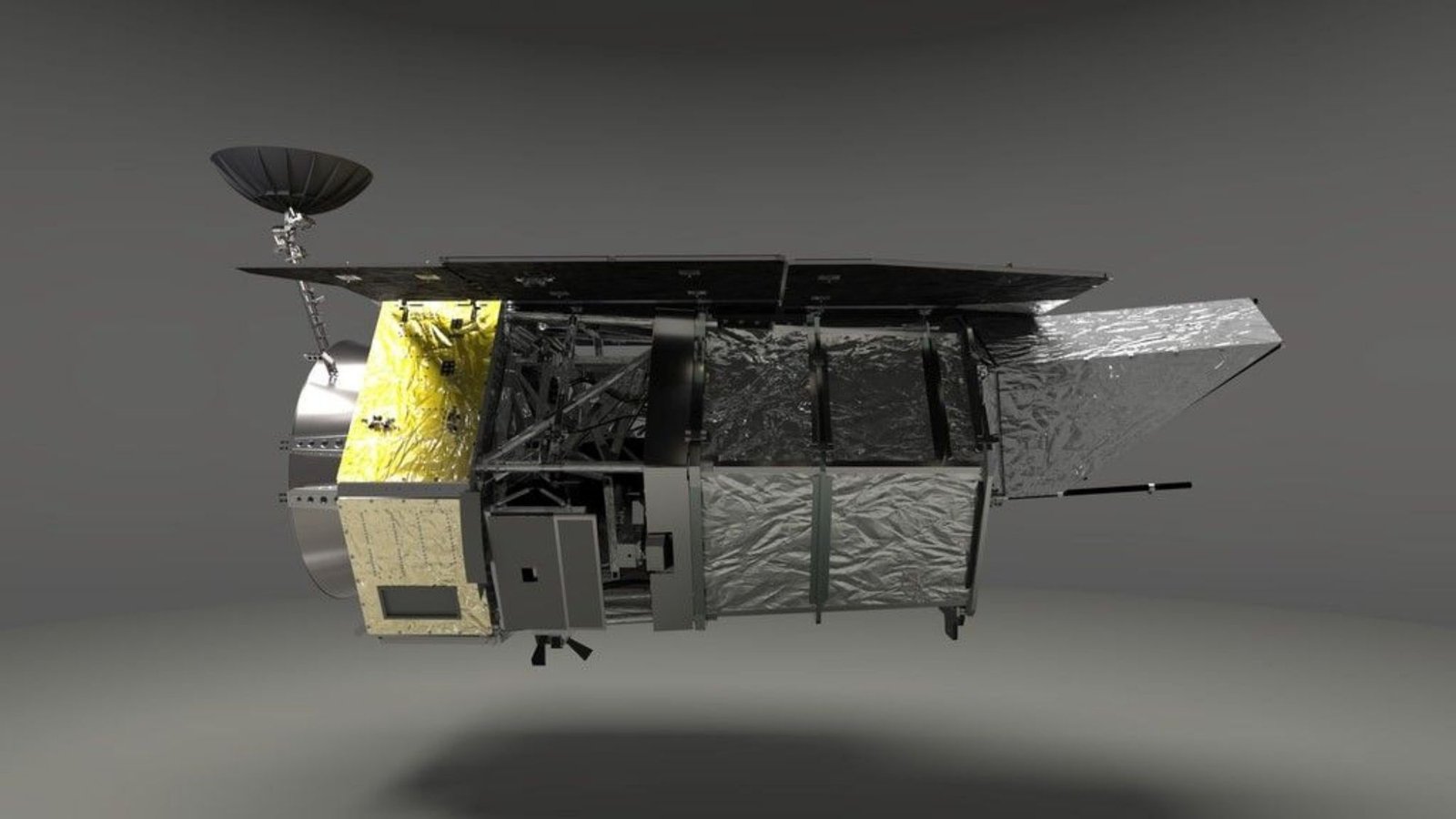
    The instruments that will make this mission possible are tucked inside the observatory that looks, oddly enough, like a helicopter frozen mid-flight. With a nose-like front end housing the telescope, a pair of flat solar panels stretched out to either side and an antenna perched on top, the resemblance turns out to be a handy way to understand the key instruments that make Roman’s mission possible.

    The telescope

    Just like a helicopter’s nose holds critical navigation and visibility instruments, the front of Roman is home to the telescope, which gathers starlight and sends it to the science instruments behind.


    You may like

    At the heart of the telescope is a primary mirror 7.9 feet (2.4 meters) across, the same size as Hubble’s, while a smaller secondary mirror that’s just under 2 feet (0.5 meters) wide sits in its front. Both mirrors are kept cold, chilled to about 19 degrees Fahrenheit (-7 degrees Celsius), to prevent heat from the telescope itself from interfering with observations, according to NASA.
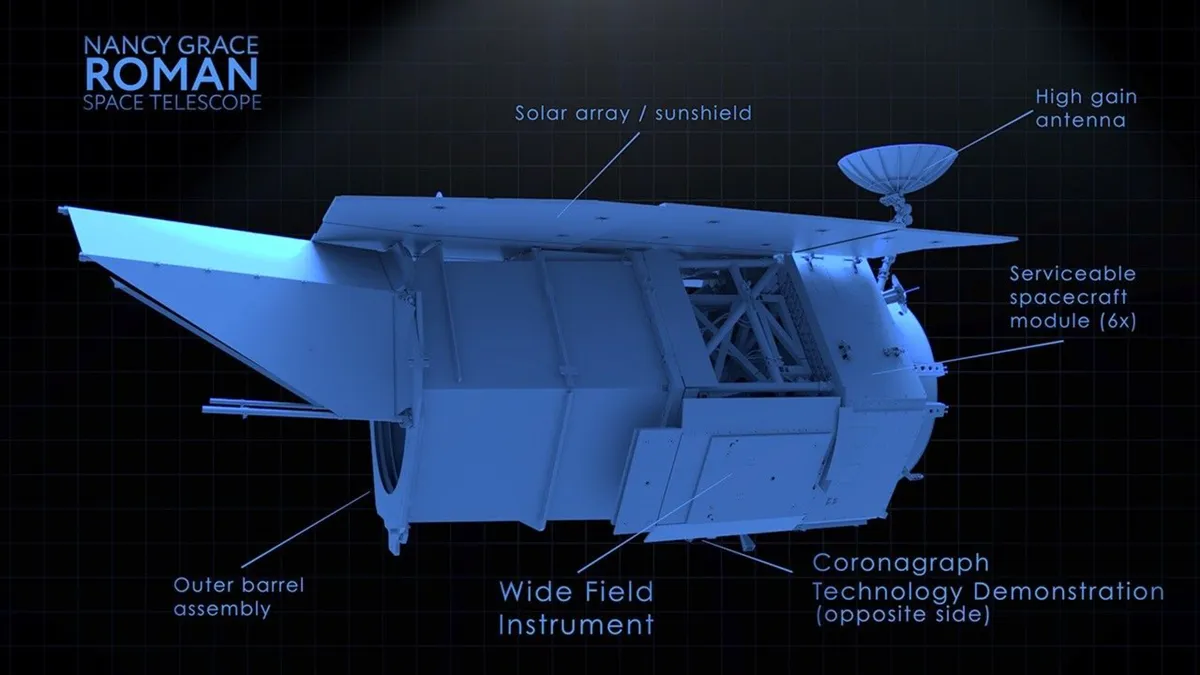
    A diagram showing a blue structure with different lines pointing to its various instruments.

    A diagram showing the Roman Space Telescope and its various instruments. (Image credit: NASA Goddard Space Flight Center Scientific Visualization Studio)

    The telescope is also kept in optimal optical working condition with the help of the Deployable Aperture Cover, or DAC. Located at the very front of Roman, this hat-like shade pops open once the observatory reaches orbit, blocking stray light from entering the telescope barrel and helping protect the telescope’s sensitive optics throughout the mission.

    Space

    Solar Array Sun Shield

    A helicopter’s wings would look a lot like the flat panels stretched out on either side of Roman — except these panels are built for power, not lift.

    The Solar Array Sun Shield, or SASS, consists of six solar panels. Two remain fixed to the spacecraft, while four more will unfold after Roman reaches orbit. Angled toward the sun, the array generates the electricity needed to power the observatory. It also throws shade over much of the spacecraft, helping keep the sensitive instruments at the low temperatures they need to operate.

    inside a white hangar with a large ceiling sits a metal cylinder from which extend three long rectangular solar panels, all pointing towards the ceiling

    The Roman Space Telescope’s solar panels. (Image credit: NASA/Jolearra Tshiteya)

    The Wide Field Instrument

    The workhorse of the mission is the Wide Field Instrument, of WFI, which is essentially a giant infrared camera with so much power and sensitivity that each image it takes captures a slice of sky bigger than the full moon as seen from Earth.


    What to read next

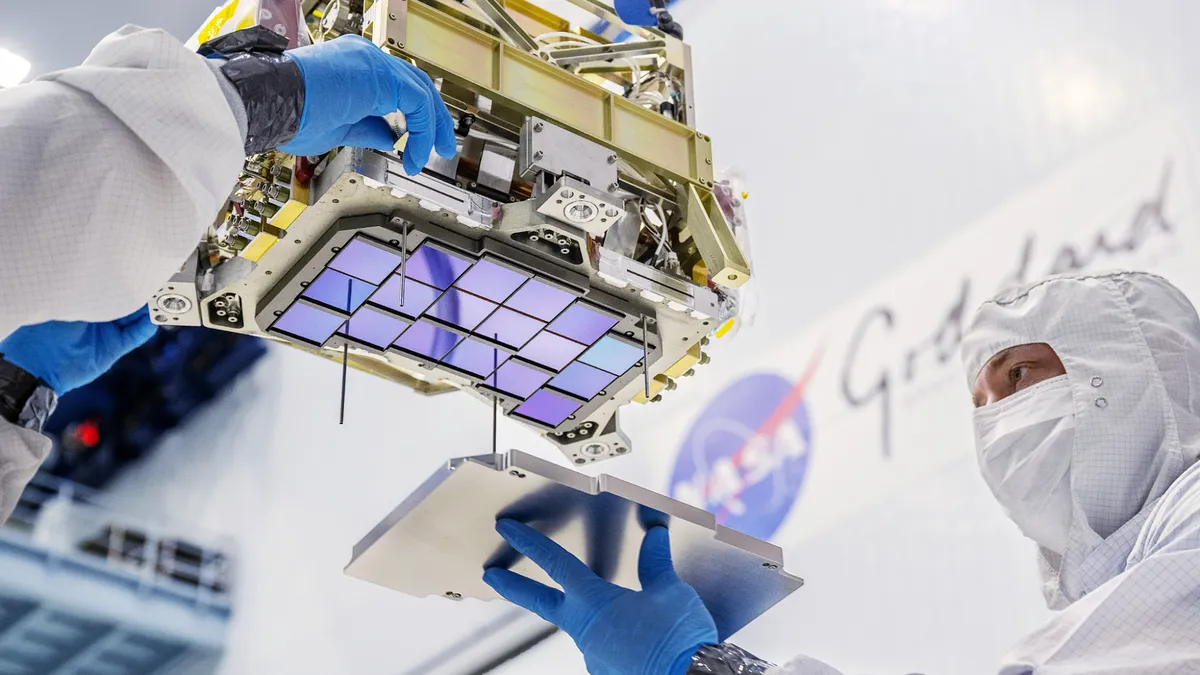
    It can do this thanks to a mosaic of 18 detectors arranged in an arc, each packing more than 16 million pixels, which collect light from astronomical sources and convert it into electrical signals that can ultimately be turned into images. Because each image covers such an enormous field of view, scientists expect virtually every exposure to be packed with information.
    Blue reflective squares are attached to an instrument that hangs from above. A person in a white clean room suit is putting a metal door on top of the reflective squares.

    Principal technician Billy Keim installs a cover plate over the WFI detectors at NASA’s Goddard Space Flight Center in Maryland on Feb. 8, 2021. (Image credit: NASA/Chris Gunn)

    The data will help scientists uncover new insights into planetary systems around other stars and map how matter is structured and distributed throughout the cosmos, offering fresh clues about the elusive nature of dark energy.

    The Coronagraph

    The coronagraph, nicknamed “Starglasses,” is designed to block the glare of stars so that planets orbiting them can come into view — including those far fainter than what scientists can currently see.

    The instrument works by using two deformable mirrors equipped with thousands of tiny actuators. As starlight streams through the telescope, those actuators subtly reshape the mirrors in real time, correcting for imperfections in the telescope’s optics smaller than the width of a strand of DNA. Specialized masks work alongside the mirrors to suppress the way light bends around internal edges such that together, the system dramatically dims a star’s glare while allowing some of the much fainter light from an orbiting planet to shine through.

    “I think of this as doing magic with physics,” Julie McEnery, Roman senior project scientist, said during a press conference in July. We’re taking advantage of the wave properties of light to cancel out the light from a star, so that we can image planets next to it.”

    A bunch of golden components and wires in top of a large black box. A person in a white clean room suit stands behind the contraption.

    In a clean room at NASA’s Jet Propulsion Laboratory in Southern California in Oct. 2023, scientist Vanessa Bailey stands behind the Roman Coronagraph. (Image credit: NASA/JPL-Caltech)

    Scientists expect this capability to allow Roman to directly image Jupiter-size planets around sun-like stars, as well as capture sharp images of fledgling planetary systems still surrounded by the dusty disks where planets are forming.

    As a bonus, the whole instrument also doubles as a proving ground for future missions, including NASA’s planned Habitable Worlds Observatory, which aims to directly image Earth-like planets around nearby stars.

    High-Gain Antenna

    Standing in for a helicopter’s rotor is the antenna dish on top of Roman. The roughly 6-foot (1.8-meter) dish high gain antenna, or HGA, is the observatory’s communications link to Earth, handling routine spacecraft data as well as high-speed science-data downloads. It is meant to transmit information home at speeds of up to 500 megabits per second.

    A large dark colored satellite dish style structure in a blue insulated room.

    The high-gain antenna for the Nancy Grace Roman Space Telescope during testing. (Image credit: NASA/Chris Gunn)

    Motorized gimbals allow the dish to swivel and remain locked onto ground stations even as Roman turns to look at different parts of the sky, ensuring that the enormous amounts of data collected by the telescope can make their way back to Earth.

    If all goes to plan, once Roman is at its station in space, Lagrange Point 2 (L2) these components together will give the observatory both the breadth and precision needed for its ambitious survey of the universe, from mapping billions of galaxies to hunting for distant planets and probing one of cosmology’s biggest mysteries, dark energy.


    Source link

    Author

    • Admin

      NewsPublicly.com is News & Articles Platform that creating SEO-focused articles on travel, lifestyle, and digital trends.

    Admin
    • Website

    NewsPublicly.com is News & Articles Platform that creating SEO-focused articles on travel, lifestyle, and digital trends.

    Related Posts

    Could Jupiter spark a Perseid meteor outburst in 2028?

    August 26, 2026

    Why do we care so much that Pluto isn’t a planet?

    August 26, 2026

    Watch the partial lunar eclipse online Aug. 27-28 with these free livestreams

    August 26, 2026
    Leave A Reply Cancel Reply

    Demo
    Top Posts

    The Blue Moon rises on May 30— Where and when to see the second full moon of the month

    May 30, 202640 Views

    New SOCOM rifle allows barrel swapping and cartridge changes

    June 1, 202633 Views

    Indian economy shows recovery despite global uncertainties, private investment gains momentum: Report

    July 29, 202627 Views

    “Inside Gemini Robotics 1.5: How Robots Learn to Reason & Act

    November 22, 202527 Views
    Don't Miss

    All you need to know about: sarcoidosis

    August 26, 20264 Mins Read0 Views

    Sarcoidosis results in affected people developing lumps on their skin or in other parts of…

    More Protein Alone Won’t Build Muscle Without Exercise

    August 26, 2026

    Bill Gates is deeply worried about AI, and he’s no longer staying quiet

    August 26, 2026

    Runable hits $21M to bet AI agents can go from building businesses to growing them

    August 26, 2026
    Stay In Touch
    • Facebook
    • Twitter
    • Instagram
    • YouTube
    • LinkedIn
    • WhatsApp

    Subscribe to Updates

    Get the latest creative news from SmartMag about art & design.

    Demo
    NEWSPUBLICLY
    Facebook X (Twitter) Instagram LinkedIn

    Home

    • About Us
    • Leadership
    • Advertise & Partner With Us
    • Pitch Your Story
    • Media Kit & Pricing
    • Career
    • FAQs

    Guidelines

    • Editorial & Submission
    • Partnership
    • Advertising & Sponsor
    • Intellectual Property Policy
    • Community & Comment
    • Security & Data Protection
    • Send Your Opinion

    Quick Links

    • Cookie Policy
    • Payment & Billing Terms
    • Refund & Cancellation
    • Copyright Policy
    • Complaint & Support
    • Sitemap
    • Contact Us

    Subscribe Us

    Get the latest news and updates!

    Copyright © 2026 Newspublicly (DIGITALIX COMMUNICATION). All Rights Reserved.
    • Privacy Policy
    • Terms of Use
    • Disclaimer