

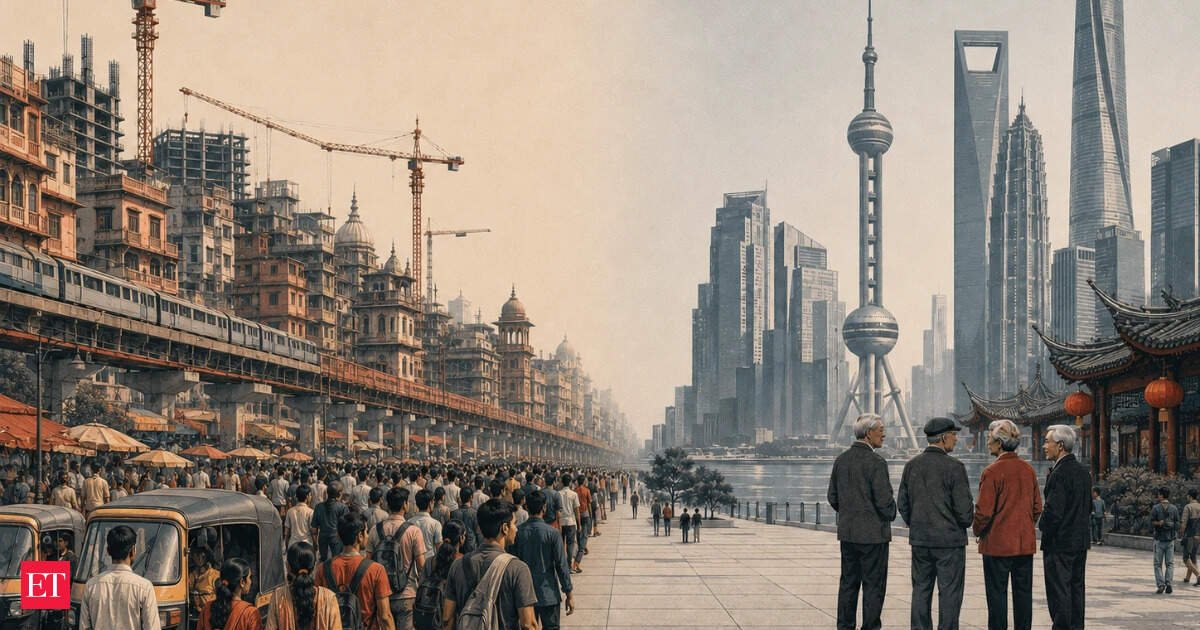
According to the Registrar General of India’s Sample Registration System (SRS) Statistical Report 2024, the country’s total fertility rate (TFR) has dropped to 1.9 births per woman, below the replacement level of 2.1 needed for one generation to replace itself in the absence of migration. When fertility remains below that level for a prolonged period, the population gradually ages as fewer young people enter it and the share of older people rises.
Also read: India’s fertility rate falls below replacement level; highest in Bihar, lowest in Delhi
India, however, is entering this era at a much lower income level than China did.
 ET Online
India’s total fertility rate has fallen below the replacement level of 2.1
According to the World Bank, India’s GDP per capita (current US$) remains around $2,700, while China had already exceeded roughly $13,000 before rapid population aging became a defining economic challenge.

The contrast raises a question: Could India become an aging society before it reaches the per capita income levels at which many other economies began aging?
Economists say the question deserves attention now because the foundations for managing an aging population must be built long before it actually becomes one.An aging population eventually means a slower-growing workforce, rising healthcare costs, mounting pension obligations and greater demand for long-term care. Wealthier economies confronted those pressures after accumulating far greater wealth. India may have to prepare for them much earlier.
Yet experts caution against treating India’s falling fertility as an immediate crisis.
The demographic dividend is the period when a country’s working-age population grows faster than its dependent population, creating the potential for faster economic growth through higher labour force participation, productivity and savings. But that window is temporary and begins to narrow as the population ages.
India’s demographic dividend remains intact. The challenge is whether the country can convert the next two decades of abundant labour into lasting productivity gains before aging begins to weigh heavily on growth.
The clock is ticking
The demographic shift is unfolding gradually rather than abruptly.
Mitali Nikore, Founder and Chief Economist at Nikore Associates, cited data from the SRS Statistical Report 2024 showing that people aged 15–59 account for 66.4% of India’s population, while those aged 60 and above make up 9.7%.
The country’s working-age population is expected to continue rising until around 2041, according to the Economic Survey 2018-19, giving policymakers a sizable—though finite—window to accelerate economic transformation.
ET Online“The decline in the fertility rate to around the replacement level points to a critical shift in India’s population story with a narrowing window of opportunity for reaping the benefits of demographic dividend,” Rajani Sinha, Chief Economist at CareEdge Group, told ET Online.
While aging is not expected to materially affect labour supply in the immediate future, she argued that employment generation and skill development should remain India’s foremost priorities. With artificial intelligence rapidly changing labour markets, India also needs a strategic approach to technology adaptation to improve future employability, she added.
DK Srivastava, Chief Policy Advisor at EY India, also believes India has time—but only if it uses it wisely. “As per UN population projections data, India’s current median age is about 29 years. This will progressively increase to become 40 years by 2056,” he said.
“The year 2056 is important because… the old dependency ratio… will overtake the share of the young dependent population,” he told ET Online.
Until then, India’s demographic dividend remains intact. “The demographic dividend window is supposed to continue until 2059 by which year the share of the working age population in the age group of 15-64 years will remain above 65%.”
For policymakers, he said, the timeline also offers a roadmap.
“From a policy perspective, we may need to accord higher priority to education until 2056 so that productivity of the working-age population can increase and subsequently higher priority may be accorded to health expenditure.”
The message from both economists is similar: India is not running out of time today. But every year that productive jobs, skilling and education lag makes the eventual ageing transition harder to manage.
Also read: Is India winning the wrong battle on infant mortality?
One country, multiple demographic transitions
The pace of population aging varies sharply across India.
Southern states crossed replacement fertility years ago, while many northern states remain younger with comparatively higher fertility.
“Aging has already begun in the south and in the larger cities,” said Nikore. “Both trends are real because Indian states are at different stages of this transition.”
The policy implications differ just as sharply.
ET OnlineSouthern states increasingly need investment in geriatric healthcare, pensions and eldercare infrastructure, Nikore said. Younger states such as Bihar, by contrast, still require investment in education, childcare and employment generation. “Bihar is not expected to reach replacement fertility until about 2039,” she added.
An Observer Research Foundation (ORF) issue brief similarly argues that India’s demographic window is narrowing at different speeds across states.
Southern and western states are expected to face labour shortages and ageing pressures sooner, while Bihar, Uttar Pradesh and Jharkhand are likely to continue adding large cohorts of young workers over the next two decades, provided sufficient investment is made in jobs, manufacturing and skills.
Inter-state migration could soften some of these regional differences, said EY India’s Srivastava. Even so, governments will need to continually recalibrate spending priorities across education, healthcare, infrastructure and skills as demographic patterns evolve across states.
Why India cannot simply follow China’s playbook
India’s demographic transition is unfolding under very different economic conditions from China’s, economists argue.
China’s fertility rate has fallen to around one child per woman, while India’s remains at 1.9, indicating that although India has entered below-replacement fertility, it still has a considerably younger population profile.
“Lower income makes India’s transition harder,” said Nikore. But she also pointed to advantages India still has, including greater room to raise female labour force participation and the opportunity to supply workers to ageing economies.
But the differences extend beyond income.
Srivastava points out that China benefited from an unusually favourable global economic environment during its demographic boom.
India, by contrast, faces a more fragmented global trading environment amid tariff and non-tariff barriers.
Yet, he does not believe this fundamentally weakens India’s prospects because “India’s strength lies in domestic demand.”
“Even with comparatively less explosive export growth, India should be able to reap the growth benefit of its demographic dividend.”
Nikore argues that India’s bigger labour challenge is participation rather than the availability of workers. Although female participation has improved in recent years, much of that increase has come from rural self-employment and agriculture, while urban participation has remained relatively subdued.
ET Online“As the elderly share rises, families need more eldercare. Where formal services do not exist, that care falls on women and pulls them out of paid work.”
According to Nikore’s research, citing the Ministry of Women and Child Development’s 2024 care economy strategy paper, women’s unpaid domestic and care work is estimated to be equivalent to 15–17% of India’s GDP.
“That is labour the economy has kept outside paid work.”
Echoing this view, the ORF paper argues that the rising “silver economy”—covering eldercare, healthcare, senior housing and longevity-focused services—could itself become a significant source of jobs and economic growth if supported by timely policy interventions.
Rather than viewing ageing solely as a fiscal burden, economists increasingly see it as the emergence of entirely new industries.
The next two decades will define the outcome
Whether India grows old before it grows rich will depend less on demographics than on the policies it adopts over the next two decades.
Srivastava said population ageing presents an opportunity to boost overall productivity through continuous reskilling. “With higher life expectancy, the population may remain economically active even after reaching the age of 65 years,” he said.
Extending the demographic dividend, he argued, will depend on productive employment while encouraging lifelong learning.
CareEdge’s Sinha stressed the need for sustained job creation, broader skilling and technology adoption, while Nikore highlighted the importance of providing equal emphasis on care infrastructure, women’s workforce participation and vocational training.
India still has a growing workforce. It still has time. But translating it into long-term growth will depend on improving skills, productivity, raising labour force participation and investing in healthcare and care infrastructure before its demographic window begins to narrow.