

Close Menu

    Subscribe to Updates

    Get the latest news information from worldwide businesses.

    What's Hot

    Hung Cao taps civilian to stand up Navy industrial base office

    August 25, 2026

    Ahead of Xi Jinping’s India Visit, What Beijing Told Ajit Doval in High-Stakes Talks

    August 25, 2026

    Flock Safety cameras face bipartisan scrutiny over mass surveillance

    August 25, 2026
    Facebook Instagram YouTube LinkedIn X (Twitter)
    Trending
    • Hung Cao taps civilian to stand up Navy industrial base office
    • Ahead of Xi Jinping’s India Visit, What Beijing Told Ajit Doval in High-Stakes Talks
    • Flock Safety cameras face bipartisan scrutiny over mass surveillance
    • 3.28 lakh Tamil Nadu teachers face job risk over TET, state seeks permanent exemption | Education News
    • The Roman Space Telescope will reveal the universe in a way the JWST and Hubble cannot
    • Remembering the ‘Visionary’ Author of Pennsylvania’s Environmental Rights Amendment
    • Ryan Blaney points at Team Penske’s “main point of focus” ahead of the Chase
    • The Fiat Topolino Is Disrupting The U.S. Golf Cart Market
    Newspublicly
    • About Us
    • Advertise & Partner with us
    • Pitch Your Story
    • Contact Us
    Facebook Instagram LinkedIn X (Twitter)
    Subscribe
    • Home
    • World News
      • Asia
      • India
      • USA
      • UK & Europe
      • Middle East
    • Economy & Business
      • Global Economy
      • Corporate & Industry
      • Finance & Markets
      • Policy & Trade
    • Technology
      • Gadgets & Devices
      • Software & Apps
      • AI & Machine Learning
      • Robotics & Automation
    • Health & Medicine
      • Fitness & Nutrition
      • Research & Innovation
      • Disease & Treatment
      • Doctors, Clinics & Patient Care
    • Travel & Tourism
    • Automobile
      • Electric & Hybrid Vehicles
      • Auto Industry Insights
    • Sports
    • More
      • Education
      • Real Estate
      • Environment & Climate
      • Space & Astronomy
      • War & Conflicts
    Newspublicly
    Home»Travel & Tourism»The Answer to ‘Where Is the International Date Line?’ Depends on How Much Time You Have
    Travel & Tourism

    The Answer to ‘Where Is the International Date Line?’ Depends on How Much Time You Have

    AdminBy AdminAugust 25, 2026No Comments3 Mins Read0 Views
    Share
    Facebook Twitter LinkedIn Copy Link WhatsApp


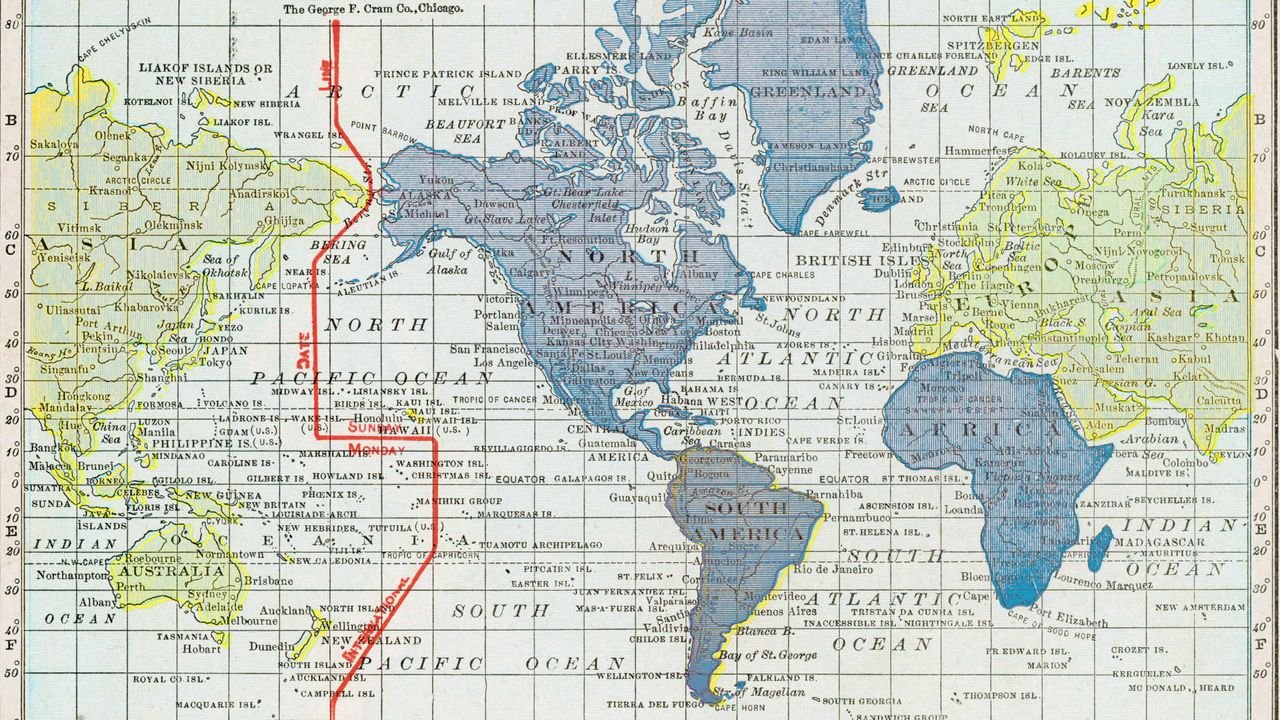
    Traveling across the International Date Line (IDL) can get weird—seriously weird. Let’s say you’re looking for a change in scenery from the Edenic climes of Auckland and fall smitten with the whale-filled waters of Vancouver. As far as long-haul flights go, this one doesn’t seem too out of the ordinary—if you fly from New Zealand on a Tuesday, you’ll land in Canada the Monday before since you crossed the IDL from the left. But that’s assuming you’ve crossed the line just once. Because of its jigsaw shape, your journey across the Pacific would more so resemble a game of time-travel hopscotch.

    Image may contain Water Outdoors Land Nature Fishing Leisure Activities Sea Chart Plot Bow and Weapon

    On this hypothetical flight, you could easily flip between dates as many as five times.

    Map data ©2026 Google

    All this to say, asking yourself where the International Date Line is, is only natural. And as it turns out, the origin story of this Parasaurolophus-headed imaginary line is more complicated than you’d think.

    How the International Date Line came to be

    Portuguese navigator Ferdinand Magellan’s surviving crew on the Victoria first documented the time-skipping phenomenon of global travel on Thursday July 9, 1522, whilst stopped at Cabo Verde. On track to become the first expedition to circumnavigate the world, the Magellan sailing came across a strange error in their log books on the home stretch of their nearly three-year journey: despite their fastidious record-keeping, they had somehow fallen back a day compared to the local calendar. As it turns out, while they kept sailing westward, they continually encountered local noon later than they would have from their point of departure, as every 15 degrees of westward travel approximately corresponds with one hour of later local time. As they traveled a full 360 degrees around the world, their record-keeping ultimately fell a full 24-hours behind by the time they returned to Portugal.

    Successive travels, observations, and a beloved Jules Verne novel all about the hijinks and perils of hot air balloon flight would later make common knowledge of the fact that circumnavigation results in the gain (if traveling westward) or the loss (if traveling eastward) of a day, and the idea that this difference in time would require its own place on our maps gradually came into fruition.

    Mapping out time took further root in October 1884 during the International Meridian Conference held in Washington, DC, which convened 25 different nations to create a global standard for keeping track of time. The existing status quo was to measure time from a destination’s local meridian, its longitudinal position on Earth. At the precise moment the sun passes a destination’s meridian, which derives from the Latin word “meridies” meaning “midday,” that locale experiences its solar noon. But this subjective practice made for a logistical nightmare when it came to coordinating trade routes, communicating using the newfangled telegraph, and scheduling train times. To create this global standard, the conference sought to establish a “universal day,” a 24-hour date scale synchronized to the beginning and end of a day measured from a designated prime meridian, a zero-degree longitudinal line from which all time zones would be defined relative to. As the late 19th century was the height of British sea power and the majority of countries present defaulted to using British maps for navigation anyway, Greenwich, England, was elected the location of the prime meridian, though not everyone left a fan—France did not adopt Greenwich Mean Time until 1911, and on the whole, the global adoption of a Coordinated Universal Time (UTC) would prove slow, taking several more decades to fully realize.


    Source link

    Author

    • Admin

      NewsPublicly.com is News & Articles Platform that creating SEO-focused articles on travel, lifestyle, and digital trends.

    Admin
    • Website

    NewsPublicly.com is News & Articles Platform that creating SEO-focused articles on travel, lifestyle, and digital trends.

    Related Posts

    The Most Comfortable Joggers to Travel In

    August 25, 2026

    What Albania’s Protesters Want Travelers to Understand

    August 25, 2026

    In Japan’s Niigata Prefecture, the Ancient Culinary Tradition of Fermentation Is Very Much Alive

    August 25, 2026
    Leave A Reply Cancel Reply

    Demo
    Top Posts

    The Blue Moon rises on May 30— Where and when to see the second full moon of the month

    May 30, 202640 Views

    New SOCOM rifle allows barrel swapping and cartridge changes

    June 1, 202633 Views

    “Inside Gemini Robotics 1.5: How Robots Learn to Reason & Act

    November 22, 202527 Views

    Indian economy shows recovery despite global uncertainties, private investment gains momentum: Report

    July 29, 202626 Views
    Don't Miss

    Hung Cao taps civilian to stand up Navy industrial base office

    August 25, 20262 Mins Read0 Views

    Within the Defense Department’s ongoing efforts to revitalize the industrial supply chain across the military…

    Ahead of Xi Jinping’s India Visit, What Beijing Told Ajit Doval in High-Stakes Talks

    August 25, 2026

    Flock Safety cameras face bipartisan scrutiny over mass surveillance

    August 25, 2026

    3.28 lakh Tamil Nadu teachers face job risk over TET, state seeks permanent exemption | Education News

    August 25, 2026
    Stay In Touch
    • Facebook
    • Twitter
    • Instagram
    • YouTube
    • LinkedIn
    • WhatsApp

    Subscribe to Updates

    Get the latest creative news from SmartMag about art & design.

    Demo
    NEWSPUBLICLY
    Facebook X (Twitter) Instagram LinkedIn

    Home

    • About Us
    • Leadership
    • Advertise & Partner With Us
    • Pitch Your Story
    • Media Kit & Pricing
    • Career
    • FAQs

    Guidelines

    • Editorial & Submission
    • Partnership
    • Advertising & Sponsor
    • Intellectual Property Policy
    • Community & Comment
    • Security & Data Protection
    • Send Your Opinion

    Quick Links

    • Cookie Policy
    • Payment & Billing Terms
    • Refund & Cancellation
    • Copyright Policy
    • Complaint & Support
    • Sitemap
    • Contact Us

    Subscribe Us

    Get the latest news and updates!

    Copyright © 2026 Newspublicly (DIGITALIX COMMUNICATION). All Rights Reserved.
    • Privacy Policy
    • Terms of Use
    • Disclaimer