

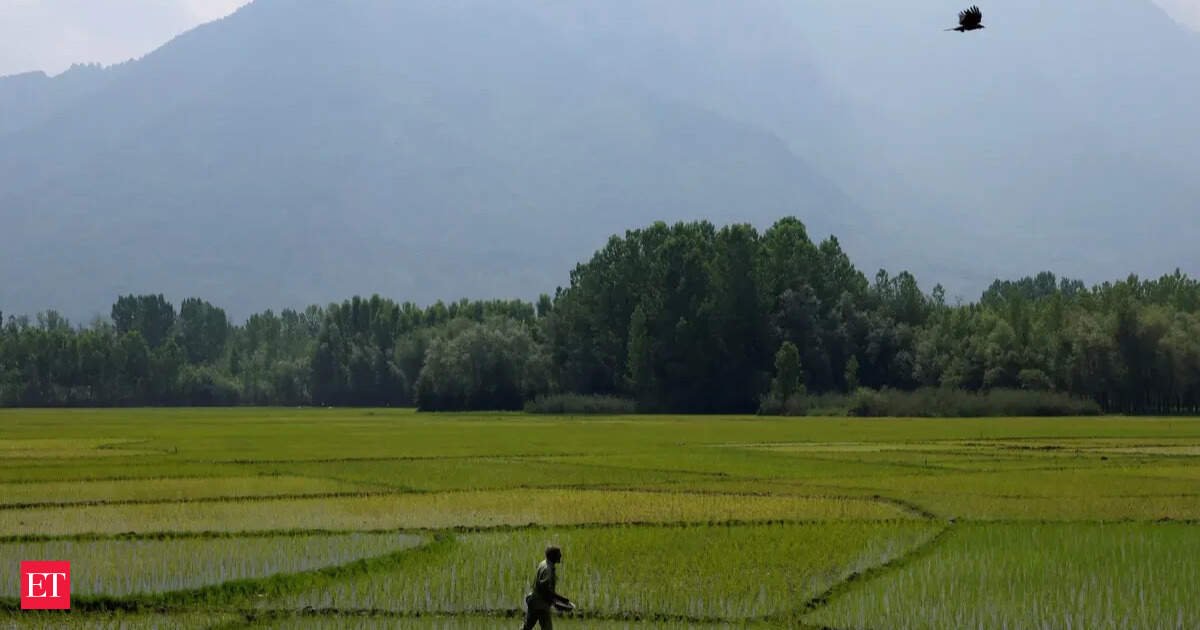
The country’s farmers use more urea – a nitrogen-heavy crop nutrient – than the US and Brazil combined, buoyed by government support that keeps prices well below market rates. As the war in Iran upended global fertilizer and energy flows, the cost to procure it more than doubled and the cargoes of gas needed to produce its own grew more scarce. That has swelled an already hefty subsidy bill and added to a surge in foreign-exchange outflows that’s put the rupee among Asia’s worst-performing currencies this year.
Also Read: India urea import offers decline 12% as war supply squeeze eases
Fertilizer prices have eased as more workarounds are put in place, but the financial damage already done is sparking a government-led effort to rein in use, a sensitive issue in a country where farmers make up a crucial voting bloc. Officials have campaigned with growers nationwide to highlight the perils of excessive fertilizer on soil health and a new system is being tested that could change how the nutrients are sold longer-term. Even Prime Minister Narendra Modi has urged cutbacks.
The country is in the middle of its biggest annual growing season, when fertilizer use peaks. Few farmers seem eager to change long-held practices, but with flows of Middle East nutrients and gas yet to normalize, cooperatives in some key states are taking steps to ration supply as the government seeks to rein in spending, according to people familiar with the matter. Combined with a lackluster monsoon, the situation risks cutting into India’s harvest – potentially boosting food inflation at home and in the dozens of countries that rely on its rice and produce abroad.

“If disruptions linked to the Strait of Hormuz persist, the key concern is not only fertilizer availability, but timely access during critical application windows,” said Laura Cross, director of market intelligence at the International Fertilizer Association. “Given India’s scale, this would have implications beyond the domestic market.”
India’s urea subsidy followed the food crises of the 1960s, when the government embraced the Green Revolution to cut dependence on grain imports and avert famine. Cheap nitrogen fertilizer became critical to raising wheat and rice yields, prompting successive governments to cap urea prices and absorb the difference between market and retail costs.Also Read: Urea imports may get 50% cheaper before kharif season as China eases supplies
The policy helped turn India into a food-surplus nation – it is today the world’s No. 1 rice exporter – while protecting small farmers and containing food inflation. But it has also made the support politically difficult to dismantle, even as the cost climbs.
India, one of the world’s largest urea buyers, paid nearly double pre-war prices for supplies in an April tender as flows through the Strait of Hormuz were choked off. In addition, the country has faced lofty costs for the natural gas imports – many of which also come from the Middle East – that serve as a crucial feedstock for domestic fertilizer production. The country’s fertilizer subsidy bill is likely to exceed 3 trillion rupees ($31 billion) in the current fiscal year, well above the budgeted 1.71 trillion rupees, according to a government official familiar with the matter.
 Bloomberg
Farmers still pay just 266.5 rupees ($2.80) for a 45-kilogram bag of urea, less than a tenth of the price the government paid in an April tender to procure it. Other types of fertilizer are also subsidized, albeit to a lesser extent, adding to the allure of nitrogen.
The spending on fertilizer subsidies is “money being used inefficiently, ineffectively,” said Avinash Kishore, a senior research fellow at the International Food Policy Research Institute. “It is baking in unhealthy, not environmentally friendly, unproductive practices in Indian agriculture.”
That’s kept demand resilient, relative to countries like Australia and France, where some farmers switched to less fertilizer-intensive crops to stave off this year’s price shock.
Also Read: Major respite for India on fertiliser front as urea prices finally fall
In a May speech, Modi said it’s “essential” for the country to reduce consumption of chemical fertilizers, urging farmers to cut use by as much as half as part of an effort to curb dependence on major imported goods. By doing so, “we can save our Mother Earth,” he said. “We have to do it.”
Sparking sustained change would require farmers to buck habits formed over decades. Plus, the average farm in India is less than a hectare (2.5 acres), a fraction of the size in countries like the US. Relying on such small plots to earn their annual income can make growers more hesitant to change prior practices and risk upsetting harvests. Government-backed procurement of wheat and rice, coupled with guaranteed purchases of sugar cane by mills, also discourages Indian farmers from shifting to less urea-reliant crops.
“As long as there is nothing stipulating legally that they have to cut back, there’s very little reason for the farmer to do it,” said Josh Linville, vice president of fertilizer at StoneX. “The Indian farmer’s no different than the rest of the world where they’re basically sitting there saying, ‘I need to produce as many bushels as humanly possible on every acre of ground.’”
As fertilizer costs spiraled in the first months of the war, a vast government effort unfolded to urge cutbacks, often with a focus on environmental benefits.
Also Read: Two urea plants with 25.4 LT annual capacity to start production soon
Farmers often apply fertilizer at rates above agronomic recommendations as they seek to maximize yields, according to industry officials. Decades of those practices have degraded soil health. Runoff is contaminating groundwater and rivers, while excess nitrogen releases nitrous oxide, a potent greenhouse gas that also contributes to air pollution. Of more than 9 million soil samples tested across India in the 2025-26 season, more than half had low levels of organic carbon – a key measure of soil fertility, according to data from the Agriculture Ministry.
India’s agriculture ministry campaigned nationwide through June to urge farmers to reduce use, just as sowing of monsoon crops began. Agriculture Minister Shivraj Singh Chouhan called for soil testing, warning that overapplication kills beneficial microorganisms, reduces yields and raises costs.
Farmer Sukhbir Ram spent more than two hours at one such gathering in Punjab on a sweltering day in early June, the northern state at the heart of India’s grain belt. Another grower, 53-year-old Prem Chand, attended a similar gathering the next day in Haryana. At the meetings, fertilizer-company officials and agricultural scientists warned that years of intensive application is eroding long-term productivity.
“If our soils remain healthy, our communities will remain healthy too,” Sanjay Kumar, a chief manager with Hindustan Urvarak and Rasayan Ltd., told farmers gathered.
Yet both growers left unconvinced — underscoring the challenge to change longstanding farming practices and rein in government spending. Chand, who grows rice, wheat, tomatoes and cauliflower on more than four acres, said he remains focused on protecting yields and income in the next harvest rather than preserving soil quality over the long term, like many farmers in Haryana’s intensively cultivated plains.
Ram, whose district ranks among the country’s top urea users, told officials he would consider cutting back on a small portion of his land, but said previous attempts to reduce fertilizer curbed his yields. Contacted a few weeks later, he said he plans to apply urea as usual.
Still, July and August mark the peak period for planting and farmers’ fertilizer availability may not be fully within their control. Ram estimates he needs four to five 45-kilogram bags of urea per acre for his rice crop, but received only three per acre for his 15-acre farm from his fertilizer supplier — a farmers’ cooperative of which he is a member. The cooperative, he said, was instructed by authorities to limit sales as part of efforts to curb excessive use.
Ram said he plans to purchase the remaining requirement from private dealers. Some require farmers to buy additional crop supplements alongside the nitrogen-based fertilizer, potentially boosting his cost.
At the large grain market in Karnal in the neighboring state of Haryana, a fertilizer retail outlet sales manager who asked not to be identified also said he is also rationing sales amid tight supplies and discouraging farmers from making bulk purchases.
A fertilizer ministry official said India has capped subsidized fertilizer purchases to curb diversion and ensure equitable distribution. Limits vary by state, with some restricting sales to 50 bags a month per buyer.
A new distribution framework is also being piloted in 40 districts, the official said. Farmers will pre-book fertilizer based on landholding and crops sown, with limits designed to ensure supply is proportional to actual farm needs.
The government’s priority remains ensuring adequate fertilizer availability, stable prices and timely subsidy payments to manufacturers so supplies remain uninterrupted, while continuing to support farm incomes and food security, the official said.
The government also recently approved a new program aimed at attracting investment to increase India’s annual urea production capacity by 10 million tons, about a third higher than current levels.
Adding to the worries for farmers is the onset of El Niño, a weather phenomenon known for curbing the monsoon rains that are vital to their crops. June was the driest in 12 years and rainfall is expected to stay below normal through September, when the season ends, the country’s meteorological department recently forecast.
Food costs, which account for more than a third of India’s consumer basket, climbed about 5.5% last month versus a year earlier. That marked an acceleration from June, when the country’s inflation breached the Reserve Bank’s target for the first time in over a year.
“Food inflation faces upside risks this year, as tightening global fertilizer supplies and deficient rainfall so far this season could weigh on agricultural output and put upward pressure on food prices,” said Sonal Varma, chief economist for Asia ex-Japan at Nomura Holdings Inc.
Also Read: India fertilizer offers sink in sign of easing supply strain
Global fertilizer prices have retreated from this year’s peak, with rates in a June tender in India falling to less than half April’s level. Offers in another tender this week also fell slightly. That drop may not be durable, however, without a lasting deal to secure traffic through the Strait of Hormuz, a conduit for about a third of global urea shipments and a fifth of liquefied natural gas supply.
With demand climbing, India’s fertilizer subsidy bill could climb to a record 3.32 trillion rupees if the conflict in the Middle East is prolonged, the Indian Council for Research on International Economic Relations, a New Delhi-based think tank, forecast in July. Even if the tensions ease, spending could total at least 2.42 trillion rupees – more than 40% above the amount allocated in the annual budget.
The government has done well securing supply during the conflict, said Sachchida Nand, a visiting professor at ICRIER and co-author of the report, but managing demand is the bigger challenge. Crises like this one, just four years after Russia’s invasion of Ukraine, can create the momentum needed to push through difficult changes, he added.
“Urea policy reforms are long overdue,” Nand said. “Without such reforms, supply-side interventions alone will continue to come at a high fiscal and economic cost.”