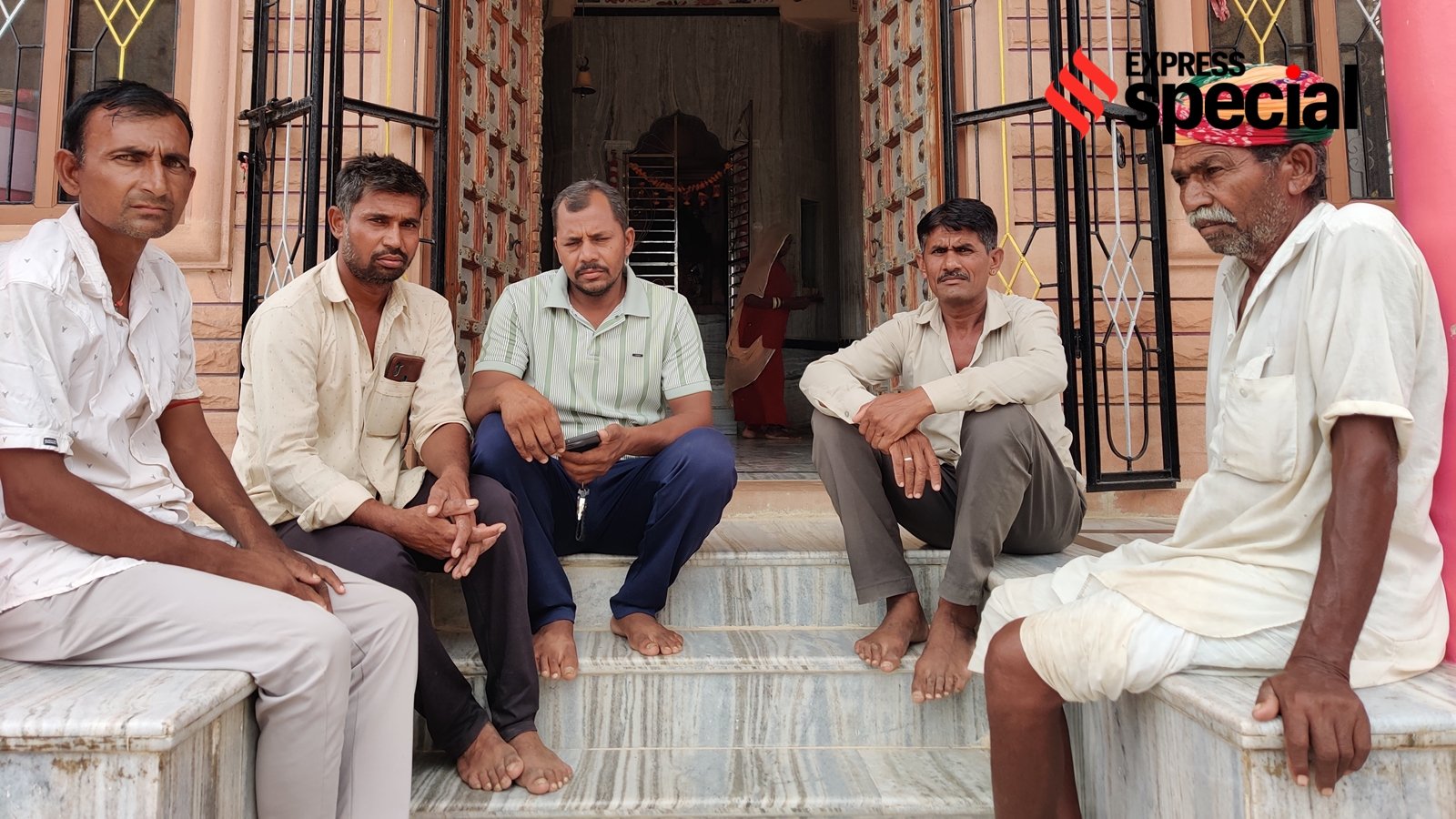
Author-activist Bhanwar Meghwanshi, who wrote a book on the episode, says that the single statement above encapsulates the tragedy of Dangawas. “The court believes that murders have been proven, the injuries have been proven and that mass violence has also been proven. But not any of the killers. So, who killed the six people that day?”

Govind Ram, 37, whose brother Ganesh, father Pancha Ram and uncle Ratna Ram, apart from extended family members, were among those killed, says: “So many among us gave statements, some of us even thrice. What happened then?”
The violence that lasted about half-an-hour abruptly ended Govind’s preparations and plans to move to AIIMS-Patna following the completion of his nursing diploma.
Dalits number about one-sixth of the population in Dangawas as per the 2011 Census, with the Jats making up roughly three-fourth. Lying on the Ajmer-Nagaur road, just outside of Merta City, the village is like any other in the area but for a police tent with two personnel posted round the clock since 2015. At the unofficial centre of the village, a ‘Baba Ramdevji’ temple doubles up as a meeting point for Dalits.
A few minutes’ drive away, farmlands give way to a dense overgrowth. It’s here that the only remnants of the 2015 violence remain: a few bricks, which were once part of the room and hut built by the Dalit side, which were brought down by a tractor that day.
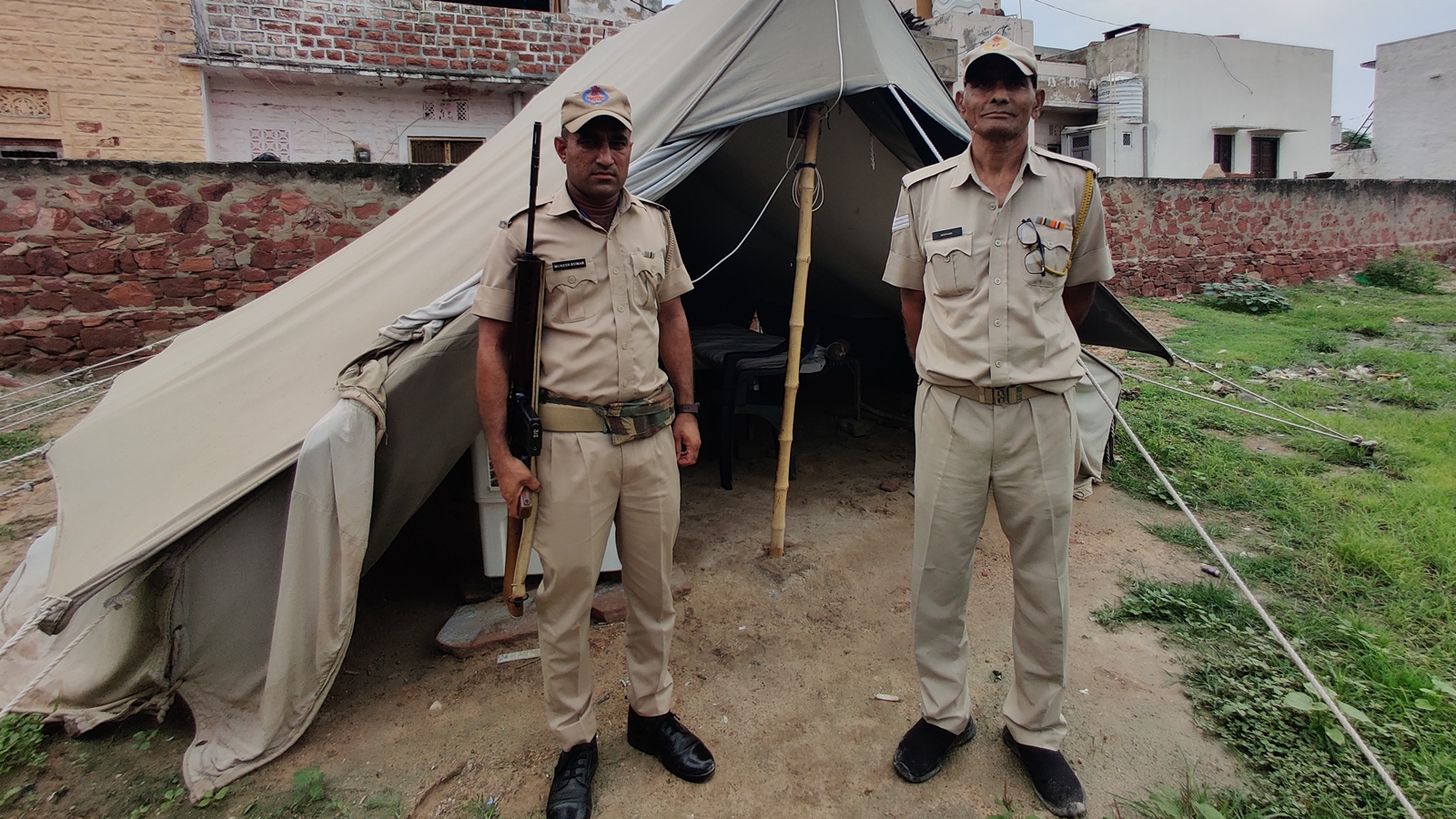 Dalits number about one-sixth of the population in Dangawas as per the 2011 Census, with the Jats making up roughly three-fourth. (Express photo by Hamza Khan)
In the outrage following the incident, the then Vasundhara Raje-led BJP government had ordered a CBI inquiry.
Govind’s uncle Khema Ram, who survived the assault, unlike his brothers and his son Ganesh, has metal rods in his legs and an arm. Recalling the day, he says the “250-300” men came on about 50 motorcycles and three tractors, encircled 16 of them – including six women – and started assaulting them with weapons. “Then, they ran a tractor over us… I saw one of the men being assaulted and stripped… I was left for dead,” Khema says, adding that he was bedridden for two-and-a-half years.
Ratna and Pancha’s wives, Bidami Devi and Sonki Devi, respectively, were among those attacked. “Our men were killed and now the judgment is also against us. How is this possible?” Bidami says, as Sonki shows lingering injury marks.
Even finding legal help was a problem, says Govind, with most of the lawyers in nearby Merta City tehsil headquarters turning them away.
The case
At the heart of the row is a roughly 23-bigha land plot allotted to Basta Ram, a Dalit, by the Rajasthan government in 1961. As per one version, in 1964, he mortgaged it to Chimnaram Jat for a loan of Rs 1,500. The arrangement was that Chimanram would not receive interest on the amount, and Basta Ram would not demand a share of the crop grown on the land.
In 1999, the land ownership was transferred to Ratna, who was Basta’s adopted son. Ratna’s decision to build a room on part of the land and to move in, so as to retake possession of the plot, was what triggered the 2015 clash, as per the Jat side.
Chimnaram’s family protested, claiming that Basta had sold the land to them as he was unable to pay back the loan. And that, since it was not legally possible to sell land owned by a Dalit to a non-Dalit, the sale was executed in the name of Ghisa Ram, a Dalit.
The Dalit side questioned this sale deed, while the Jat family claimed that the certificate showing Ratna’s adoption was fake.
The Dalit side also claimed that in the run-up to May 15, 2015, the Jats tried to browbeat them several times, including with a rape attempt, leading to an FIR.
On May 14, 2015, a panchayat meeting was called to resolve the matter, as per the Jat side, and it descended into chaos and a “free for all”, “with no clarity on who assaulted whom”.
As per another account, Rampal Goswami and Ramdev Khadav (a Jat) were sent as messengers to the panchayat on May 14, and that the Dalit side opened fire, leaving Rampal dead and Ramdev injured. Govind and others were acquitted in this incident, an order that has been challenged in courts.
Mahipal Chaudhary, who represented the 40 accused from the Jat side in the clash that happened, says they were up against many odds, including the fact that Sub-Divisional Magistrate Sohan Lal Kayal was a Dalit.
However, as pointed out by Meghwanshi in his 2018 book, the scales were heavily tilted in favour of the other side. “The sachiv, sarpanch, patwari, the SHO, the Deputy SP, Additional SP, the BDO, pradhan and zila pramukh were all Jats” at the time, he writes. Additionally, a minister in the Raje Cabinet, Ajay Singh Kilak, and then Nagaur MP C R Chaudhary were Jats with family links to Dangawas.
The arguments
Sitting behind a pile of court files in his chamber at the Merta District and Sessions Court, Chaudhary talks about how the Dangawas case was only the second ever CBI probe in Nagaur.
The lawyer pinpoints the many “issues” with the prosecution version, including “contradictions in witness statements to police, CBI and the court”, and that the earliest X-ray of the injured was done five days after the incident.
On the violence, Chaudhary says that some accounts mentioned a crowd of 1,500 attackers, while the FIR mentions 200-300. “But, how can you identify 40 out of 1,500 or even 300?” Chaudhary asks, adding that many of those named were not in Dangawas that day.
He questions the projection of the clash as between two communities, saying it was actually between two families, and denies that tractors were used to crush the victims. Running someone down with a tractor would mean crushed, not broken, bones, Chaudhary argues.
To the Dalit families’ argument of who killed their men, Chaudhary says: “The accused spent four to nine years in jail for something which they didn’t do. Who will return their years?”
In their argument, the lawyer for the Dalit side said that “considering the rural environment, their educational level, the horror of the incident, the witnesses’ old age, and the lapse of time, minor contradictions in their evidence cannot render the entire prosecution story suspect”.
Says Meghwanshi: “This verdict reveals another horrifying truth: it’s difficult for a poor Dalit family to access the court, to fight a case for years, to secure witnesses, to gather documents, and to monitor the investigation. And when the accused are acquitted, what is left for the family?”
Post-script
While former Congress chief minister Ashok Gehlot has slammed the “serious flaws in the investigation and prosecution”, the usually outspoken Congress state president Govind Singh Dotasra, a Jat, is yet to comment on the issue, though he sent an emissary – Congress SC Cell chief Mamta Bhupesh – to Dangawas following the verdict.
Another senior Congress leader, Sachin Pilot, spoke only on August 11, on a day when Leader of Opposition Tika Ram Jully visited the victims’ family in Dangawas.
Reserved for SCs, the Merta City Assembly seat is represented by the BJP’s Laxman Ram. He told The Indian Express: “We will know the investigation’s shortcomings once we have full court (order). If the victims aren’t satisfied, then courts are open to them… If needed, I will also meet the CM.”
However, the Dalits are losing hope: Even in 2015, despite the national outrage, there was no financial support beyond the provisions of the SC/ST Act, and only one of their 18 demands – a CBI inquiry – was accepted, they say.
“It feels like our family members have been killed once again,” says one of the victims.