

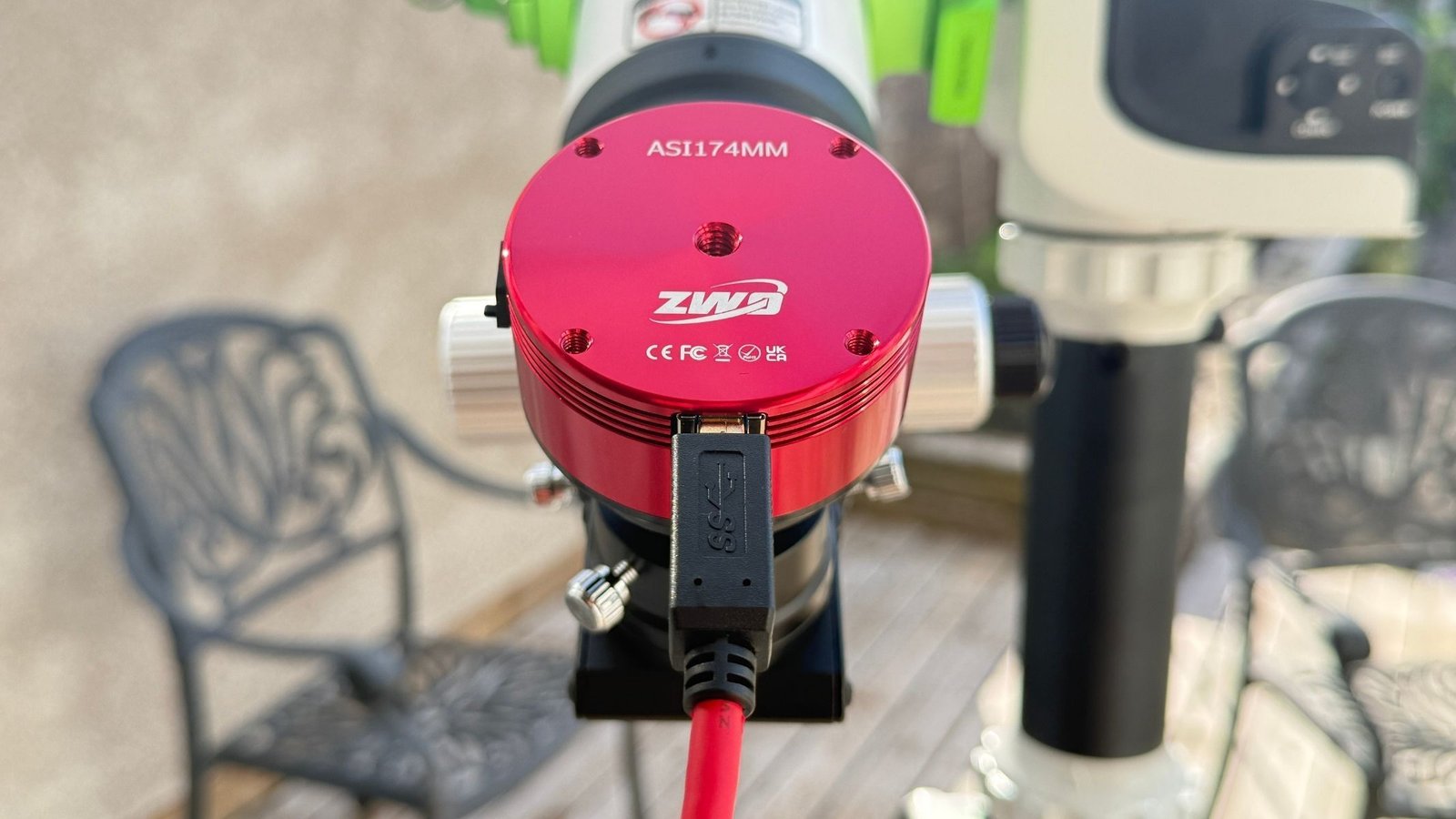
Originally launched a decade ago, the ZWO ASI174MM is a planetary astrophotography camera — something you insert into the eyepiece of a telescope to take images and video of deep-sky objects, planets, the moon and the sun. This one is very much geared towards the latter, with solar and lunar imaging its goal.
Specifications
Product type: Monochrome astronomy camera
Sensor: 1/1.2-inch Sony Exmor IMX174LLJ / IMX174LQJ CMOS
Resolution: 2.3MP, 1936×1216
Pixel size: 5.86µm
Shutter: Pregius global shutter
Maximum frame rate: 164.5fps at full resolution in 10-bit mode; 128.2fps at full resolution in 12-bit mode
Interface: USB 3.0 / USB 2.0
Guide port: ST4
Adapters: 2-inch / 1.25-inch / M42 x 0.75
Dimensions: 62 x 36 mm
Weight: 140g / 4.2 oz
Accessories: M42-to-1.25-inch nosepiece adapter, 1.25-inch cap, 2m USB 3.0 cable, 2m ST4 cable
At first glance, the specification looks simple: a 2.3MP monochrome Sony IMX174 sensor, 5.86µm pixels, USB 3.0 connectivity and a compact red aluminum body. The important details are the sensor size, speed and global shutter. For lunar and solar imaging, where you often want to capture large areas in high frame rate videos and freeze split-seconds of steady “seeing” — when turbulence in Earth’s atmosphere doesn’t degrade an image of an astronomical object — those traits matter more than headline megapixels.
The ASI174MM is especially attractive for solar imaging with an H-alpha telescope — a filter that blocks all wavelengths of light other than H-alpha, which is emitted by hydrogen atoms. That’s because its 5.86 μm pixels match the focal ratios typical of solar telescopes, yielding sharp, efficient detail. Its relatively large sensor can cover more of the solar disc than many small planetary cameras, while its high frame rate supports the usual lucky-imaging workflow of capturing video, selecting the best frames and stacking them for sharper images.
ZWO ASI174MM astronomy camera: Design

- Compact aluminum camera body
- USB 3.0 and ST4 guide port included
- Useful adapter bundle
The ZWO ASI174MM has a compact, lightweight and practical design that’s ideal for use as a camera attached to a telescope. Its small cylindrical aluminum body adds very little strain to a focuser, solar diagonal or off-axis guider, which is particularly useful when working with solar telescopes.

Usefully, the camera includes a high-speed USB 3.0 connection, which is important because the ASI174MM’s main strength is capturing and transferring many video frames very quickly. It can also be used over USB 2.0, but doing so gives up much of the performance that makes the camera appealing in the first place.

(Image credit: Jamie Carter)


An ST4 guide port adds extra flexibility. Although the ASI174MM is primarily sold as a planetary camera, it can also be used as a guide camera (mounted on top of a main imaging scope to capture a wide field of view), especially with off-axis guiders (a device that sits between a main camera and the telescope to precisely track stars), where the larger sensor helps find guide stars more easily than smaller-chip models.
ZWO ASI174MM astronomy camera: Performance

- Excellent for solar and lunar video capture
- Global shutter is a real advantage
- Large pixels favor longer focal lengths

The ASI174MM’s combination of a relatively large 1/1.2-inch sensor, 5.86µm pixels, and fast video capture makes it particularly well-suited to imaging the sun and moon. Compared with planetary cameras built around smaller sensors, it records a considerably larger area of the telescope’s field of view, reducing the number of panels needed for mosaics and making it easier to locate and frame a target.

That larger sensor is especially useful for solar imaging, which is what we tested it with. The exact field of view depends on the telescope’s focal length, but the ASI174MM can capture larger active regions — and, with some setups, most or all of the solar disc — without immediately requiring a mosaic. For example, we tested it with the Sky-Watcher Heliostar 76Ha solar telescope, for which it is a natural match, where prominences, filaments, sunspots and rapidly changing structures on the solar surface need to be recorded at high speed.

The camera’s global shutter is another advantage for solar imagers. A rolling shutter (the standard choice for deep-sky imaging) records an image progressively, one row of pixels at a time, to produce a low-noise, high-dynamic-range image. However, atmospheric turbulence, which slightly shifts the image, can cause distortion. A global shutter exposes the entire sensor simultaneously, helping the ASI174MM preserve the shape of solar and lunar features more accurately from frame to frame.

High-speed capture also supports lucky imaging. Instead of trying to produce one perfect exposure, the camera records thousands of short exposures in rapid succession. Software then identifies and stacks the sharpest frames — the brief instants when Earth’s turbulent atmosphere becomes relatively steady.

While it’s ideal for solar imaging, the ASI174MM is much less convincing as a conventional deep-sky camera. Long exposures can reveal pronounced amp glow towards one side of the frame, while the uncooled sensor becomes increasingly noisy as exposure times increase. Calibration with dark frames can reduce these effects, but it adds complexity and cannot turn the ASI174MM into a modern cooled deep-sky camera. It can be used for short-exposure imaging, guiding and some specialist applications, but solar, lunar and planetary video remain its natural strengths.
ZWO ASI174MM astronomy camera: Functionality

- Captures good data
- ZWO software works well
- Little guidance available
The ASI174MM fits neatly into the established workflow for solar, lunar and planetary imaging: capture a high-speed video, identify the sharpest frames, align and stack them, then sharpen and process the image. Its fast USB 3.0 connection enables high data transfer rates, while region-of-interest controls allow the user to record only a selected portion of the sensor. Reducing the size of the recorded area can substantially increase the frame rate, which is particularly useful when imaging an individual sunspot.

Several free applications can control the camera and record these videos, including SharpCap and FireCapture. AutoStakkert! is widely used to analyze, align and stack solar, lunar and planetary frames, while programs such as ImPPG, RegiStax, Siril, Adobe Photoshop and GIMP can be used for sharpening, contrast adjustment and final processing. Windows users have the widest choice of third-party astronomy software.
However, ZWO also provides its own free ASIStudio software suite. For the ASI174MM, the most relevant applications are ASICap, which controls the camera and records lossless SER or AVI video, and ASIVideoStack, which analyses and stacks the resulting frames (and can also be used for post-processing). ASIStudio is available for both Windows and macOS.

The basic capture process is straightforward. After connecting the ASI174MM to ASICap, exposure time and gain are adjusted until the brightest areas of the sun or moon remain below saturation. Because this is a monochrome camera, the live view can be shown either in grayscale or with false color applied for easier viewing. A video containing around 1,000 to 3,000 frames is then recorded, though the ideal number depends on the target, seeing conditions and available storage.
Storage requirements are significant. Uncompressed high-frame-rate video from the full sensor can consume several gigabytes in a matter of seconds, so a fast computer, a USB 3.0 connection and plenty of free drive space are essential.

Once a video is loaded into ASIVideoStack, the software can assess frame quality, align the image and combine a chosen percentage of the sharpest frames. The finished stack can be exported in formats including JPEG and FITS. JPEG is convenient for immediate sharing, but FITS preserves more of the original image data and is better suited to serious post-processing.

The workflow is functional rather than polished. There is relatively little guidance for beginners and obtaining the best results requires experimentation with exposure, gain, frame rate, focus, stacking percentages and sharpening settings. It can take many attempts to determine which combination works best with a particular telescope and observing conditions. For that reason, it’s wise to archive the video files, which can be revisited and processed later as processing skills/software improves.
How we tested the ZWO ASI174MM

We tested the ZWO ASI174MM planetary camera for two weeks and used it in conjunction with the Skywatcher HelioStar 76mm solar telescope and Solar Quest mount to image the sun in H-Alpha (Hα).
Should I buy the ZWO ASI174MM?
Buy it if:
✅ You mainly image the sun or moon: The ZWO ASI174MM astro cam excels in solar, planetary and lunar imaging, so if these are your main astrophotography targets, it’s the perfect choice.
✅ You have an H-Alpha telescope: If you have a solar telescope and want to move on from observation to start imaging the sun with it, you will need a monochrome astrocam like the ZWO ASI174MM.
Don’t buy it if:
❌You want a dedicated deep-sky imaging camera: This model exhibits severe amp glow for exposures longer than a few seconds and lacks thermoelectric cooling (TEC) needed for noise reduction.
❌You need high megapixel resolution: The low resolution is another reason it fails as a deep-sky imaging camera as you would want a higher resolution model for detail in star clusters and galaxies.
Buy the ZWO ASI174MM if your main targets are the sun and moon, especially if you want a monochrome camera with a larger-than-average sensor, fast frame rates and a global shutter. It remains particularly suited for H-alpha solar imaging, where monochrome capture, speed and sensor area matter.
If this product isn’t for you
If you want a cheaper first planetary camera, a smaller-sensor ZWO ASI120-series-style camera may be enough for basic lunar, planetary and guiding use, though it will not offer the same field of view.
If you want a more modern planetary camera, look at newer monochrome planetary models like the ZWO ASI585MM with lower read noise, smaller pixels or higher resolution, depending on your telescope’s focal length.
If your goal is deep-sky imaging, a cooled astronomy camera is a better choice than the ASI174MM. We have reviewed the ZWO ASI533MC Pro and the ASI183MC Pro and gave both of them nothing less than four and a half stars for beautiful deep-sky astrophotography.