

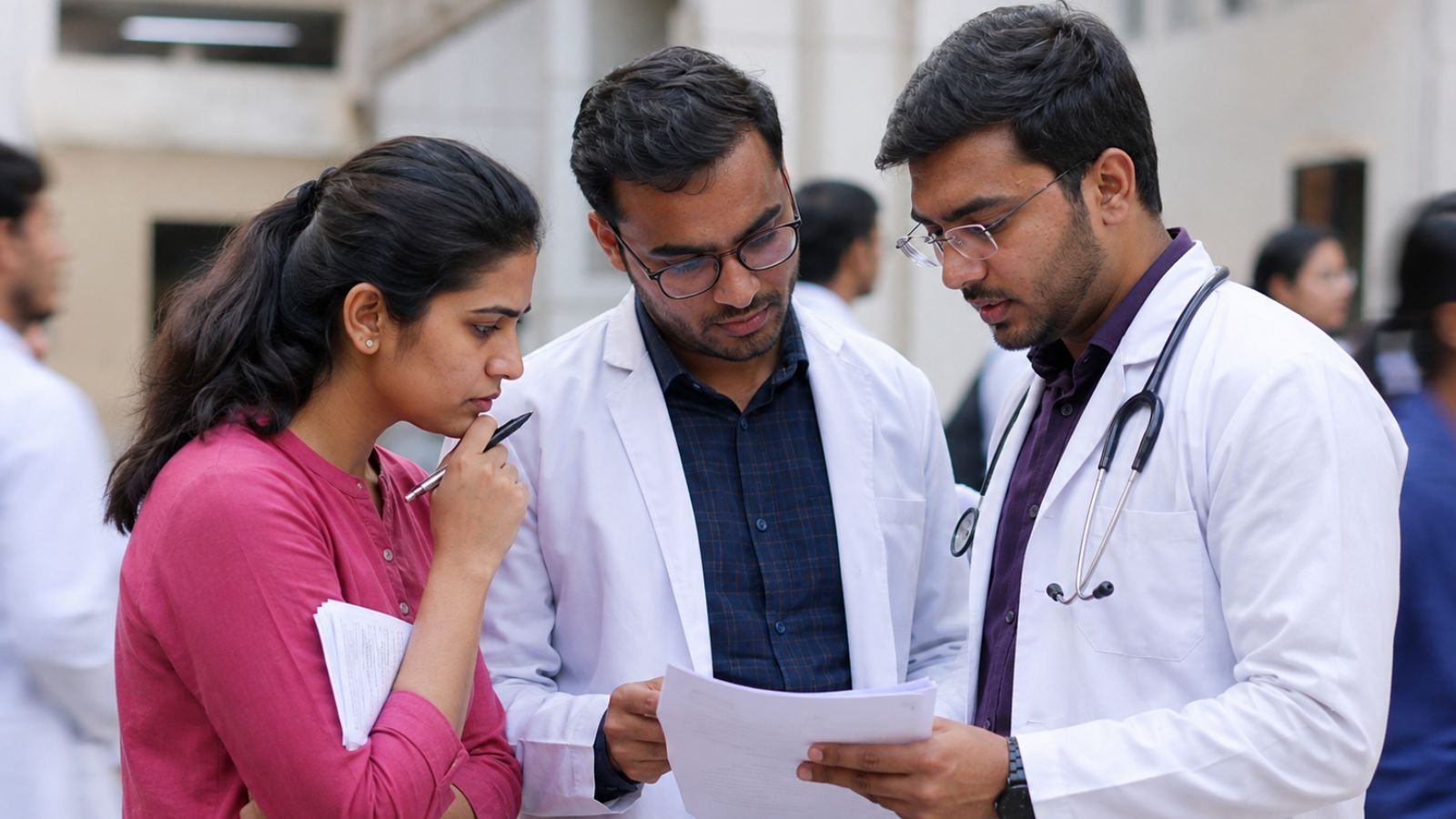
Only 12.38 per cent of the 37,448 candidates who appeared for the Foreign Medical Graduate Examination (FMGE) in June cleared the test. The low pass rate has become a flashpoint for Foreign Medical Graduates (FMGs), who have been protesting for the past one month, alleging that the examination was tougher, lacked transparency and was poorly managed.
The FMGE, conducted by the National Board of Examinations in Medical Sciences (NBEMS), is the screening examination for foreign-trained medical graduates seeking to practise medicine in India.
The All India Medical Students’ Association – Foreign Medical Students’ Wing (AIMSA-FMSW) and the All FMGs Association (AFA) wrote to NBEMS with a formal representation. They have also been holding a protest at New Delhi’s Jantar Mantar since early August. Their demand has been the release of the official answer key and response sheets, review the sudden introduction of video-based questions, fix poor exam centre conditions, review the exam fee, and offer relief or a lower cutoff to candidates hurt by this session.
A group of candidates who earlier moved the Supreme Court led it to issue a notice to the Centre, the National Medical Commission (NMC), and NBEMS, seeking their response on the demand for transparency. According to AIMSA’s general secretary Kanishka Kalra, board officials have also recently met a group of student representatives at the NBEMS office. The board told them a new three-member committee would look into the release of the answer key, and asked for three weeks.
FMGE 2026: How low pass rate became a flashpoint
The numbers explain much of the demands. FMGE pass rates have always been low. That’s roughly half the rate of the previous few sessions, and one of the lowest in the exam’s history, close to the 2023 low. Over 31,000 candidates failed to clear the 50 per cent cutoff.
As per data accessed by indianexpress.com for FMGE’s June sessions specifically — as opposed to comparing across June and December sittings — the pass percentages read differently: 10.40% in 2015, 11.09% in 2016, 7.41% in 2017, 26.74% in 2018, 23.13% in 2019, 11.62% in 2020, 24.86% in 2021, 10.91% in 2022, 10.44% in 2023, 20.93% in 2024, 18.62% in 2025, and 12.77% in June 2026. People aware of the development within the health ministry said this year’s dip, seen only against other June sessions, is “not a very large deviation” from the exam’s historical trends.
Students argue this isn’t a coincidence, pointing to two factors: a harder paper, and the unannounced introduction of video-based questions that ate into exam time.
Story continues below this ad
What are video-based questions, why do they matter
For the past decade, FMGE has been conducted in MCQ-based, computer-based tests, with 300 questions split across two shifts, and one minute per question on average. Until 2020, most questions were short, one-line, largely fact-recall items. After 2020, the exam shifted to clinical-scenario questions, which needed deeper understanding rather than rote memory. Picture-based questions also found their way in, with a single image, usually of a surgical procedure, with a question attached; a two-time FMGE taker requesting anonymity explained.
In June 2026, NBEMS added a new format: video-based questions. According to Kalra, these were real clinical recordings, apparently sourced from hospital clinical postings, showing a patient with a specific complaint. Candidates had to watch the clip and diagnose the condition to answer. The Supreme Court petition placed the count at around 12; NBEMS has not confirmed an official number.
Each question, video-based or not, was worth one mark, with no negative marking. But the video clips took time to watch on top of reading and eliminating options, within the same one-minute-per-question limit — a squeeze that, combined with a tougher paper overall, left many candidates unable to complete all 300 questions, Kalra said.
Students say the biggest issue was the lack of advance notice. While the NBEMS had announced changes to this year’s NEET-PG pattern, including video-based questions, before the exam, FMGE candidates say no similar notification was issued. Kalra also pointed out that the NBEMS has never released an official FMGE answer key, unlike other major medical examinations.
Story continues below this ad
‘Safeguarding healthcare system’: What the NMC said
When indianexpress.com reached out to the NMC on these claims, it confirmed that video-based questions were indeed part of the June 2026 paper.
Senior officials in the NMC said the video format is standard practice in Western examination systems. They maintained that the change had been notified in advance, with demo tests also conducted ahead of the exam. Indianexpress.com could not independently verify the notification, but did find that the demo test made available ahead of the exam includes video-based questions, as officials said.
Students claimed the count ranged from 12 to 28; officials maintained it was limited to 12–14, with clips kept brief and only as long as necessary to depict the relevant clinical finding. They said video-based questions assess clinical signs and examination findings that static images cannot capture, consistent with routine undergraduate training and not exceeding a medical graduate’s expected competencies.
Officials also defended the exam’s broader purpose, saying all doctors entering India’s healthcare system — regardless of where they trained — must meet a minimum competency standard: “This is not merely a test. It safeguards our own healthcare system,” and that letting underprepared candidates through would harm the system long-term.
Story continues below this ad
Why officials say the pass rate looks worse than it is
Officials attributed the recurring struggle largely to gaps in clinical training abroad rather than exam design. NMC said many institutions overseas do not provide adequate clinical exposure, with the first two to two-and-a-half years of many foreign medical courses being largely theoretical. Students are then sent into hospital settings where the patient profile, language, and disease patterns differ sharply from what they will eventually encounter in India. However, they were careful to add that this isn’t true of every foreign medical college, or graduate, but said the shortcoming is a recurring pattern.
Officials also noted that foreign curricula may differ from India’s in public health priorities, disease patterns and clinical practices — which the FMGE is designed to test for safe practice in India.
On the protests, a senior National Medical Commission official acknowledged the students’ concerns, saying the number of FMGE candidates has risen from a few thousand annually to tens of thousands, creating a growing backlog and uncertainty over career prospects.
The protest is over as the officials said an independent committee has been constituted to examine the grievances and recommend measures to the National Board, which will implement feasible recommendations within the existing legal and statutory framework. The committee will currently review the issues.
Story continues below this ad
Officials pointed to roughly 4,000–5,000 new FMG candidates appearing each year against a far larger accumulated backlog. The Health Ministry told Parliament’s ongoing monsoon session that about 88% of this year’s candidates were repeaters, signalling that chronic repeaters may need to be addressed going forward. Even so, officials maintained that confrontation alone “will not solve the issue.”