

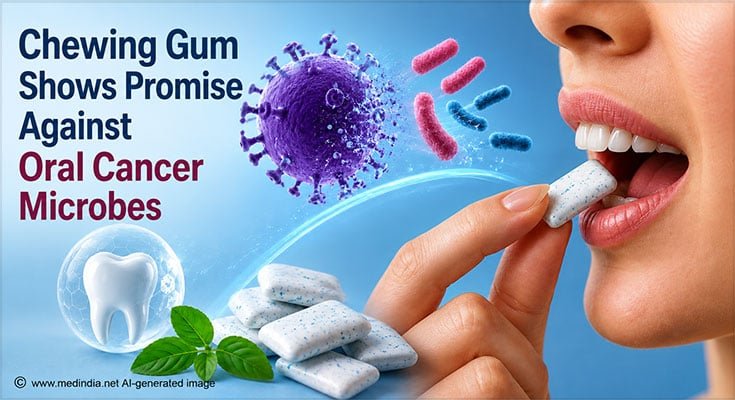
ScienceDaily reports that a bioengineered chewing gum reduced HPV by up to 93% and nearly eliminated oral cancer-linked bacteria in laboratory tests.

- Bioengineered chewing gum reduced HPV by up to 93% in saliva samples
- Two bacteria linked to oral cancer were almost completely eliminated
- Healthy mouth bacteria were largely preserved during treatment
Researchers have developed a bioengineered chewing gum that could become a simple new way to target viruses and harmful bacteria linked to head and neck cancer (1✔ ✔Trusted Source
Ex vivo HNSCC clinical studies using saliva and antiviral or antibacterial chewing gums reveal reduction in carcinogenic microbes
).
According to a ScienceDaily report based on a study published in Scientific Reports, an experimental chewing gum reduced human papillomavirus (HPV) by up to 93% in laboratory tests.
The gum also almost completely eliminated two cancer-associated bacteria in saliva and oral rinse samples collected from patients.
Researchers from the University of Pennsylvania School of Dental Medicine say the plant-based chewing gum could one day become an affordable add-on to current cancer therapies or help reduce the spread of cancer-related infections.
However, they emphasize that the research is still at an early stage. Since the study was conducted on patient samples outside the human body, clinical trials are still needed before the chewing gum can be used in routine medical care.
Advertisement
Can a Chewing Gum Really Help Fight Oral Cancer?
Researchers developed a plant-based bioengineered chewing gum that targets viruses and bacteria linked to head and neck squamous cell carcinoma (HNSCC).
Instead of attacking cancer cells directly, the chewing gum targets harmful microbes that may promote cancer growth while largely preserving the healthy bacteria naturally found in the mouth.
Researchers believe this targeted approach could one day support existing cancer treatments if future clinical trials confirm its benefits.
The study reported several promising findings.
|
Study Finding |
Key Result |
Clinical Importance |
|
HPV in saliva |
Reduced by 93% |
May help lower one of the major viral risk factors for HPV-related throat cancers. |
|
HPV in oral rinse samples |
Reduced by 80% |
Demonstrated strong antiviral activity in different oral samples. |
|
Porphyromonas gingivalis (Pg) |
Reduced to almost undetectable levels |
This bacterium has been linked to faster oral cancer progression and poorer survival. |
|
Fusobacterium nucleatum (Fn) |
Reduced to almost undetectable levels |
May reduce bacteria associated with inflammation and tumour growth. |
|
Healthy oral bacteria |
Largely preserved |
Helps maintain the normal oral microbiome while targeting harmful microbes. |
|
Protegrin-1 |
A single dose showed strong antibacterial activity |
Successfully reduced both cancer-associated bacteria in laboratory tests. |
|
Overall effect |
Combined antiviral and antibacterial action |
Targets multiple cancer-associated microbes using a single plant-based chewing gum. |
One of the biggest strengths of the chewing gum was its ability to reduce harmful microbes without significantly disturbing the healthy oral microbiome.
Researchers noted that this could offer an advantage over treatments such as radiation therapy, which may reduce beneficial bacteria and encourage the growth of opportunistic infections like Candida.
Advertisement
Why Are HPV and Certain Mouth Bacteria Linked to Oral Cancer?
Researchers did not choose these microbes by chance. The chewing gum was designed to target three microbes that are increasingly linked to head and neck squamous cell carcinoma (HNSCC)—a common cancer that develops in the mouth and throat.
These include:
- Human papillomavirus (HPV)
- Porphyromonas gingivalis (Pg)
- Fusobacterium nucleatum (Fn)
HPV infection is one of the main reasons for the global rise in oropharyngeal cancers.
At the same time, infections caused by P. gingivalis and F. Nucleatum have been linked to poorer survival in people with recurrent or advanced oral cancer, even after surgery and other treatments.
According to a review published in the journal Infectious Agents & Cancer, these two bacteria can work together to make oral cancer more aggressive. They can:(2✔ ✔Trusted Source
Porphyromonas gingivalis and Fusobacterium nucleatum synergistically strengthen the effect of promoting oral squamous cell carcinoma progression
- Increase long-term inflammation inside the mouth.
- Help cancer cells grow and multiply.
- Make it easier for cancer cells to spread.
- Reduce the body’s natural anti-tumor response.
- Worsen outcomes in people with oral squamous cell carcinoma.
This is why researchers believe that reducing these microbes could become an important part of supporting future oral cancer treatment.
According to a review, HPV is now recognized as one of the leading causes of many cancers of the throat and back of the mouth. Preventing HPV infection through vaccination and reducing oral HPV levels may therefore play an important role in lowering future cancer risk.(3✔ ✔Trusted Source
The Effect of Prophylactic HPV Vaccines on Oral and Oropharyngeal HPV Infection-A Systematic Review
Advertisement
Why Did Researchers Choose a Chewing Gum Instead of a Pill?
The delivery system is just as important as the medicine itself.
Instead of developing another tablet or mouthwash, researchers designed a medicated chewing gum that slowly releases active ingredients while a person chews.
According to another review, chewing gum allows medicines to mix continuously with saliva and remain in contact with the mouth and throat for a longer time. This helps deliver treatment directly to the tissues where viruses and bacteria are present (4✔ ✔Trusted Source
Chewing Gums as a Drug Delivery Approach for Oral Health
A separate review also highlights that medicated chewing gums are becoming increasingly popular because they are easy to use, non-invasive, and can provide controlled release of therapeutic compounds without the need for injections (5✔ ✔Trusted Source
Biodegradable medicated chewing gum: A modernized system for delivering bioactive compounds
Compared with many conventional drug delivery methods, medicated chewing gums may offer several advantages.
- Deliver active ingredients directly inside the mouth.
- Release medicines gradually while chewing.
- Improve patient comfort and convenience.
- Require no water or injections.
- May improve treatment adherence.
- Could be more affordable for long-term use.
How Does This Plant-Based Chewing Gum Work?
The experimental chewing gum combines two natural protective ingredients that work in different ways against cancer-associated microbes.
FRIL, a natural protein obtained from lablab beans, acts against HPV by helping trap and block the virus before it infects more cells.
Protegrin-1 is a naturally occurring antimicrobial peptide that destroys harmful bacteria by damaging their protective outer membranes, making it difficult for them to survive.
Combining FRIL and Protegrin-1 allowed the chewing gum to fight both viral and bacterial microbes in a single treatment.
Another important finding was that the chewing gum largely preserved beneficial bacteria that naturally live in the mouth. These healthy bacteria help maintain oral health, protect tissues, and prevent harmful microbes from taking over.
Researchers believe this combination of antiviral activity, antibacterial action, and preservation of healthy mouth bacteria makes the chewing gum a promising new approach that deserves further testing in human clinical trials.
Could This Chewing Gum Change the Future of Oral Cancer Care?
Although the results are encouraging, researchers stress that this chewing gum is not yet a treatment or cure for oral cancer.
According to the ScienceDaily report, the current research was conducted using saliva and oral rinse samples collected from patients with head and neck squamous cell carcinoma (HNSCC).
Because the chewing gum has not yet been tested in large human clinical trials, more research is needed before it becomes part of routine medical care.
However, researchers believe the chewing gum could eventually become an important adjunct (add-on) therapy rather than a replacement for existing cancer treatments.
If future clinical trials are successful, the chewing gum may help:
- Reduce HPV levels inside the mouth.
- Lower harmful oral bacteria before or after cancer treatment.
- Support existing treatments such as surgery or radiotherapy.
- Help reduce infection and transmission of cancer-associated microbes.
- Improve oral health while preserving beneficial mouth bacteria.
Why Is Protecting Healthy Mouth Bacteria Just as Important?
The mouth naturally contains millions of beneficial bacteria that help:
- Protect the teeth and gums.
- Maintain a healthy balance of microbes.
- Prevent harmful bacteria from multiplying.
- Support the body’s natural defense against infections.
According to the researchers, the bioengineered chewing gum selectively targeted disease-causing microbes without causing major damage to beneficial oral bacteria.
This is important because conventional treatments such as radiation therapy can disturb the normal balance of microbes in the mouth.
Radiation may reduce helpful bacteria while allowing opportunistic organisms such as Candida albicans to grow, increasing the risk of oral complications.
Preserving healthy bacteria while reducing harmful microbes could represent a new direction in supportive cancer care.
Why Could This Discovery Matter for India?
India continues to carry one of the world’s highest burdens of oral cancer.
According to an analysis published in Oral Oncology, based on the Global Burden of Disease study, India accounts for nearly one-third of the world’s oral cancer cases. Tobacco use, smokeless tobacco, betel quid chewing, alcohol consumption, poor oral hygiene, and HPV infection remain among the major contributors to this growing burden (6✔ ✔Trusted Source
Burden of oral cancer and associated risk factors at national and state levels: A systematic analysis from the global burden of disease in India, 1990-2021
According to researchers, new approaches that target cancer-associated microbes could become especially valuable in countries where oral cancer is common and access to expensive treatments remains limited.
If proven effective in future clinical trials, an affordable medicated chewing gum could become a practical supportive therapy for high-risk populations.
Preventing HPV infection also remains an important strategy for reducing HPV-related cancers. Along with avoiding tobacco and alcohol, HPV vaccination has been shown to significantly reduce oral and oropharyngeal HPV infections and remains one of the most effective preventive measures currently available.
Researchers hope the technology may eventually serve as both an adjunct therapy alongside current cancer treatments and a preventive approach to reduce infection and transmission of cancer-associated microbes.
Frequently Asked Questions
Q: Does this chewing gum cure oral cancer?
A: No. The chewing gum is experimental and is not a cure for oral cancer. It is being studied as a possible supportive therapy.
Q: How effective was the chewing gum in the study?
A: In laboratory tests, it reduced HPV in saliva by up to 93% and almost completely eliminated two bacteria linked to oral cancer.
Q: How does the chewing gum work?
A: It combines plant-derived FRIL, which targets HPV, with Protegrin-1, an antimicrobial peptide that destroys harmful bacteria.
Q: Why is preserving healthy mouth bacteria important?
A: Healthy bacteria help protect the mouth from infections and maintain oral health. The chewing gum largely preserved these beneficial microbes while targeting harmful ones.
Q: Can people use this chewing gum now?
A: No. It has only been tested on patient saliva and oral rinse samples outside the human body. Human clinical trials are still required.
Q: Why is this research important for India?
A: India has one of the world’s highest burdens of oral cancer. If future studies confirm its safety and effectiveness, this affordable chewing gum could become a useful supportive therapy for high-risk populations.
References:
- Ex vivo HNSCC clinical studies using saliva and antiviral or antibacterial chewing gums reveal reduction in carcinogenic microbes – (https://www.nature.com/articles/s41598-026-39062-w)
- Porphyromonas gingivalis and Fusobacterium nucleatum synergistically strengthen the effect of promoting oral squamous cell carcinoma progression – (https://link.springer.com/article/10.1186/s13027-025-00689-5)
- The Effect of Prophylactic HPV Vaccines on Oral and Oropharyngeal HPV Infection—A Systematic Review – (https://www.mdpi.com/1999-4915/13/7/1339)
- Chewing Gums as a Drug Delivery Approach for Oral Health – (https://pmc.ncbi.nlm.nih.gov/articles/PMC9236808/)
- Biodegradable medicated chewing gum: A modernized system for delivering bioactive compounds – (https://www.sciencedirect.com/science/article/pii/S2666833521000447)
- Burden of oral cancer and associated risk factors at national and state levels: A systematic analysis from the global burden of disease in India, 1990–2021 – (https://www.sciencedirect.com/science/article/abs/pii/S1368837524003816)
Source-Medindia