

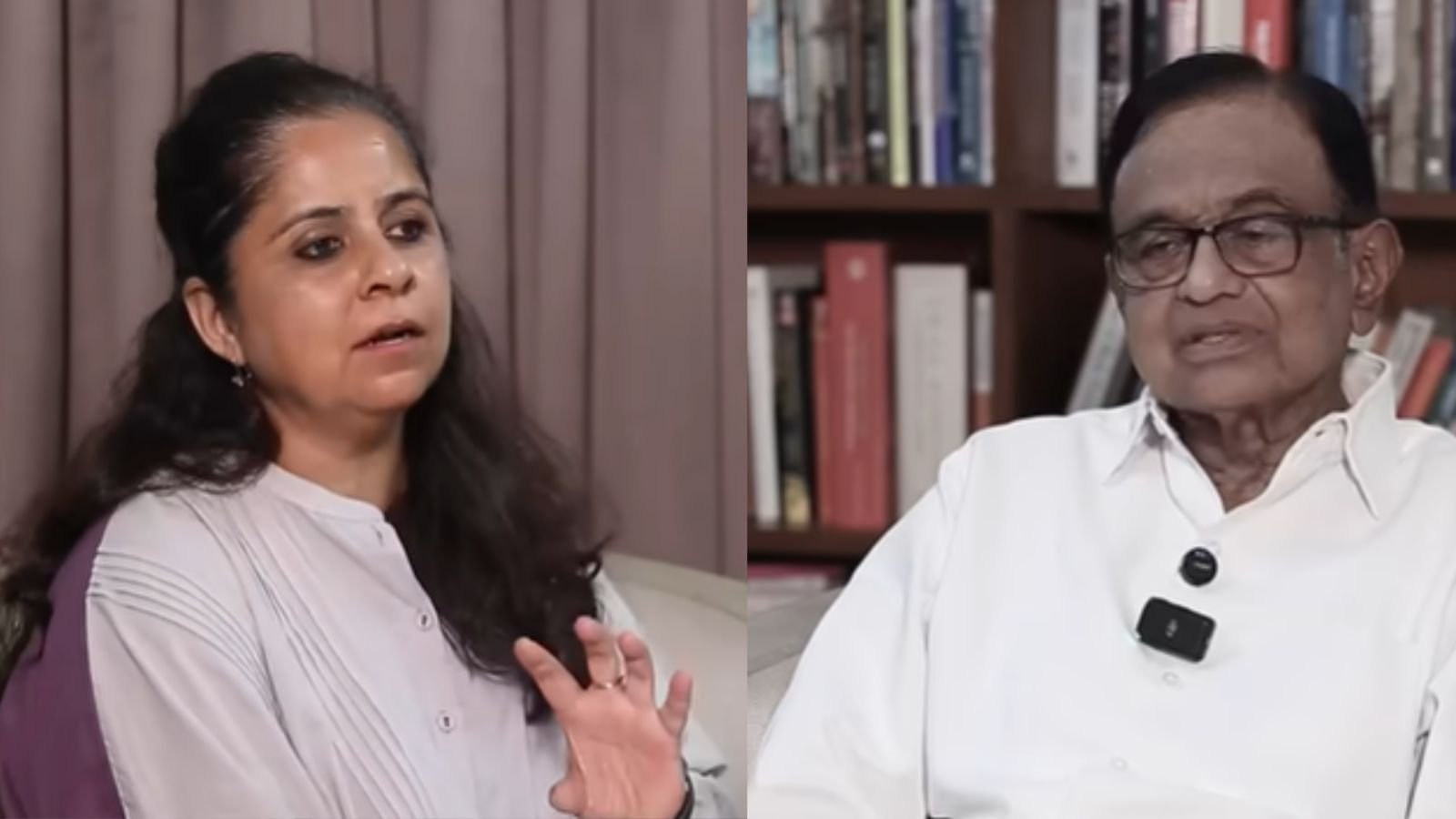
The government’s proposed amendments to the Foreign Contribution Regulation Act – expected in parliament this week – may not be tabled at all, ex-Finance Minister P Chidambaram told The Indian Express. “The Bill may undergo amendments… hasn’t been tabled at all,” he said.
Chidambaram also spoke extensively on the Cockroach Janta Party-led protests against leaked exam question papers. Delhi Police responded to the CJP’s July 20 ‘Sansad Chalo’ march with a lathi charge and the firing of tear gas – all of which has been criticised as police brutality.
The Congress leader also weighed in on Union Home Minister Amit Shah’s absence from the House, an issue the Opposition has picked on vociferously in this session of parliament.
The government is reportedly trying to build consensus on the proposed delimitation exercise and possible amendments to the FCRA. What is your party’s position on these issues, and do you believe a special session is likely?
On reports that the government was seeking consensus with the Opposition on delimitation and a proposed FCRA Bill, senior Congress leader, P Chidambaram said “I have no knowledge of the meeting of the Minister of Parliamentary Affairs.” However, he reiterated his party’s position on delimitation, saying “we are not happy with the kind of delimitation that we are talking about.”
On the proposed FCRA amendments, he said no bill had yet been introduced in Parliament. “FCRA Bill has not been tabled. The FCRA Bill may undergo amendments. FCRA Bill may not be tabled at all. How do I know?”
The Opposition has held the Union Home Minister responsible for the crackdown. Do you believe he is accountable and should he explain his role in Parliament?
Story continues below this ad
The Home Minister has not attended either the Rajya Sabha or the Lok Sabha for the past 10 days despite being in Parliament. “A Home Minister should come to the House, stand up and explain his position. The opposition is absolutely correct in asking why the Home Minister is not attending either House.“
On the use of force, P Chidambaram said “pellet guns are a no-no in a civilian protest” and argued that they are meant only as a last resort in riot-like situations. He questioned why they were used during what he described as a peaceful student protest.
Referring to his Indian Express column on the CJP protests, he said the movement showed that there is obviously a space beyond political parties. Unlike conventional political parties, the protesters had no organisational structure or leadership, yet they spoke in one voice.
He argued that political parties have failed to occupy that space, and it is now being filled by popular movements like CJP and the Jantar Mantar gathering. This is a portent of changes to come in the way voters and citizens behave.
Story continues below this ad
The government has amended the Public Examinations Act, saying it will curb exam leaks and malpractice. What do you think on the Act?
On the amendments to the Public Examinations Act, he questioned whether they actually prevent malpractice. “Show me one section, one provision, one clause which prevents unfair means. It’s all about punishment. It’s post facto,” he said. According to him, the law only comes into effect after exam leaks or malpractice have already occurred.
While supporting action against offenders, he argued that “I have no objection to punishing the criminals. You punish them.” However, he asked whether such punishment restores cancelled examinations or compensates students for the time they lost preparing. He therefore described the law as a misnomer to call it a prevention of unfair means bill, it should be called punishment for use of unfair means bill.”
On Opposition demands regarding the Union Home Minister, Chidambaram said that the primary demand was that the Home Minister attend the House and respond to questions. “We want him to come to the House and answer questions, make a statement and we should be able to question the statement. There should be a discussion and we should be able to ask questions and the Home Minister must answer.”
Story continues below this ad
Seven years after the abrogation of Article 370, Jammu and Kashmir is yet to regain statehood despite repeated assurances from the Centre. How do you view this delay, and do you believe the government’s promise has been broken?
Marking seven years since the abrogation of Article 370 on August 5, 2026, P Chidambaram described “what happened on the 5th of August 2019” as ‘a constitutional outrage.’ While acknowledging that the Supreme Court upheld the government’s decision, he said he was not commenting on the merits of the judgment but on what he considered the more fundamental constitutional issue.
According to Chidambaram, the real question was not Article 370 itself but “can a state be divided or split or splintered into two or more Union territories?” He stressed that Jammu and Kashmir had acceded to India as a full-fledged state under the Maharaja and argued that reducing a state to a Union Territory with limited powers raised an entirely different constitutional question than creating new states through reorganisation.
He noted that states such as Uttar Pradesh, Andhra Pradesh and Madhya Pradesh had previously been divided to create Uttarakhand, Telangana and Chhattisgarh, but said “we are not talking about division of states into two states… We are discussing a state being reduced to a Union territory with limited powers.”
Story continues below this ad
P Chidambaram said that he was surprised that the Constitution Bench did not rule on whether Parliament has the power to convert a state into a Union Territory. “The Constitution Bench said, we are not answering the question because the Solicitor General and the Attorney General have assured this court that statehood will be restored.” He recalled that the Centre had also publicly stated that statehood would be restored after elections.
He questioned why that promise had still not been fulfilled. “How soon is soon? That’s what I’m asking,” he said, noting that elections had already taken place but Jammu and Kashmir remained a Union Territory with limited powers while Ladakh continued as a Union Territory without an elected Chief Minister. He said he was “questioning the assurance of the Government” as well as “the acceptance of the so-called assurance by the Supreme Court.”
The Centre says statehood can be restored only when the security situation in Jammu and Kashmir improves, often citing continued terrorist incidents. How do you see that?
Responding to the government’s argument that statehood depends on the security situation, P Chidambaram accused the Centre of taking contradictory positions. “You can’t have it both ways,” he said. According to him, the government cannot simultaneously claim that terrorism has largely been eliminated while also arguing that terrorism remains the reason for withholding statehood.
Story continues below this ad
He argued that if terrorism continues to be cited as the reason for delaying statehood, the government is effectively admitting that “you have not been able to quell terrorism in J&K” and “you have failed to provide security for the people of J&K.” At the same time, he noted, the government often compares the present situation favourably with previous Congress governments by claiming terrorism has significantly reduced.
Referring to demonetisation, he recalled that one of its stated objectives was to curb terror financing and questioned whether that goal had been achieved. He argued that if terrorism is still being cited as a justification for withholding statehood, then the government’s policies, including demonetisation and its law-and-order measures in Jammu and Kashmir, must also be judged by that standard. “Your law and order measures in J&K is a failure… You can’t have it both ways,” he said.