

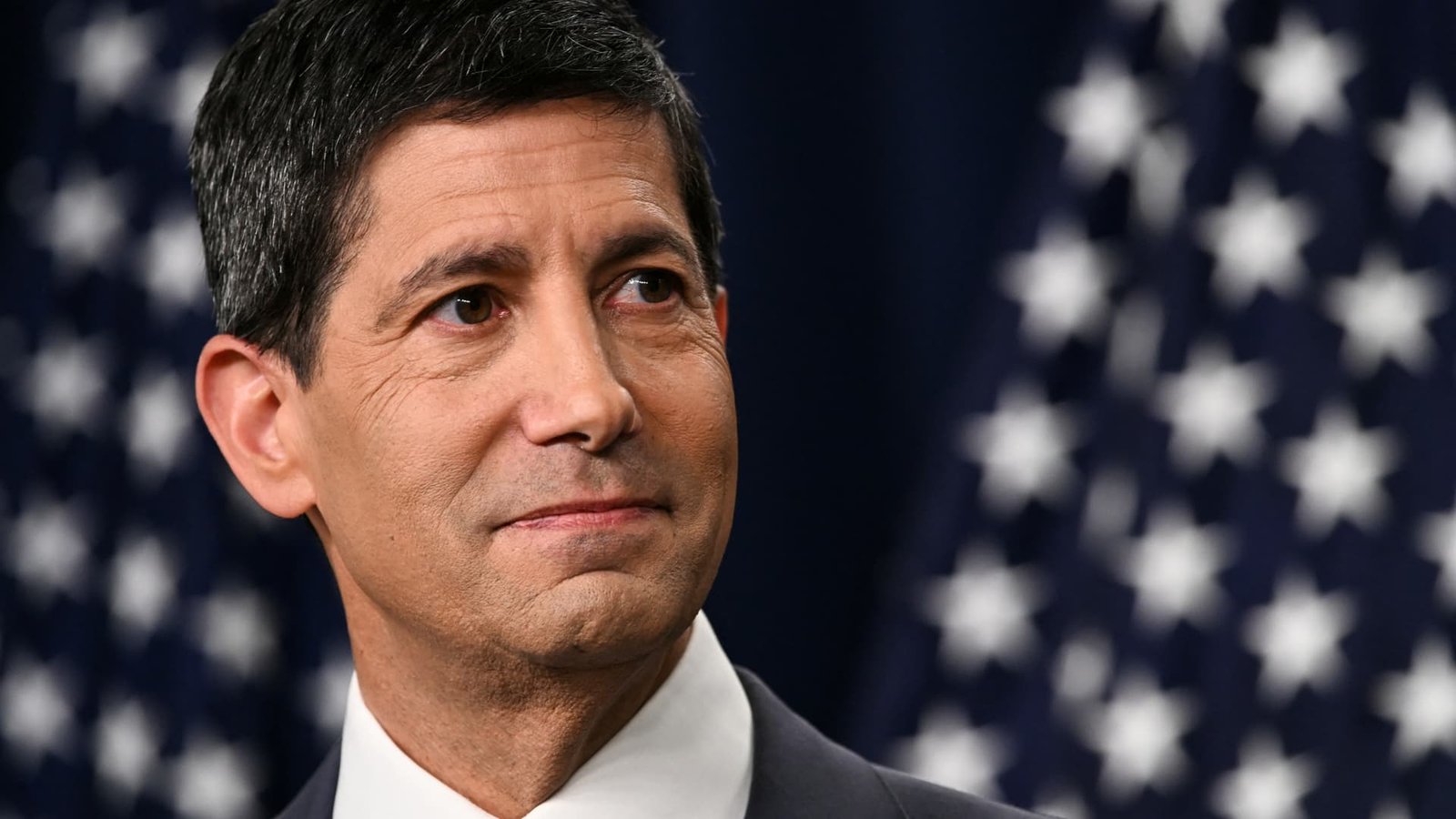
Chair of the Federal Reserve Kevin Warsh speaks during a news conference at the William McChesney Martin Jr. Federal Reserve Board Building in Washington, DC, on July 29, 2026.
Brendan Smialowski | Afp | Getty Images
Add the possibility of fewer meetings into the mix of how Federal Reserve Chairman Kevin Warsh wants to reduce the central bank’s footprint on financial markets, a move that some experts say could introduce both volatility and opportunity for investors.
Since taking office in May, Warsh has implemented several measures that reverse decades of Fed culture in which policymakers have been aggressively transparent — some say overly so — about where they think monetary policy is headed.
Thus far, he has curtailed so-called forward guidance, or how the Fed signals its future rate moves, dramatically shortened the post-meeting statement and provided cryptic and often evasive answers when questioned about his views during the two news conferences he’s held so far.
Now comes the possibility, discussed in what one Fed source described as mostly hypothetical terms, of reducing the long-held schedule of eight meetings each year for the rate-setting Federal Open Market Committee.
Such a move would further curtail the communications output from the Warsh Fed — and lead to some uncertain outcomes for the stock and bond markets.
“Certainly, it’s going to increase volatility,” said George Catrambone, head of fixed income for the Americas at DWS Group. “Having less transparency forces market participants to hedge or have a wider dispersion of outcomes.”
‘Nothing magical’ about schedule
The Fed has used various meeting strategies over the decades.
Until the early 1980s, it met nearly monthly before changing to eight a year under former Chairman Paul Volcker. Moreover, the Fed is free at any time to call meeting, though the market implications could be substantial given that such a move would be considered an emergency.
Minneapolis Fed President Neel Kashkari told CNBC on Wednesday that he is fine with re-examining the meeting schedule.
“I don’t think there’s any magic number about eight or 10 or six. You know, we always have the ability to call emergency meetings if things happen, but that’s a big event,” he said. “When the FOMC calls an emergency meeting, it really sends a signal that we’re concerned about something. And so, you know, I think I’m open-minded. I don’t have a strong view.”
Philadelphia Fed President Anna Paulson on Tuesday expressed similar sentiments, telling CNBC, “it’s healthy to have a good discussion about that.” Other Fed experts take a similar tack that having a fewer meetings a year might not be a big deal to markets.
“There’s nothing magical about eight meetings,” said Bill English, the Fed’s former head of monetary affairs during Warsh’s first stint there and now a Yale professor. “There are costs associated with having a lot of meetings, but on the other hand, you don’t want to have so few meetings that you end up not acting in a timely way.”
English said he once proposed six meetings a year, but with each including a news conference as well as an update to the Fed’s Summary of Economic Projections. Overall, he sees eight as “close to the right number” and instead is more concerned about other aspects of Warsh’s strategy.
“I really don’t like this effort to communicate much less,” he said. “Explaining more about why you’re doing what you’re doing helps the public to understand it. It helps the public to anticipate it. It makes monetary policy more effective, and also it it just seems like it’s appropriate to make the Fed accountable.
Muted market reaction
So far, markets either have been willing to give Warsh the benefit of the doubt, or simply have been too focused on geopolitics to care about the Fed rumblings.
The Dow Jones Industrial Average has added about 3,500 points, or 7%, since Warsh took over from now-Governor Jerome Powell on May 22. Bond yields on net have risen though not dramatically, with the policy-sensitive 2-year Treasury up about 8 basis points, or 0.08 percentage points, while the benchmark 10-year yield has risen about the same.

Dow since May 22
Those moves have come despite Warsh defying a tradition of open communication that dates back into the latter part of the 20th century while also establishing five task forces aimed at a top-to-bottom rethinking of the Fed’s approach to policy, communications strategy and data utilization, among other things.
“He’s kind of getting away with it,” said Mark Hackett, chief market strategist at Nationwide. “Warsh is really the first Fed official that I’ve seen explicitly say he wants the Fed to have less direct impact on market movement.”
Indeed, Warsh has told market participants explicitly that they should be reacting to data, not the vagaries of Fedspeak.
“Market participants are learning to play the ball, not the referee — and market prices will continue to respond in the direction and magnitude they see fit,” Warsh said during last week’s news conference. “This is, in my view, a change for the better — and we are just getting started.”
Still, some investors think Warsh’s strategy is risky.
“The main takeaway is more volatility,” Dario Perkins, head of global macroeconomics at TS Lombard, said in a note in which he deemed the result of Warsh’s approach “a regime of continuous market repricing.”
“Investors have to get used to FOMC meetings at which they don’t know the outcome ahead of time,” he added. “That will also provide new trading opportunities. It goes without saying that this may well be what Warsh has wanted all along.”
Potential ramifications
Concerns already have been raised about the chairman’s feelings over forward guidance, and that has been exacerbated by a loosely defined reaction function — a delineation of the economic conditions that would cause the Fed to react. Warsh also has spoken critically about the Fed’s “dot plot” of individual officials’ rate expectations and declined to submit his own dot when the Federal Open Market Committee last updated the grid in June.
Adding to the information vacuum by only meeting, say, four or six times a year raises further concerns that a market that has for decades looked for cues from the Fed now will have to guess at policy.
“Obviously, if the the dot plot changes or if guidance changes, I don’t think that’s the end of the world,” Hackett said. “If you stop start having less meetings, that’s a different level, and that could be seen as disruptive.”
One potential consequence would be longer-term yields rising faster than shorter-term rates, what the market refers to as a bear steepener, said Komal Sri-Kumar, president of Sri-Kumar Global Strategies. The implication is that fixed income investors would see the Fed holding short-term rates low and causing inflation expectations to rise.
10-year Treasury yield in 2026
“Bondholders are not babies trying to have their hands held,” Sri-Kumar said. “The bondholders are saying, ‘Please don’t make my life more difficult by introducing even more uncertainty.'”
The federal government literally can’t afford a spike in yields as it struggles with financing costs for the $31.1 trillion in outstanding Treasury debt held by the public.
If investors sour further on government debt, it will make Bessent’s job tougher at a time when interest on the debt is second only to Social Security in government outlays. The Treasury Department estimates it will spend $1.3 trillion this year on debt financing costs.
In a CNBC appearance Tuesday, Treasury Secretary Scott Bessent described the Warsh approach as a “detox” for markets.
There are plausible benefits and plausible drawbacks, and after such a short time, nobody really knows if the new approach will work. In the meantime, Warsh has a very important speech coming up when the Fed holds its annual gathering in Jackson Hole, Wyoming at the end of August, a time that prior chairmen used to lay out new agendas.
“Warsh is trying to undertake a very large change in terms of how to communicate the data and how to interpret it,” said Catrambone, the DWS bond strategist. “I would say we should also provide a little bit of grace.”