

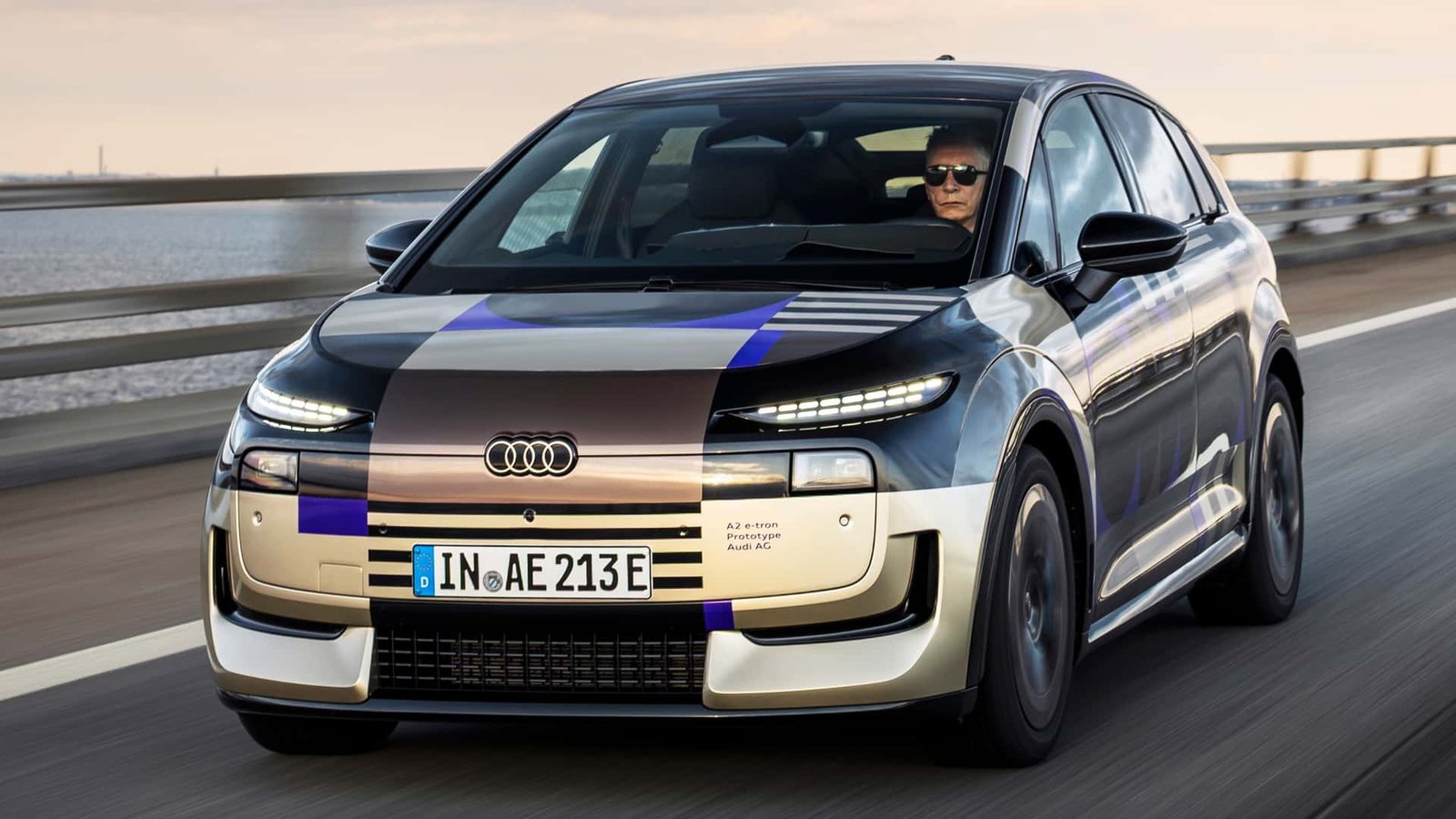
- Audi claims the new A2 e-tron electric hatchback is the most efficient car it has ever made.
- The upcoming EV harks back to the revolutionary A2 of the 2000s, which also emphasized efficiency.
- The new A2 features an active cool-air intake, air curtains, gap reducers, and gap breathers—all in the name of reducing drag.
As a kid of the 90s, I vividly remember when the original Audi A2 debuted. It was a funky hatchback that had the odd party piece of not being able to open the hood, though people eventually figured out how to do that without going to the dealer.
But weird manufacturer tricks aside, the A2 was built for efficiency, and now there’s a new one that follows the same principle, only this time it’s electric.

Photo by: Audi
The Audi A2 e-tron, which will be revealed in all its glory this fall, is officially the most efficient car ever built by the German automaker, with preliminary WLTP measurements pointing to an efficiency of 4.85 miles/kilowatt-hour (12.8 kWh/100 km or 20.59 kWh/100 mi). It’s worth noting that these numbers were achieved with the optional efficiency package, which comes with a bunch of aerodynamic optimizations, lowering the standard model’s energy consumption by up to 1.44 kWh/100 mi (0.9 kWh/100 km).
The automaker said that the A2 e-tron with the efficiency package has a drag coefficient of 0.24, the lowest among its compact models. That figure has been achieved thanks in part to the active air intake at the front, which stays closed during normal driving and at higher speeds to reduce drag, but opens during charging, quick acceleration, or when it’s very hot outside to protect the battery and electronics.
Speaking of the battery, one of the options available in the new A2 e-tron will be a 58-kilowatt-hour (61 kWh gross) lithium-iron-phosphate pack with a cell-to-pack arrangement, where the cells are mounted directly into the battery cradle, eliminating the need for modules and increasing the energy capacity without needing more volume.
38
Source: Audi
According to the automaker, fine-tuning the battery thermal management system—along with adopting silicon carbide (SiC) semiconductors for the power electronics, using a new low-friction oil in the transmission, and using thinner laminations in the electric motor—has helped increase the overall efficiency of the A2. When it comes to charging, a revised cooling strategy increases home charging efficiency to 89.6%.
The compact four-door hatchback also comes with vehicle-to-load (V2L) and vehicle-to-home (V2H) functionality. V2L enables owners to export energy from the high-voltage battery at up to 2.3 kW through a household socket in the trunk to power tools, appliances, or camping equipment, while V2H uses the charge port to energize an entire house, provided there is the necessary equipment installed at the building.
Audi notes that the 58 kWh LFP battery will be mated with an 187-horsepower (140 kW) rear electric motor, but a now-deleted page on the brand’s German website showed that three additional versions will be available: 167 hp (125 kW), 228 hp (170 kW), and 321 hp (240 kW). Meanwhile, the longest-range version was touted as being capable of delivering 403 miles (649 km), presumably with the 228 hp motor and the same 79 kWh nickel-manganese-cobalt (NMC) battery pack as the Volkswagen ID.3 Neo.
The same webpage showed a starting price of €38,200 ($44,000) including VAT, making it Audi’s cheapest new EV yet.