

Close Menu

    Subscribe to Updates

    Get the latest news information from worldwide businesses.

    What's Hot

    Michigan cyclosporiasis outbreak kills 2, sickens more than 11,000

    August 3, 2026

    Jupiter’s moon Europa may have signs of life in its buried ocean — but can we get to them?

    August 3, 2026

    “They got a picture with their idol”- Fans react as BTS’ RM gives Nas a stage shoutout & meets the rap legend with Suga backstage at MetLife Stadium

    August 3, 2026
    Facebook Instagram YouTube LinkedIn X (Twitter)
    Trending
    • Michigan cyclosporiasis outbreak kills 2, sickens more than 11,000
    • Jupiter’s moon Europa may have signs of life in its buried ocean — but can we get to them?
    • “They got a picture with their idol”- Fans react as BTS’ RM gives Nas a stage shoutout & meets the rap legend with Suga backstage at MetLife Stadium
    • Base Power raises $1B to roll out its giant new home battery
    • Scientists may have found aging’s hidden trigger for brain disease
    • Study links prolonged heat exposure during pregnancy to adverse birth outcomes
    • A Natural Shield Against Salt Damage
    • Europe’s AI labeling and transparency rules are now in effect
    Newspublicly
    • About Us
    • Advertise & Partner with us
    • Pitch Your Story
    • Contact Us
    Facebook Instagram LinkedIn X (Twitter)
    Subscribe
    • Home
    • World News
      • Asia
      • India
      • USA
      • UK & Europe
      • Middle East
    • Economy & Business
      • Global Economy
      • Corporate & Industry
      • Finance & Markets
      • Policy & Trade
    • Technology
      • Gadgets & Devices
      • Software & Apps
      • AI & Machine Learning
      • Robotics & Automation
    • Health & Medicine
      • Fitness & Nutrition
      • Research & Innovation
      • Disease & Treatment
      • Doctors, Clinics & Patient Care
    • Travel & Tourism
    • Automobile
      • Electric & Hybrid Vehicles
      • Auto Industry Insights
    • Sports
    • More
      • Education
      • Real Estate
      • Environment & Climate
      • Space & Astronomy
      • War & Conflicts
    Newspublicly
    Home»More»Space & Astronomy»3 moons of Neptune may be remnants of ice worlds shattered in a catastrophic crash
    Space & Astronomy

    3 moons of Neptune may be remnants of ice worlds shattered in a catastrophic crash

    AdminBy AdminAugust 3, 2026No Comments5 Mins Read0 Views
    Share
    Facebook Twitter LinkedIn Copy Link WhatsApp


    Three of Neptune’s moons might have been born from the remnants of ancient icy worlds shattered by Neptune’s largest moon, Triton, a new study finds.

    These findings suggest further research of these moons might give researchers an unprecedented look at the innards of icy worlds.

    “The interiors of large icy moons are normally permanently hidden from us, buried beneath thick shells of water ice,” study lead author Ryleigh Davis, a planetary scientist currently at the University of California, San Diego, told Space.com. “Neptune‘s inner moons may be the only place in the solar system where we can directly observe that material, because a catastrophic event essentially turned those ancient worlds inside out.”

    Triton is by far the largest of Neptune’s 16 known moons. More than 99 percent of the mass of all of Neptune’s moons is concentrated in Triton, which is roughly the size of Pluto, Davis said.

    Whereas the largest moons of the solar system’s other giant planets all orbit their worlds in the same direction as those planets spin, Neptune’s largest moon, Triton, orbits in the opposite direction. This unusual configuration suggests the Neptunian system evolved in a dramatically different way than those of its siblings. Instead of Triton forming around Neptune, as the largest moons of the other giant planets likely did around their worlds, Triton’s backward orbit has led researchers to suspect “it was captured from the outer solar system,” Davis said.


    You may like

    When Neptune captured Triton with its gravity, Triton may have acted like a giant wrecking ball, smashing many of the moons Neptune may have originally had, Davis said. However, much remained uncertain about what happened in the aftermath of this destruction.

    To shed light on the mysteries of Neptune’s history, scientists investigated Neptune’s rings and three of its moons — Larissa, Galatea, and Proteus. Discovered in 1989 with the Voyager 2 flyby of Neptune, these moons are small and close to Neptune, orbiting just outside the planet’s main rings. Their locations and tiny sizes have made it difficult for astronomers to study them in detail from Earth.

    Space

    In the new study, the researchers analyzed near-infrared light from those inner moons using the James Webb Space Telescope . This data helped reveal their chemical makeup for the first time.

    The rings and two of the inner moons — Larissa and Galatea — possessed clay minerals previously unseen on the surfaces of bodies in the outer solar system beyond Jupiter. Specifically, they contain magnesium-rich phyllosilicates, commonly found in main belt asteroids and carbonaceous chondrite meteorites.

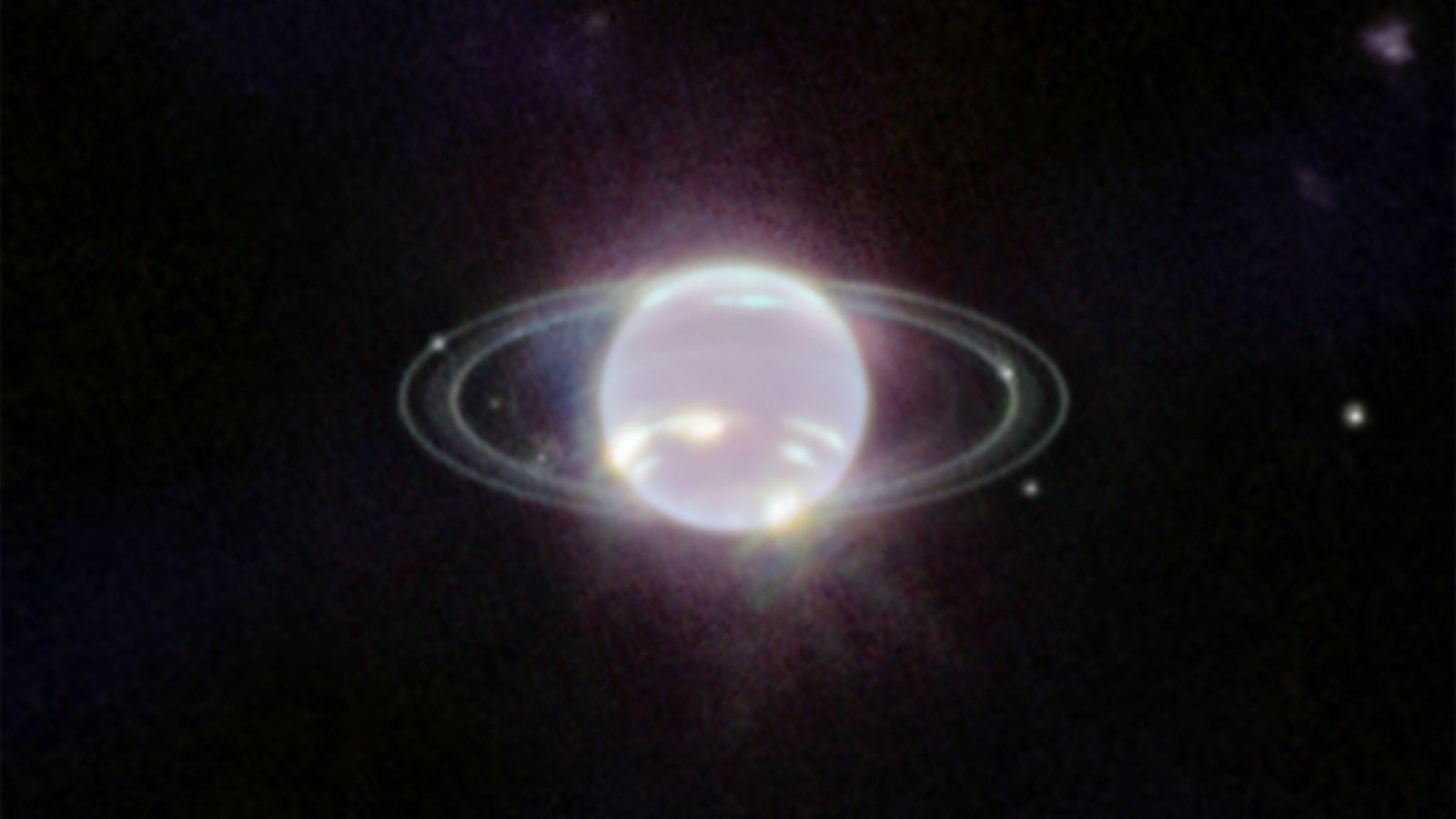
    A view of a glowing orb surrounded by rings and against a section of space with some other glowing dots in the background. Several white dots close to the orb are labeled with the names of Neptune's moons. Toward the top left is a very bright point of light surrounded by blue spikes.

    The JWST captured seven of Neptune’s 14 known moons: Galatea, Naiad, Thalassa, Despina, Proteus, Larissa, and Triton. Neptune’s large and unusual moon, Triton, dominates this portrait of Neptune as a very bright point of light sporting the signature diffraction spikes seen in many of the JWST’s images. (Image credit: NASA, ESA, CSA, STScI; Image Processing: Joseph DePasquale (STScI), Naomi Rowe-Gurney (NASA-GSFC))

    “The most surprising thing is simply that we found clay minerals at all,” said Davis, who conducted this research at the California Institute of Technology in Pasadena. “That was genuinely not on our list of things we expected to find.”


    What to read next

    These minerals require major prolonged heating to form. One likely place they were created was the deep interior of a large icy body, where heat might come from radioactive material and other sources.

    As such, the researchers suggest these minerals are evidence Triton may have demolished Neptune’s original moons. The rubble could then come together, forming Neptune’s inner moons, with the clay minerals exposed on their surfaces.

    Another possibility is that these clay minerals came from a dwarf planet similar in size to Pluto that passed too close to Neptune. Neptune’s gravity might then have shredded this dwarf planet apart, Davis said.

    These clay minerals only form in the presence of liquid water. Mysteriously, no water ice was detected in any of the three moons studied or the rings.

    “That’s really surprising because everything out in this part of the solar system is really icy,” Davis said in a statement. “So, we’re fairly confident that they had to come from deep inside something that was big enough to generate enough heat that it melted its water ice. We think the most likely place would be an original system of icy moons, although it’s a bit of a mystery where the ice may have gone.”

    The scientists noted they did not see these clay minerals on Proteus, the biggest of the three moons they investigated. They suggested it might have formed from a clay-mineral-poor part of the debris, or experienced subsequent heating that destroyed any such minerals.

    Curiously, the scientists found all three moons and the rings had a hydrated mineral the researchers were not able to identify. “Identifying it will likely require new laboratory measurements under outer solar system conditions, which is technically challenging but doable,” Davis said.

    To learn more about Neptune, a spacecraft dedicated to visiting the planet “is the obvious next step,” Davis said. “We’ve had only a single flyby — Voyager 2 in 1989 — and these results make clear there’s much more to learn. The main obstacle is time and resources: an ice giant mission was identified as a high priority in the most recent Planetary Science Decadal Survey, but these missions take decades to develop.”

    The scientists detailed their findings July 29 in the journal Science Advances.


    Source link

    Author

    • Admin

      NewsPublicly.com is News & Articles Platform that creating SEO-focused articles on travel, lifestyle, and digital trends.

    Admin
    • Website

    NewsPublicly.com is News & Articles Platform that creating SEO-focused articles on travel, lifestyle, and digital trends.

    Related Posts

    Jupiter’s moon Europa may have signs of life in its buried ocean — but can we get to them?

    August 3, 2026

    Is the Nocs Provisions Lite View spotting scope suitable for stargazing?

    August 3, 2026

    On this day in space! Aug. 3, 2004: NASA launches MESSENGER spacecraft to orbit Mercury

    August 3, 2026
    Leave A Reply Cancel Reply

    Demo
    Top Posts

    The Blue Moon rises on May 30— Where and when to see the second full moon of the month

    May 30, 202640 Views

    New SOCOM rifle allows barrel swapping and cartridge changes

    June 1, 202633 Views

    “Inside Gemini Robotics 1.5: How Robots Learn to Reason & Act

    November 22, 202527 Views

    525 pounds of cocaine seized after Nebraska K9 alerts troopers on I-80

    May 28, 202624 Views
    Don't Miss

    Michigan cyclosporiasis outbreak kills 2, sickens more than 11,000

    August 3, 20263 Mins Read0 Views

    Cyclosporiasis outbreak surges across 41 states Dr. Marc Siegel discusses the alarming cyclosporiasis outbreak, with…

    Jupiter’s moon Europa may have signs of life in its buried ocean — but can we get to them?

    August 3, 2026

    “They got a picture with their idol”- Fans react as BTS’ RM gives Nas a stage shoutout & meets the rap legend with Suga backstage at MetLife Stadium

    August 3, 2026

    Base Power raises $1B to roll out its giant new home battery

    August 3, 2026
    Stay In Touch
    • Facebook
    • Twitter
    • Instagram
    • YouTube
    • LinkedIn
    • WhatsApp

    Subscribe to Updates

    Get the latest creative news from SmartMag about art & design.

    Demo
    NEWSPUBLICLY
    Facebook X (Twitter) Instagram LinkedIn

    Home

    • About Us
    • Leadership
    • Advertise & Partner With Us
    • Pitch Your Story
    • Media Kit & Pricing
    • Career
    • FAQs

    Guidelines

    • Editorial & Submission
    • Partnership
    • Advertising & Sponsor
    • Intellectual Property Policy
    • Community & Comment
    • Security & Data Protection
    • Send Your Opinion

    Quick Links

    • Cookie Policy
    • Payment & Billing Terms
    • Refund & Cancellation
    • Copyright Policy
    • Complaint & Support
    • Sitemap
    • Contact Us

    Subscribe Us

    Get the latest news and updates!

    Copyright © 2026 Newspublicly (DIGITALIX COMMUNICATION). All Rights Reserved.
    • Privacy Policy
    • Terms of Use
    • Disclaimer