

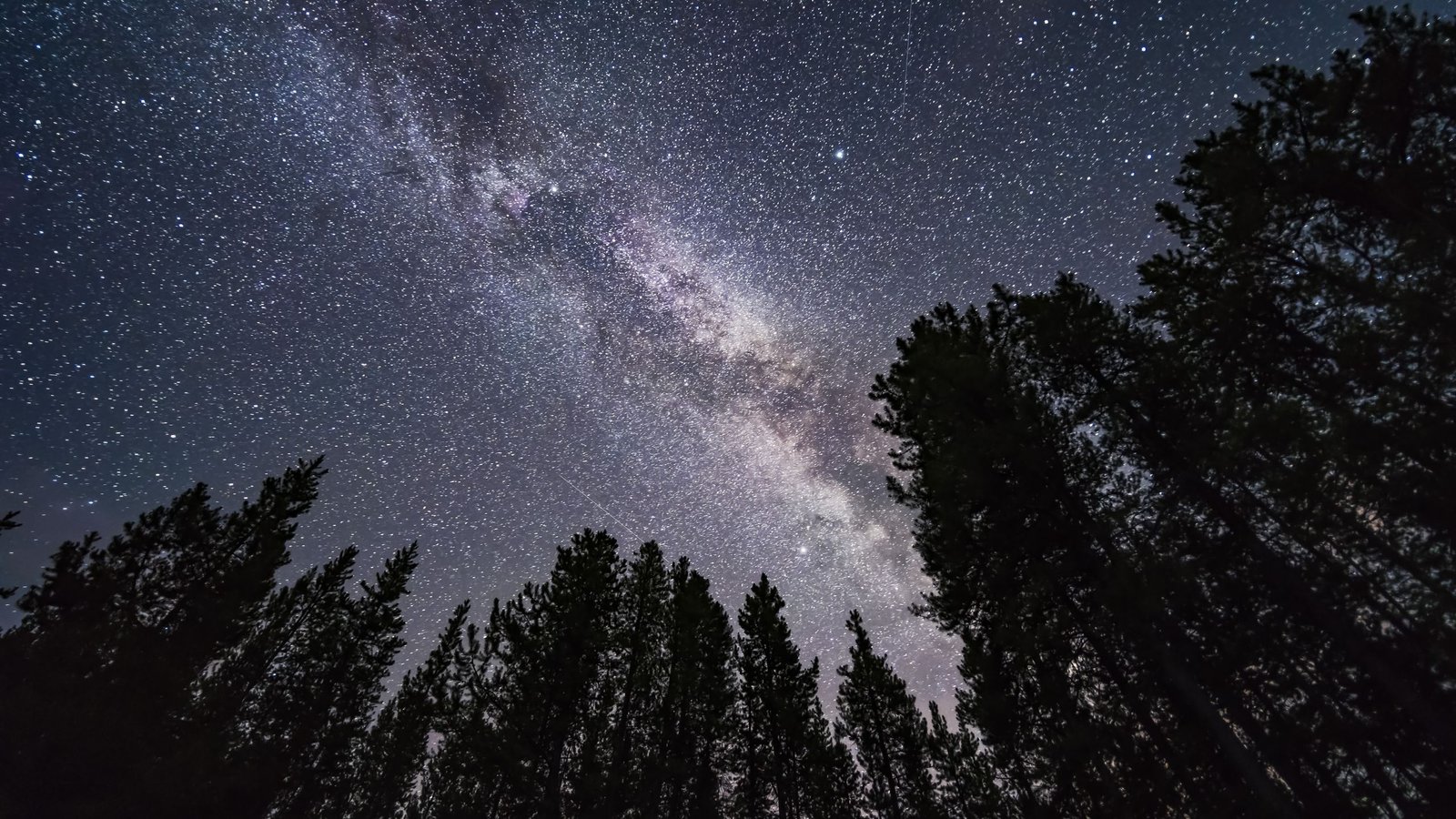
If you’ve not seen the Milky Way this year from the Northern Hemisphere, it’s time to make a plan. August’s dark sky window opens around Aug. 6, when the moon begins to rise late at night as a waning crescent, meaning dark moonless skies for about 10 nights. That’s when to see the Milky Way (and if you can time it for Aug. 12/13’s Perseid meteor shower peak, all the better).
Five things are required to successfully see the Milky Way:
- the correct time of year (The brightest part is visible March-October)
- the correct moon phase (last-quarter moon through slim crescent moon)
- a dark sky away from light pollution
- dark-adapted eyes (stand in total darkness for 25 minutes)
- an idea of what you’re going to see
The best way to dark-adapt your eyes is to start stargazing. Look south and begin picking out stars you know, paying special attention to the Summer Triangle. These three stars — Vega, Deneb and Altair — are your major signpost for finding the dense arc of starlight that will gradually emerge. Specifically, focus on the sky from Deneb through Altair — the left-hand side of the Summer Triangle — and you’ll slowly see not only the Milky Way, but something else in front of it that few stargazers properly appreciate.
Sure, you can see the bright halo of gas and stars that indicate the center of the Milky Way galaxy, which is particularly bright below the Summer Triangle in the Sagittarius constellation. The closer you are to the equator, the higher in the sky, and the brighter, this region — known as the Galactic Center — will be.
Now look again. See those dark patches within the arc winding from Deneb to Altair? That’s the Great Rift, so named because it appears to tear the Milky Way in half. It’s an interstellar cloud of gas and dust (dark nebulas) between the solar system and the bright center of the Milky Way, which blocks and scatters visible light, essentially covering up bright stars and nebulas from our point of view. It looks like someone has spilled black ink across the Milky Way.
There are two ways of seeing the Great Rift. The most modern way is to observe it in infrared and radio light, which passes through the dust without being absorbed. This is exactly what some observatories are built to do, from radio dishes to the James Webb Space Telescope, which can probe the inner Milky Way — including the billions of stars in the center of our galaxy — which are on the other side of the Great Rift. Meanwhile, the new Vera C. Rubin Observatory has begun observing the entire visible southern sky every few nights over the course of a decade, mapping the Milky Way (including the Great Rift) to answer questions about its structure and formation.
The second way to see the Great Rift is to see it for what it is. Astronomers call the section we’re looking at the Cygnus Rift, also called the Northern Coalsack, 1,000-3,000 light-years away in the constellation Cygnus. It’s just below Deneb (which is 1,500 light-years distant), slightly outside of the Summer Triangle over an otherwise bright, dense region of stars called the Cygnus Star Cloud (around 2,600 light-years away). About six degrees in diameter, the Northern Coalsack blocks the light of background stars. However, it’s just the northern tip of the Great Rift, which stargazers also call The Dark River or Dark Cloud.
Beyond the Northern Coalsack, however, the Great Rift is something to travel to see more of. It stretches across about 120 degrees of the night sky from Cygnus and Sagittarius in the Northern Hemisphere to Centaurus in the Southern Hemisphere. The latter is home to the famous Southern Cross and, besides its star Acrux, the original Coalsack Nebula. Another reason to travel to see more of the Milky Way is to appreciate how Southern Hemisphere cultures view the Great Rift. While modern astronomers see it as a dark cloud that needs to be peered through, indigenous cultures see its shapes. The Wiradjuri in Australia see the silhouette of an emu (its head is the Coalsack Nebula) and use its position in the night sky as a seasonal calendar. Meanwhile, the Inca in South America saw a llama (and, beside it, a baby llama).
The Great Rift is one of my favorite things to see, because it reveals what we’re doing when we see that arc of light stretch across a summer night sky — we’re looking at a galaxy from the inside, with all of its depth and complexity.
How and when I’m watching it

You do need perfect darkness and excellent timing. With that in mind, I’m trying out a new app called Milky Way Tonight, which is built around a useful question: is tonight actually worth the effort? It checks when the Milky Way core is above the horizon, then weighs that against moon phase, moonrise and moonset times, the local cloud forecast and the Bortle rating for your location. That last part matters. A technically clear night in a bright suburb is still a bad Milky Way night. The app also has a dark-sky finder, which is the feature I suspect I will use most.
Although the Milky Way has to be enjoyed as a naked-eye sight, it’s also worth bringing along some binoculars to let you sweep across the dense star fields right up to the edges of the Great Rift.
Stargazer’s corner: July 31-August 7, 2026
This is a good week to plan a trip to see the Milky Way and the Great Rift, but not to actually take that trip. Since the moon was recently full, our galaxy will be badly washed out for much of the night. That will make it difficult to see much of the Southern Delta Aquariids peak around July 30-31, as well as the now-active Perseids building toward their August peak. Saturn is worth a pre-dawn look, and Venus remains bright low in the evening sky if the horizon is clear, but if you’re an astrophotographer or you have a smart telescope, you can use light-pollution filters to take advantage of nebula season — with key deep-sky sights being the Lagoon and Trifid Nebula (M8 and M20), the Little Sagittarius Star Cloud (M24) and the Wild Duck star cluster (M11).
Asterism of the week: The Coathanger/Brocchi’s Cluster

The Coathanger looks exactly like its name. Also known as Brocchi’s Cluster, it’s a pattern of 10 stars in the small constellation Vulpecula, with six forming a straight bar and four making a curved hook. First find the Summer Triangle — Vega, Altair and Deneb — then scan roughly halfway between Vega and Altair. The small constellation Sagitta, the Arrow, points nearby, with the Coathanger just to its north. Dark skies may reveal it to keen naked eyes, but binoculars are the best way because they show the whole shape at once. One last thing: it’s not a real coathanger! Once thought to be a cluster of stars born together, the shape is now known to be a chance alignment of unrelated stars at different distances — yet another cosmic illusion.