

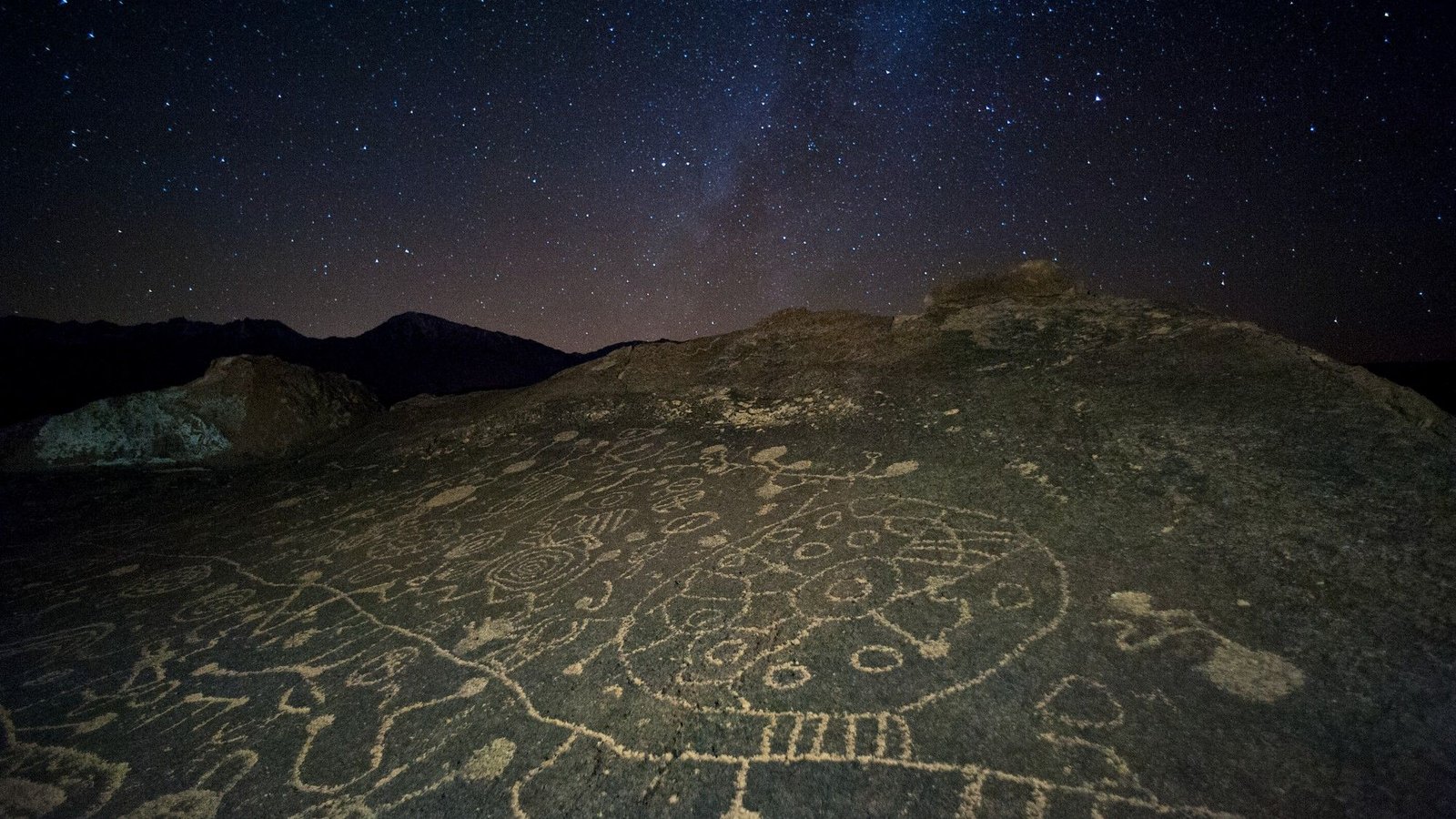
The search for alien life has tended to focus on looking for either signs of extraterrestrial technology or evidence of biological processes on other worlds. But new and ongoing research suggests that scientists should start considering signs of intelligence that are not necessarily technological, but which are sufficiently complex as to be evidence of a conscious mind at work.
Biosignatures are possible signs of biology on other planets, whereas technosignatures are clues to the presence of advanced technology that might be detectable across light-years. What, though, of everything that comes between these two extremes? How do we detect life that is more complex than simple microbes and which displays intelligence that is not highly technological?
This is where the field of noosemiotics comes in, says Julia DeMarines, an American astrobiologist who has been involved in both biosignature and technosignature research. “We want to figure out if we can detect signatures of intelligence that occur before the invention of radio communication,” DeMarines told Space.com. “We’re looking at the ways that mind can be imprinted on matter.”
Noosemiotics is derived from the Ancient Greek concept of ‘nous’, which refers to the theory of mind. In the 1920s the Soviet biochemist Vladimir and the French Jesuit priest Pierre Teilhard de Chardin developed the idea of the noosphere as being the sphere of human reason or thought encapsulating the Earth.
More recently, Adam Frank, David Grinspoon and Sara Imari Walker applied the noosphere to SETI by considering the collective intelligence of all the beings on a planet acting as a kind of combined planetary scale intelligence.
Therefore, according to DeMarines, a noosignature would be a sign of a noosphere, of conscious minds at work.
“Bread doesn’t just pop out of a molecular cloud”
Technology is, of course, a major imprint of mind on matter, and DeMarines acknowledges that just as technosignatures can be biosignatures since they can originate from biological entities, they can also be noosignatures — for instance, gases such as nitrogen released into the atmosphere by agricultural practices. But noosignatures can be something other than biosignatures and technosignatures, too.
Which is where DeMarines’ work comes in. She had been working for a company who were looking to apply the concept of Assembly Theory, which is a chemistry theory originated by Sara Walker and Glasgow-based chemist Lee Cronin, to online data and artificial intelligence to search for thresholds that denote complex signatures of intelligence.
Assembly Theory describes the minimum number of steps required to assemble something. In chemistry it is the steps taken to assemble, for example, important biomolecules, or to facilitate evolutionary processes. The number of steps taken is referred to as the Assembly Index. As part of her work on this, as a thought exercise, DeMarines was given the task of applying assembly theory to ‘bread as a technosignature’.
“I know how that sounds,” she laughed. “I get weird looks when I tell people about it!”

However, bread, like anything that is made by a conscious mind be it a stone tool or a radio telescope, is a signature of intelligence. At first DeMarines approached it as a proto-technosignature before realizing that it was more appropriate to describe it as a noosignature.
“Bread doesn’t just pop out of a molecular cloud, it requires technology, it requires history, it requires intelligence,” said DeMarines. “Say that you have samples of bread at different human and hominin archaeological sites throughout time, dating back 14,000 years – the bread would be a signature of intelligence changing over time as the type of bread, its ingredients and how it is made also change.”
How it changes over time can be measured by Assembly Theory – the number of steps taken to get from early breads made from wild grain to modern sliced white bread produced from domesticated wheat is the Assembly Index. The task is to identify how many steps it takes to get past certain thresholds that indicate change, or rather developments, in intelligence, such as new technology for farming and germinating seeds, the construction of windmills or mass production.
As such, it fills part of the space between talking about a simple biosphere and searching for a technosphere, as do things ranging from stone tools to the development of written language and everything in between.
Non-technological intelligence
The trick, though, is detecting such signatures. Archaeological finds require being present on a planet, and digging up artifacts. Are there noosignatures that could be detected on other planets remotely from Earth? DeMarines isn’t sure yet, and admits that at this stage she is thinking about it from the perspectives of metrics and thresholds rather than detectability.
If there are detectable noosignatures, they could also operate as a sign to anyone watching that there is intelligence on Earth, too. DeMarines highlights the example of gases released into the atmosphere by basic agriculture. Around three-quarters of all human-made nitrogen emissions were produced before industrialization, and agriculture was the source of that, ranging from fertilizers to animal waste to microbes in the soils used, all beginning many thousands of years ago.
For example, it took human civilization 4,000 years of bread-making before they domesticated wheat over 10,000 years ago. The release of excess nitrogen into the atmosphere disrupts the planet’s nitrogen cycle, creating a disequilibrium.
While thousands of years is far too long a time for humans to detect such disequilibrium on exoplanets, alien observers may have been watching Earth for a lot longer than that. Common wisdom is that while biology on Earth has been detectable for billions of years through biosignatures, intelligence only became apparent in the past 100 years or so when we began beaming radio waves out into space.

However, if we are producing noosignatures that are detectable, such as disrupting the nitrogen cycle, then that means intelligence on Earth has been visible to the rest of the universe for much longer than we realized.
Then there’s the conundrum of non-technological intelligent life in the universe. Often in the past intelligence has been equated to technology, but to solely rely on technology as a measure of intelligence misunderstands what intelligence is. Technological intelligence is one form of intelligence, but there are others.
Dolphins, for instance, are greatly intelligent creatures with sophisticated social interactions, but with the best will in the world dolphins will never have technology because they do not have the dexterity in their flippers to manipulate the environment around them to the necessary degree.
However, can they imprint their minds on their environment in other ways? It has previously been speculated that the universe is silent because technological intelligence is rare, but Dolphin-like intelligence could be abundant — yet we’d never detect it. Now, thanks to noosemiotics, perhaps a way will be found to detect signs of such life. If that can happen, maybe we will quickly discover that we are not alone after all.
You can read about DeMarines work in a paper published on the open-source arXiv repository.