

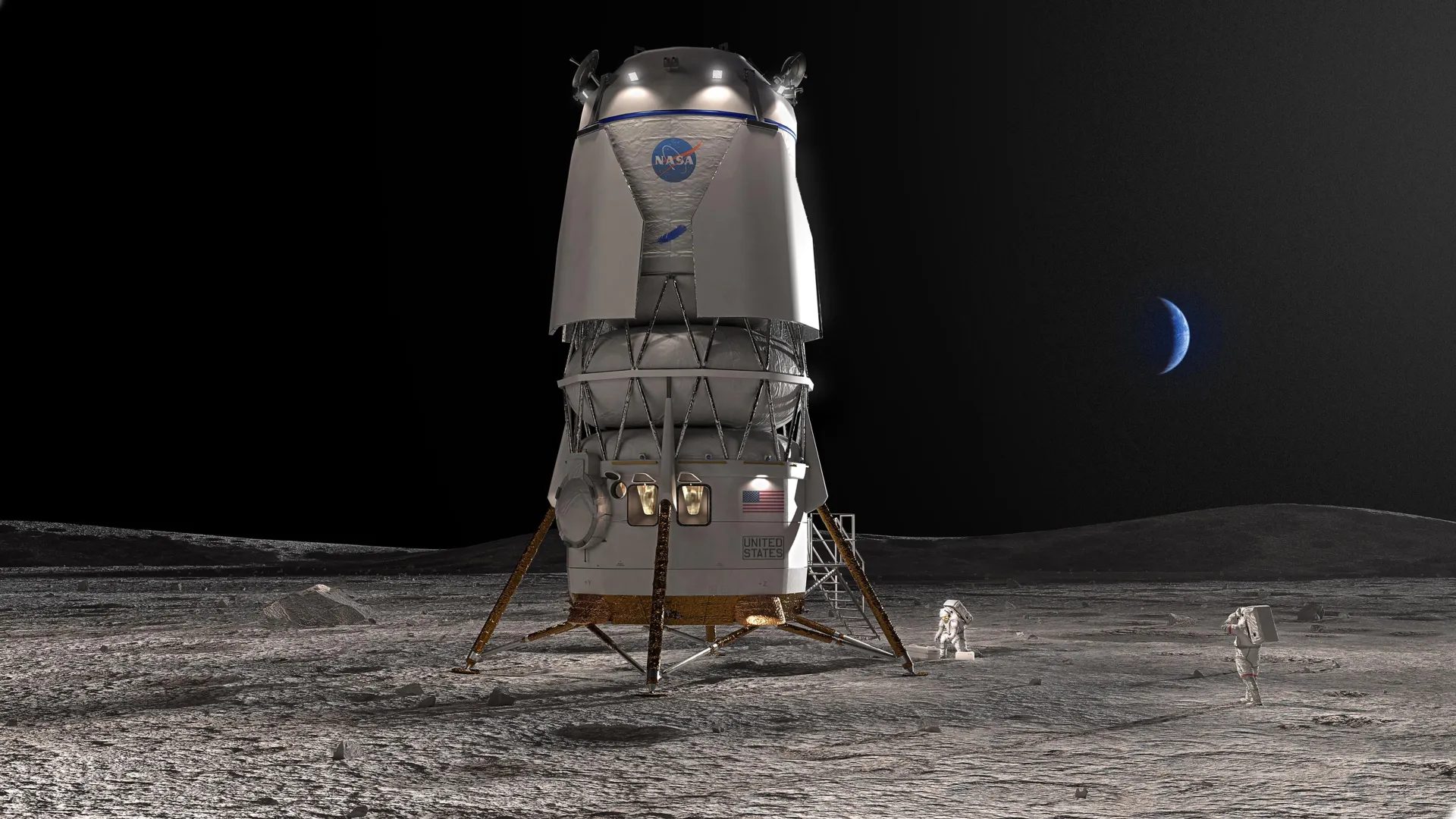
Scientists are preparing for a new era of lunar exploration, but a new study suggests that every landing could leave behind more than footprints. Researchers found that methane released in spacecraft exhaust may spread across the moon surprisingly quickly, potentially contaminating regions that could preserve ancient chemical clues about how life first emerged on Earth.
The findings suggest that even a landing near the moon’s South Pole could send methane molecules “hopping” across the lunar surface to the North Pole in less than two lunar days. As more governments, private companies, and NGOs plan missions to the moon, the researchers say it is becoming increasingly important to understand how exploration itself could affect future scientific discoveries.
The study was published in Journal of Geophysical Research: Planets, an AGU journal focused on planetary science.
“We are trying to protect science and our investment in space,” said Silvio Sinibaldi, the planetary protection officer at the European Space Agency and senior author of the study. The moon offers a rare opportunity to study the early history of the solar system, he said, but, paradoxically, “our activity can actually hinder scientific exploration.”
Ancient Lunar Ice Could Preserve Clues to Life
Near the moon’s poles are craters that never receive sunlight (called permanently shadowed regions). These frozen environments contain ice that may have trapped material delivered by comets and asteroids billions of years ago.
Scientists believe those deposits could include “prebiotic organic molecules,” chemical ingredients that may have eventually combined to form the first building blocks of life, including DNA. If researchers can examine those molecules in their original state, they may gain new insight into how life first developed on Earth.
“We know we have organic molecules in the solar system — in asteroids, for example,” Sinibaldi said. “But how they came to perform specific functions like they do in biological matter is a gap we need to fill.”
Earth’s constantly changing surface has likely erased much of this ancient evidence. In contrast, parts of the moon have remained largely unchanged for billions of years, making them an ideal archive of early solar system history. Permanently shadowed regions are especially valuable because their extremely cold temperatures help trap and preserve molecules. However, those same cold traps could also collect organic compounds released by visiting spacecraft, potentially obscuring the pristine material scientists hope to study.
Computer Simulations Track Spacecraft Methane
To investigate the problem, Sinibaldi and lead author Francisca Paiva, a physicist at Instituto Superior Técnico, developed a detailed computer model using the European Space Agency’s Argonaut mission as a case study.
The team simulated how methane, the primary organic compound produced during combustion of Argonaut’s propellants, would spread following a landing near the moon’s South Pole. While earlier studies had examined the movement of water molecules on the moon, this research is the first to model the behavior of an organic molecule such as methane. The simulations also incorporated the effects of solar wind and UV radiation.
“We were trying to model thousands of molecules and how they move, how they collide with one another, and how they interact with the surface,” said Paiva, who was a master’s student at KU Leuven and an intern at the European Space Agency during the research. “It required a lot of computational power. We had to run each simulation for days or weeks.”
Methane Can Spread Across the Moon in Days
The simulations showed methane reaching the North Pole in less than two lunar days. Within seven lunar days (almost 7 months on Earth), more than half of all methane released had become “cold trapped” in the permanently cold polar regions, with 42% accumulating at the South Pole and 12% at the North Pole.
“The timeframe was the biggest surprise,” Sinibaldi said. “In a week, you could have distribution of molecules from the South to the North Pole.”
The rapid spread is possible because the moon has almost no atmosphere. Without air molecules to slow them down, methane molecules move freely under the influence of gravity, bouncing across the surface as sunlight energizes them and colder temperatures reduce their speed.
“Their trajectories are basically ballistic,” Paiva said. “They just hop around from one point to another.”
According to Paiva, this means there may be no completely safe landing location. “We showed that molecules can travel across the whole moon. In the end, wherever you land, you will have contamination everywhere.”
Protecting Future Lunar Science
The researchers emphasize that contamination is not necessarily unavoidable. Paiva said colder landing sites may help keep exhaust molecules more localized than warmer regions. Sinibaldi also plans to investigate whether exhaust molecules remain only on the surface of the ice, leaving deeper material untouched and still suitable for scientific study.
Both researchers stress that the computer simulations need to be confirmed through additional modeling and direct measurements during future lunar missions.
“I want to bring this discussion to mission teams, because, at the end of the day, it’s not theoretical — it’s a reality that we’re going to go there,” Sinibaldi said. “We will miss an opportunity if we don’t have instruments on board to validate those models.”
Paiva also hopes to examine whether materials besides methane, including compounds released from spacecraft components such as paint and rubber, could contaminate scientifically important lunar sites.
“We have laws regulating contamination of Earth environments like Antarctica and national parks,” she said. “I think the moon is an environment as valuable as those.”
The study was published in Journal of Geophysical Research: Planets, an AGU journal.