

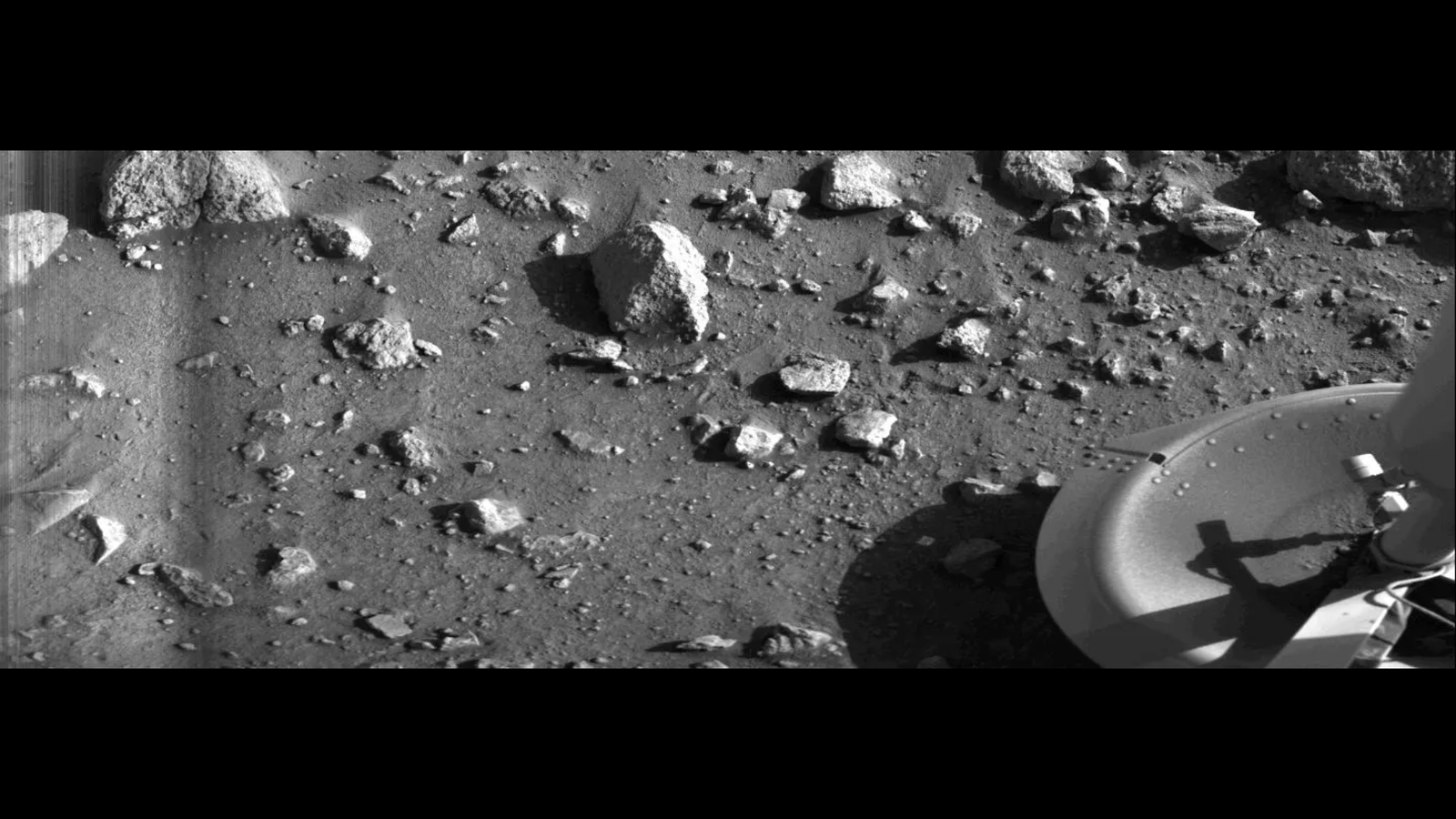

You’re looking at history. What might seem like a simple black-and-white picture of some rocks is actually the first photograph ever taken on the surface of Mars.
What is it?
Bright and early on the morning of July 20, 1976, NASA’s Viking 1 lander touched down on the surface of Mars. This moment 50 years ago marked the first fully successful touchdown on the Red Planet, and, pretty much as soon as it landed, Viking 1 captured the first image of the Martian surface.
The Soviet Union had already made multiple Mars landing attempts, all of them failures to some degree. The nation’s Mars 3 lander did manage to survive its landing initially in December 1971, but it lost contact less than two minutes later.

Viking 1 did more than just survive. While its mission tasked the lander with studying the planet for 90 days after landing, it lasted over six years on the planet and made some incredible observations. The Viking 1 lander worked in tandem with an orbiter by the same name, and was soon joined at Mars by Viking 2, another lander/orbiter pair.
Why is it incredible?
It has now been 50 years since Viking 1’s historic first, which opened our eyes to the Martian surface. And NASA has kept improving technologies and exploring further on Mars ever since. Agency rovers began scouring the planet’s surface in the 1990s, so we have gathered data on the planet’s surface for decades upon decades at this point.
But in 1976, no one had ever seen the surface of Mars close up. This view was preceded by science fiction like Ray Bradbury’s “The Martian Chronicles,” which painted fantastical possibilities about what it might really be like on Mars. With Viking 1’s view, we finally got some concrete evidence of the reality on the planet.
In 50 years, our understanding of Mars, our solar system and beyond has grown tremendously. But with each major accomplishment, we can look back at previous milestones such as this to see the stepping stones that paved the way to get us there.