

Researchers have developed a highly sensitive test strip that visually detects chikungunya virus without complex laboratory equipment, offering potential for field surveillance and low-resource settings.

Can a portable test strip detect mosquito-borne viruses at levels normally requiring sophisticated laboratory equipment?
A new diagnostic platform suggests it may be possible. Researchers have developed a multisite bridging-mediated lateral flow immunoassay, or mbLFIA, that detected chikungunya virus at concentrations as low as 2 picomoles per litre through a visible test-strip signal.
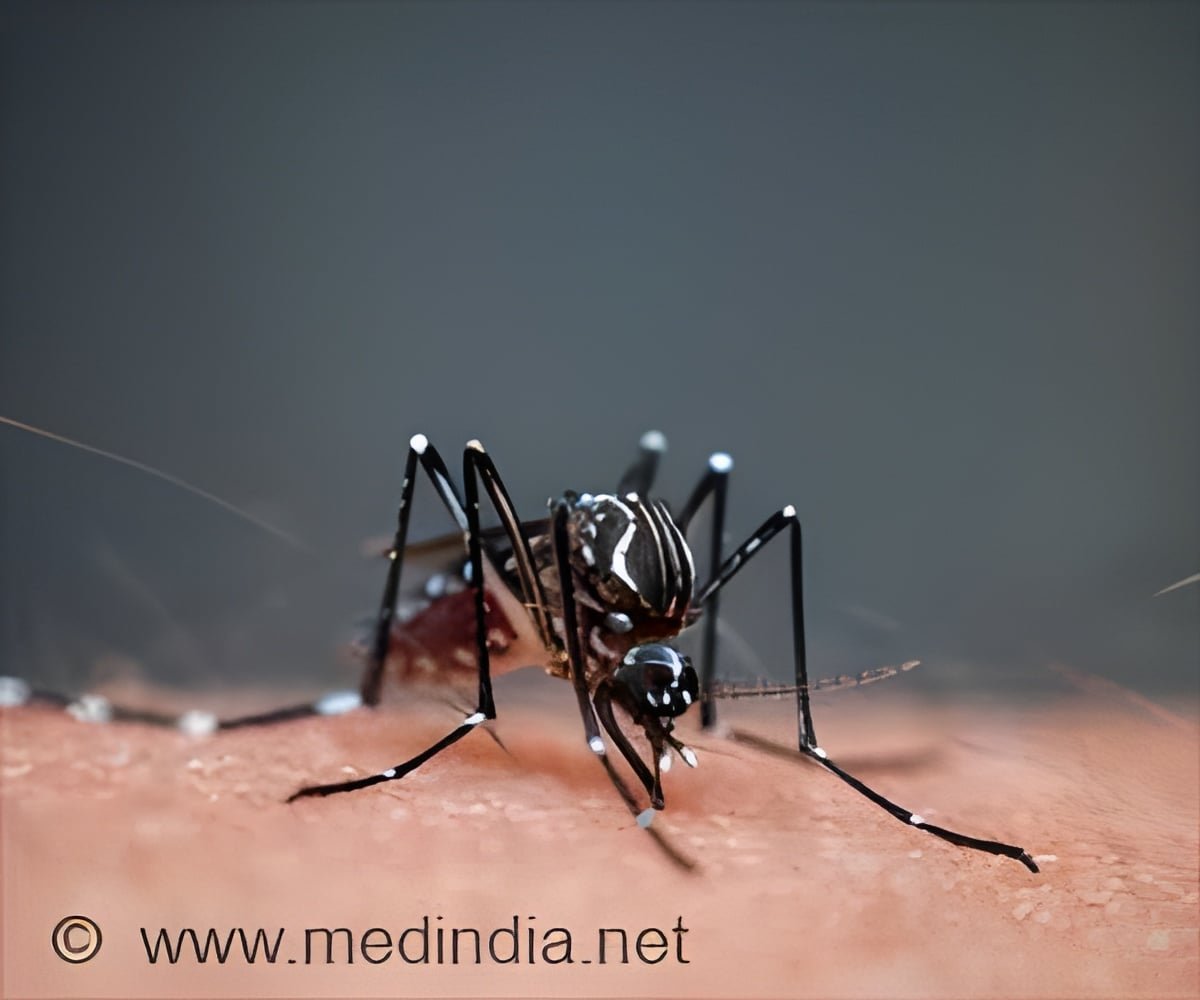
chikungunya is a viral disease transmitted mainly through the bites of infected Aedes aegypti and Aedes albopictus mosquitoes. Symptoms usually begin within several days of an infected mosquito bite. The most common signs are sudden fever and severe joint pain, along with headache, muscle pain, joint swelling, fatigue or rash.(1✔ ✔Trusted Source
Chikungunya
The enzyme-free system combines molecular amplification with gold-platinum nanoparticles to strengthen the colour produced on the test line.
Researchers say the platform could eventually support rapid testing, outbreak surveillance and infection control in clinics, ports, field stations and regions with limited access to laboratory instruments.
Advertisement
New Test Strip Detected Chikungunya at Very Low Levels
The mbLFIA platform achieved a visual detection limit of 2 pmol/L for chikungunya virus after colour enhancement. Its visual detection range extended from 2 to 10,000 pmol/L.
By comparison, the assay without the additional colour-enhancement step detected concentrations from 20 to 10,000 pmol/L. This represents a tenfold improvement in the lowest visually detectable concentration.
The stronger signal could make low-level viral material easier to identify without fluorescence readers or other specialised instruments.
Advertisement
Multisite Bridging Produced a Stronger Test-Line Signal
Conventional lateral flow nucleic acid tests may have only a limited number of sites where colour-producing probes can bind. The researchers addressed this limitation by redesigning the amplified molecular products to contain multiple equivalent binding sites.
These multisite products could connect more gold-platinum DNA probes to the test line through two bridging mechanisms. At low concentrations, the multisite design produced signals 10.8 times and 9.6 times stronger than two limited-site designs tested by the researchers.
The increased number of molecular connections allowed more signal-producing particles to accumulate on the test strip.
Advertisement
Enzyme-Free Amplification Simplified the Detection Process
The system used a two-round catalytic hairpin assembly involving four DNA hairpin probes known as H1, H2, H3 and H4. When chikungunya target RNA was present, it triggered H1 and H2 to bind together.
The viral target was then released and could initiate further amplification cycles.
The resulting H1-H2 complex activated H3 and H4, producing molecular structures containing multiple probe-binding sites. Because catalytic hairpin assembly does not require enzymes, the method may avoid some of the storage and handling challenges associated with enzyme-dependent tests.
Gold-Platinum Nanoparticles Enhanced the Visible Readout
The researchers used gold-platinum, or Au@Pt, nanoparticles to further strengthen the test-strip signal. These particles have enzyme-like catalytic properties.
They catalysed the oxidation of 3-amino-9-ethylcarbazole, producing an insoluble brown-red deposit on the test line. This colour deposition made low concentrations of the target easier to see with the naked eye.
The team confirmed the nanoparticles’ structure and composition using techniques including transmission electron microscopy, X-ray photoelectron spectroscopy and X-ray diffraction.
Test Distinguished Chikungunya from Other Mosquito-Borne Viruses
Specificity tests showed that the chikungunya signal was substantially stronger than signals produced by other mosquito-borne viruses.
The researchers tested the system against:
- Zika virus
- Dengue virus
- West Nile virus
- Yellow fever virus
- Japanese encephalitis virus
- Getah virus
The findings suggest that the assay could distinguish its intended chikungunya target from several related or clinically relevant mosquito-borne viruses.
Specificity is important because these infections can circulate in overlapping regions and may produce similar early symptoms.
Biological Samples Did Not Prevent Detection
The test was also evaluated using serum, saliva and urine samples that had been spiked with target material. Recovery rates remained between 80% and 120% across these biological sample types.(2✔ ✔Trusted Source
Multisite bridging-mediated lateral flow immunoassay for enhanced detection of mosquito-borne viruses
)
This suggests that substances naturally present in the samples did not prevent the assay from detecting the target. Testing across different sample types may be useful when developing future diagnostic applications.
Further work is still needed to determine which clinical sample would provide the most reliable results in infected people.
Preclinical Results Matched RT-PCR in 36 Mouse Samples
The researchers tested the mbLFIA platform using 36 suspected chikungunya mouse serum samples.
The assay identified:
- 16 positive samples
- 20 negative samples
These results matched those obtained using reverse transcription polymerase chain reaction, or RT-PCR. The study reported 100% concordance, sensitivity and specificity within this small preclinical sample set.
These findings are encouraging, but they do not yet establish equivalent performance in human patients. Larger studies using clinical samples from people with suspected chikungunya infection will be needed.
Portable Testing Could Strengthen Mosquito-Borne Virus Surveillance
Current molecular tests such as RT-PCR, loop-mediated isothermal amplification, rolling circle amplification and CRISPR-based assays can detect viral genetic material with high accuracy. However, many require enzymes, temperature control, specialised readers and trained laboratory staff, limiting their use in remote communities, border areas, outbreak sites and under-resourced health facilities.(2✔ ✔Trusted Source
Multisite bridging-mediated lateral flow immunoassay for enhanced detection of mosquito-borne viruses
)
The need for accessible testing is growing as climate change, international travel and trade expand the reach of chikungunya, dengue, Zika and other mosquito-borne viruses.
Portable diagnostic tools could support earlier case detection and stronger outbreak surveillance without depending heavily on complex laboratory equipment.
Human Trials Are Needed Before Clinical Use
The new assay is not yet ready for routine patient testing because its comparison with RT-PCR involved only 36 mouse serum samples.
Human studies must confirm its sensitivity at low viral levels, performance across different stages of infection, reliability in diverse populations, stability under field conditions, storage life and risk of false results.
Regulatory approval would also be required before the test could enter clinical practice.
Test Strip Could Support Outbreak Surveillance
The mbLFIA platform offers a new strategy for improving visual detection on lateral flow strips. By combining enzyme-free molecular amplification, multisite probe binding and nanoparticle-assisted colour deposition, the test produced a stronger signal without relying on complex laboratory readers.
The technology may eventually help support rapid screening in clinics, ports, field stations and low-resource areas. It could also potentially be adapted to detect other viral or microbial genetic targets by redesigning the sequence-specific probes.
For now, the results provide promising preclinical evidence rather than proof of clinical effectiveness.
Further testing in human samples will determine whether this highly sensitive strip can become a practical tool for controlling chikungunya and other mosquito-borne infections.
References:
- Chikungunya.- (https://www.who.int/news-room/fact-sheets/detail/chikungunya)
- Multisite bridging-mediated lateral flow immunoassay for enhanced detection of mosquito-borne viruses- (https://doi.org/10.48130/targetome-0026-0016
)
Source-Medindia